Dispossesions in the Americas

Dispossesions in the Americas

  • Home
  • Explore
  • About
  • Authors
  • Art
  • Bodies
  • Curricula
  • Cultural Heritage
  • Maps
  • Territories
Back to Explore
Narrative 1490 - 1600

Estimating Populations of the Americas pre-1492

  • Williams, Charlotte

Published: 2023

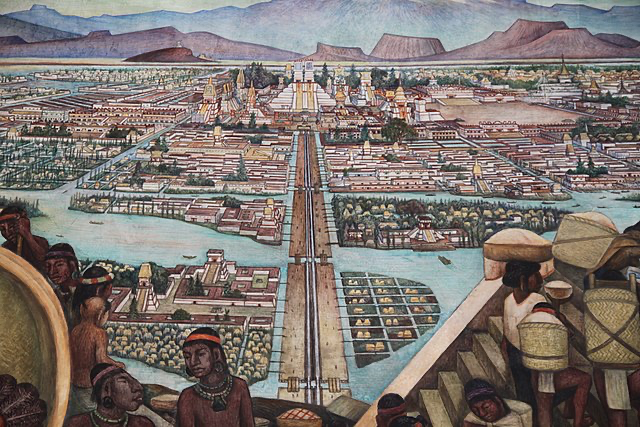
Figure 1. Diego Rivera, Ceremonial Center at Tenochtitlan (source: Wikimedia Commons)

Figure 1. Diego Rivera, Ceremonial Center at Tenochtitlan (source: Wikimedia Commons)

Abstract

Native, First Nations, Pueblos Originarios and Indigenous people live, and have lived in this land that bears many names; Turtle Island, Tawantinsuyu, and the Americas, among others, for at least between 11,500 and 20,000 years before present.1 Archaeological evidence from 20,000 years ago shows that people were making their lives as far north as the Meadowcroft shelter in what is now Pennsylvania, in the United States, to cave dwellings as far South as what is now called, by some, Monte Verde, Chile.2 But archaeology is but one way to understand time. According to many philosophers and historians, in many ways Indigenous peoples have always been present upon the land3, and have helped shape the land as we know it today.4

The story of the Americas represents an incredibly long, shifting, and complex narrative of many interactions between groups pre-European arrival.5 While peoples’ histories were anything but static, the accidental arrivals6 shifting political ties, and colonization characterized by European presence drastically altered life; just how many people were present in this hemisphere in 1491, and how many people lost their lives post European presence? Scholars rely on a host of different data sets to reconstruct the numbers, from colonial census documents7, to estimating carrying capacities of land8, to changes in measurements of carbon in the earth’s atmosphere.9

Through stitching together all of these data, there is a general consensus that the Indigenous population in the Americas was nearly 100 million people at the time of Spanish contact.10 When inhabitants of Guanahani found Columbus docked at the shore of the Island now called San Salvador, in the Bahamas, there were nearly 4 million people who lived there and engaged in a huge Caribbean economy of travel and exchange.11 In 1491, the valley of Central Mexico may have been the most densely populated place on earth, with 25.2 million people in 200,000 square miles.12 Tenochtitlán, the imperial city of the Triple Alliance13, was an architectural wonder14 constructed on an artificial lake and held a population amidst pyramids, plazas and public buildings15, a capital city supporting about three million people of the Mexica empire.16 The Amazon basin, channeled by inhabitants into a series of canals, platforms, mounds17, and villages, was an agro-forestry system18 that sustained upwards of 6 million people. 19 Southward, the Inka empire, or Tawantinsuyu, was a four-state system spanning from the North of Argentina to the Southern section of Colombia. It was united by one of the oldest, and the longest road systems in the world, called the Qhapac Ñan.20 The road united a series of capital cities, and a carved landscape of aqueducts, drainage systems, and terraces yielded robust agricultural systems that fed nearly 11,000,000 people.21

Capturing the statistics of populations in this particular time in human history is complex. One fact, however, is certain. These were never empty lands. Rather, emperors, civilians, scientists, and philosophers enfolded Columbus into their own complex histories and infrastructures. The hemispheric part of the world in 1491 was a swarming, interconnected series of empires, states, cities, and settlements with unique histories and names that most likely outnumbered populations in Europe.22 Throughout the next century these places, people, and stories would become enfolded by the European imagination into what came to be called The Americas.

Bibliography

Beltraõ M. C. de M. C. “Datacres arqueológicas mais antigas do Brasil.” Annais de Academia Brasileira de Ciencias 46, no.2: (1974): 212-251.

Cook, Sherburne Friend, and Lesley Byrd Simpson. The population of Central Mexico in the sixteenth century. Vol. 31. Berkeley, U. of Calif. P, 1948.

Covey, R. Alan, Geoff Childs, and Rebecca Kippen. “Dynamics of Indigenous Demographic Fluctuations: Lessons from Sixteenth-Century Cusco, Peru.” Current Anthropology 52, no. 3 (2011): 335–60. https://doi.org/10.1086/660010.

Denevan, William M. “The Pristine Myth: The Landscape of the Americas in 1492.” Annals of the Association of American Geographers 82, no. 3 (1992): 369–85. http://www.jstor.org/stable/2563351.

______________ Estimating the Native Population of the Americas in 1492. Madison: University of Wisconsin Press. 1992.

Dillehay, Tom D., Gerardo Ardila Calderón, Gustavo Politis, and Maria da Conceicao de Moraes Coutinho Beltrão. “Earliest hunters and gatherers of South America." Journal of World Prehistory 6 (1992): 145-204.

Dobyns, Henry F. “An Appraisal of Techniques with a New Hemispheric Estimate.” Current Anthropology 7, no. 4 (1966): 395–416. http://www.jstor.org/stable/2740306.

Englert, Sai. “Accumulate, Accumulate!” In Settler Colonialism: An Introduction, 26–78. Pluto Press, 2022. https://doi.org/10.2307/j.ctv2x6f052.6.

Erickson, Clark L. “8. The Domesticated Landscapes of the Bolivian Amazon.” In Time and complexity in historical ecology, pp. 235-278. Columbia University Press, 2006.

Guidon, N., and Delibrias, G. “Carbon-14 dates point to man in the Americas 32,000 years ago” Nature 321 (1986): 769-771.

Howey, Meghan CL. ““The question which has puzzled, and still puzzles”: How American Indian Authors Challenged Dominant Discourse about Native American Origins in the Nineteenth Century.” American Indian Quarterly 34, no. 4 (2010): 435-474.

Kimmerer, Robin. Braiding sweetgrass: Indigenous wisdom, scientific knowledge, and the teachings of plants. Milkweed editions, 2013.

Koch, Alexander, Chris Brierley, Mark M. Maslin, Simon L. Lewis, “Earth system impacts of the European arrival and Great Dying in the Americas after 1492”, Quaternary Science Reviews, Volume 207, (2019):13-36.

Lee, Jongsoo. “The Aztec Triple Alliance: A Colonial Transformation of the Prehispanic Political and Tributary System.” In Texcoco: Prehispanic and Colonial Perspectives, edited by Jongsoo Lee and Galen Brokaw, 63–92. University Press of Colorado, 2014. http://www.jstor.org/stable/j.ctt6wrrdm.8.

Liebmann, Matthew J., Joshua Farella, Christopher I. Roos, Adam Stack, Sarah Martini, and Thomas W. Swetnam. “Native American Depopulation, Reforestation, and Fire Regimes in the Southwest United States, 1492–1900 CE.” Proceedings of the National Academy of Sciences of the United States of America 113, no. 6 (2016): E696–704. https://www.jstor.org/stable/26467696.

Livi Bacci, Massimo Conquest: the Destruction of the American Indios. Translated from italian by Carl Ipsen. Cambridge, UK and Maiden, MA: Polity 2008.

Mann, Charles C. 1491 New Revelations of the Americas before Columbus New York: Alfred A Knoph, 2005.

Montenegro,V. A. Mostajo de Muente, P. Mostajo de Muente

La Situacion Poblacional Peruana: Balance Y Perspectivas. Technical Report Instituto Andino de Estudios en Población y Desarrollo, Lima (1990).

Mundy, Barbara E. “Mapping the Aztec Capital: The 1524 Nuremberg Map of Tenochtitlan, Its Sources and Meanings.” Imago Mundi 50 (1998): 11–33. http://www.jstor.org/stable/1151388.

Quilter, Jeffrey. The ancient central Andes. Taylor & Francis, 2022.

Reher, David S. “Reflections on the Fate of the Indigenous Populations of America.” Population and Development Review 37, no. 1 (2011): 172–77. http://www.jstor.org/stable/23043267.

Truer, David. “ David Truer on the Myth of an Edenic Pre-Columbian “New World”: Indigenous American Civilizations are far Older and More Complex than history suggests.” Literary Hub 2019.


  1. Some archaeologists believe that giving the timing of how sites were populated that the estimate should be upwards of 40,000 years ago. Tom Dillehay et al, “Earliest hunters and gatherers of South America,” Journal of World Prehistory no 6. 1992:150. See Also Beltraõ 1974, Guidon and Delibrias 1985. ↩︎

  2. Dillehay et al “Earliest hunters and gatherers of South America.”; David Truer “ David Truer on the Myth of an Edenic Pre-Columbian “New World”: Indigenous American Civilizations are far Older and More Complex than history suggests.” Literary Hub 2019. ↩︎

  3. Many scholars, including those since the 1850s, have shown that a European obsession with understanding native origins had the motive to dispossess people of their lands, by arguing that everyone in the Americans came from elsewhere. As Meghan C. L Howey writes, three Anishinaabeg writers, Kahkewaquonaby, Kahgegagahbowh, and William Whipple Warren fought dispossession logics and argued that they were a “spontaneous people” meaning that they emerged with the land and could not be seen as separate from it. See Mechan Howey “The question which has puzzled, and still puzzles,” How American Indian Authors Challenged Dominant Discourse about Native Origins in the 19th Century.” American Indian Quarterly, Vol 34. No. 4 (Fall 2010) pp. 435-474. University of Nebraska Press. ↩︎

  4. Howey “The Question that Still Puzzles”; Robin Kimmerer Braiding Sweetgrass: Indigenous Wisdom, Scientific Knowledge, and the Teaching of Plants(Minneapolis, MN: Milkweed Editions 2013). ↩︎

  5. There are plenty of relationships archaeologically that show vast trade networks- as early as 1000 A.D, North America had been traversed along the North and South; as Charles C Mann explains, “mother of pearl from the Gulf of Mexico has been found in Manitoba, and Lake Superior copper in Louisiana.” Charles C Mann, 1491 New Revelations of the Americas before Columbus (New York: Alfred A Knoph, 2005): 25 ↩︎

  6. The term “accidental arrival” is used to combat the long-held narrative of Columbus as an actor of scientific creed; Columbus believed the island of Guanahani (which he named Hispaniola) to be and island to the east of India. See Sai Englert’s Chapter “Accumulate, Accumulate” in Settler Colonialism: an Introduction (Pluto Press, 2022): 32. ↩︎

  7. Census documents are informative but, especially in colonial moments, can also be misleading as Europeans also had biases to report back or exaggerate claims to the crown the number of people they had conquered. Bartolomé de Las Casas, for instance, reported that in 1496 that the area of Hispaniola had about 1,000,000 Indigenous inhabitants. Gonzalo Fernández de Oviedo estimated that people living in the Castillo del Oro, or what is now Panama, reached nearly 2,000,000. Information from William Denevan, the Native Population of the Americas in 1492. Madison: University of Wisconsin Press. 1992:14. For more on comparisons of colonial census data, see Alan Covey et al, “Dynamics of Indigenous Demographic Fluctuations: Lessons from Sixteenth-Century Cusco, Peru.” Current Anthropology 52, no. 3 (2011): 335–60; Liebmann, Matthew J. et al. “Native American Depopulation, Reforestation, and Fire Regimes in the Southwest United States, 1492–1900 CE.” Proceedings of the National Academy of Sciences of the United States of America 113, no. 6 (2016): E696–704. ↩︎

  8. Massimo Livi Bacci, Conquest: the Destruction of the American Indios. Translated from Italian by Carl Ipsen. Cambridge, UK and Maiden, MA: Polity 2008. ↩︎

  9. Alexander Koch, et al “Earth system impacts of the European arrival and Great Dying in the Americas after 1492”, Quaternary Science Reviews, Volume 207, (2019):13-36. ↩︎

  10. Englert “Accumulate, Accumulate”; See also David Reher “Reflections on the Fate of Indigenous Populations of America” Population and Development Review 37 no. 1 (2011): 172-77. ↩︎

  11. William Denevan “The Pristine Myth”. ↩︎

  12. Mann 1491: pp 129; See also Cook, S.F. and L. B Simpson. 1948. The Population of Central Mexico in the Sixteenth century. Berkeley, CA: University of California Press. ↩︎

  13. The Triple Alliance refers to a political system whereby the city states of Tenochtitlán, Texcoco, and Tlacopan united to create a system of land distribution and tribute payment. See Jongsoo Lee’s Chapter, “The Aztec Triple Alliance: a colonial transformation of the Prehispanic Political and Tributary System.” Texcoco: Prehispanic and Colonial Perspectives. University Press of Colorado (2014): 63. ↩︎

  14. When Spanish conquistadors encountered the city, many had never seen anything like it. Tenochtitlán was much larger than Paris, at the time Europe’s largest city. They encountered botanical gardens, aqueducts that brought lake water into the city, and hugely ornate temples and streets that were described as immaculate. Mann 1491: 126 ↩︎

  15. For context, the population of England in the 1490s was nearly 1/10 of the size. Mann 1491: 120 ↩︎

  16. See Barbara Mundy “Mapping the Aztec Capital: the 1594 Nuremburg Map of Tenochtitlan, Its Sources and Meanings” Imago Mundi vol 50. (1998):11-33. ↩︎

  17. See Clark Erickson, “The Domesticated Landscapes of the Bolivian Amazon,” in Balée and Erickson eds. 2005. ↩︎

  18. This kind of agro-forestry or “farming with trees” was not easily perceptible to Europeans who had never seen systems like it- many Europeans who encountered people in the Amazon incorrectly stated that they had no agriculture, whereas in reality they had come across a kind of agriculture unlike anything in Europe, Africa, or Asia. Charles C. Mann. 1491:pp 26. ↩︎

  19. Denevan “The Pristine Myth” ↩︎

  20. The interconnectedness of roads such as the Qhapac Nan, or Inka Road, is precisely what created different timelines of colonization’s effects. it is estimated that Inka citizens, for instance, felt the effects of Small pox long before the arrival of Spanish individuals; in a case in which disease can travel faster than people, it is likely that their trading partners to the North had passed it through a series of encounters within a well-defined infrastructure of trade routes. See Jeff Quilter, The Ancient Central Andes [2014] Taylor and Francis 2022. ↩︎

  21. Montenegro et al, “La Situacion Poblacional Peruana: Balance Y Perspectivas” Technical Report Instituto Andino de Estudios en Poblacion y Desarrollo, Lima (1990). ↩︎

  22. Based on the estimations by Henry Dobyns done in 1966, in 1491, the Indigenous population may have reached nearly 112.000.000 people, which at this time would have substantially outnumbered Europe’s population. See Mann. 1491: 94. See also Henry Dobyns “An Appraisal of Techniques with a New Hemispheric Estimate” Current Anthropology. 7 no 4: 1966. ↩︎

Citation

Williams, Charlotte. 2023. 'Estimating Populations of the Americas pre-1492'. Dispossessions in the Americas. https://dia.upenn.edu/en/content/WilliamsC003/
Reading in Spanish

Narrative 1490 - 1600

Estimación de la población de las Américas antes de 1492

  • Williams, Charlotte

Published: 2023

Figura 1. Diego Rivera, Centro Ceremonial en Tenochtitlán (Fuente: Wikimedia Commons)

Figura 1. Diego Rivera, Centro Ceremonial en Tenochtitlán (Fuente: Wikimedia Commons)

Reading in Portuguese

Narrative 1490 - 1600

Estimando as Populações das Américas pré-1492

  • Williams, Charlotte

Published: 2023

Figura 1. Diego Rivera, Centro Cerimonial em Tenochtitlan (fonte: Wikimedia Commons)

Figura 1. Diego Rivera, Centro Cerimonial em Tenochtitlan (fonte: Wikimedia Commons)

Resumo

Povos nativos, das Primeiras Nações, originários e indígenas vivem e viveram nesta terra que possui muitos nomes; Ilha da Tartaruga, Tawantinsuyu, as Américas, entre outros, por pelo menos 11.500 a 20.000 anos.1 Evidências arqueológicas de 20.000 anos atrás mostram que as pessoas viviam em locais tão ao norte quanto o abrigo de Meadowcroft, no que hoje é a Pensilvânia, nos Estados Unidos, e em cavernas tão ao sul quanto o que hoje é conhecido por alguns como Monte Verde, no Chile.2 Mas a arqueologia é apenas uma das maneiras de compreender o tempo. De acordo com muitos filósofos e historiadores, de muitas maneiras, os povos indígenas sempre estiveram presentes na terra3, e ajudaram a moldá-la do jeito como a conhecemos hoje.4

A história das Américas representa uma narrativa incrivelmente longa, mutável e complexa de muitas interações entre grupos antes da chegada dos europeus.5 Embora a história dos povos estivesse longe de ser estática, as chegadas acidentais,6 que alteraram os laços políticos, e a colonização caracterizada pela presença europeia modificaram drasticamente a vida. Quantas pessoas estavam presentes neste hemisfério em 1491 e quantas perderam a vida após a chegada dos europeus? Estudiosos se baseiam em uma variedade de conjuntos de dados diferentes para reconstruir os números, desde documentos de censos coloniais,7 até estimativas da capacidade de suporte da terra8 e mudanças nas medições de carbono na atmosfera.9

Ao reunir todos esses dados, existe um consenso geral de que a população indígena nas Américas era de quase 100 milhões de pessoas na época do contato com os espanhóis.10 Quando os habitantes de Guanahani encontraram Colombo atracado na costa da ilha que hoje corresponde a San Salvador, nas Bahamas, havia quase 4 milhões de pessoas vivendo ali e envolvidas em uma enorme economia caribenha baseada em viagens e trocas.11 Em 1491, o vale do México Central pode ter sido o lugar mais densamente povoado da Terra, com 25,2 milhões de pessoas em 518.000 quilômetros quadrados.12 Tenochtitlán, a cidade imperial da Tríplice Aliança,13 capital do império Mexica,14 era uma maravilha arquitetônica15 construída sobre um lago artificial e abrigava uma população de cerca de três milhões de habitantes em meio a pirâmides, praças e edifícios públicos.16 A bacia amazônica, canalizada pelos habitantes em uma série de canais, plataformas, montes17 e aldeias, era um sistema agroflorestal18 que sustentava mais de 6 milhões de pessoas.19 Ao sul, o Império Inca, ou Tawantinsuyu, era um sistema de quatro estados que se estendia do norte da Argentina até o sul da Colômbia. Era unida por um dos sistemas de estradas mais antigos e extensos do mundo, chamado Qhapaq Ñan.20 A estrada unia uma série de capitais e uma paisagem esculpida por aquedutos, sistemas de drenagem e terraços proporcionou sistemas agrícolas robustos que alimentavam quase 11 milhões de pessoas.21

Capturar as estatísticas populacionais neste período específico da história da humanidade é complexo. Uma coisa, porém, é certa. Essas terras nunca estiveram vazias. Em vez disso, imperadores, civis, cientistas e filósofos integraram Colombo em suas próprias histórias e infraestruturas complexas. Em 1491, esta parte do mundo era um fervilhante e interconectado conjunto de impérios, estados, cidades e assentamentos com histórias e nomes únicos, que provavelmente superavam em número populações na Europa.22 Ao longo do século seguinte, esses lugares, pessoas e histórias seriam incorporados pela imaginação europeia no que veio a ser chamado de Américas.

Bibliografia

Beltrão M. C. de M. C. “Datações arqueológicas mais antigas do Brasil”. Anais da Academia Brasileira de Ciências 46, no.2: (1974): 212-251.

Cook, Sherburne Friend, e Lesley Byrd Simpson. The population of Central Mexico in the sixteenth century. Vol. 31. Berkeley, U. of Calif. P, 1948.

Covey, R. Alan, Geoff Childs e Rebecca Kippen. “Dynamics of Indigenous Demographic Fluctuations: Lessons from Sixteenth-Century Cusco, Peru”. Current Anthropology 52, no. 3 (2011): 335–60. https://doi.org/10.1086/660010.

Denevan, William M. “The Pristine Myth: The Landscape of the Americas in 1492”. Annals of the Association of American Geographers 82, no. 3 (1992): 369–85. http://www.jstor.org/stable/2563351.

______________ Estimating the Native Population of the Americas in 1492. Madison: University of Wisconsin Press. 1992.

Dillehay, Tom D., Gerardo Ardila Calderón, Gustavo Politis e Maria da Conceição de Moraes Coutinho Beltrão. “Earliest hunters and gatherers of South America”. Journal of World Prehistory 6 (1992): 145-204.

Dobyns, Henry F. “An Appraisal of Techniques with a New Hemispheric Estimate”. Current Anthropology 7, no. 4 (1966): 395–416. http://www.jstor.org/stable/2740306.

Englert, Sai. “Accumulate, Accumulate!” In Settler Colonialism: An Introduction, 26–78. Pluto Press, 2022. https://doi.org/10.2307/j.ctv2x6f052.6.

Erickson, Clark L. “8. The Domesticated Landscapes of the Bolivian Amazon”. In Time and complexity in historical ecology, p. 235-278. Columbia University Press, 2006.

Guidon, N. e Delibrias, G. “Carbon-14 dates point to man in the Americas 32,000 years ago” Nature 321 (1986): 769-771.

Howey, Meghan CL. “‘The question which has puzzled, and still puzzles’: How American Indian Authors Challenged Dominant Discourse about Native American Origins in the Nineteenth Century”. American Indian Quarterly 34, no. 4 (2010): 435-474.

Kimmerer, Robin. Braiding sweetgrass: Indigenous wisdom, scientific knowledge, and the teachings of plants. Milkweed editions, 2013.

Koch, Alexander, Chris Brierley, Mark M. Maslin e Simon L. Lewis, “Earth system impacts of the European arrival and Great Dying in the Americas after 1492”, Quaternary Science Reviews, Volume 207, (2019): 13-36.

Lee, Jongsoo. “The Aztec Triple Alliance: A Colonial Transformation of the Prehispanic Political and Tributary System”. In Texcoco: Prehispanic and Colonial Perspectives, editado por Jongsoo Lee e Galen Brokaw, 63–92. University Press of Colorado, 2014. http://www.jstor.org/stable/j.ctt6wrrdm.8.

Liebmann, Matthew J., Joshua Farella, Christopher I. Roos, Adam Stack, Sarah Martini e Thomas W. Swetnam. “Native American Depopulation, Reforestation, and Fire Regimes in the Southwest United States, 1492–1900 CE”. Proceedings of the National Academy of Sciences of the United States of America 113, no. 6 (2016): E696–704. https://www.jstor.org/stable/26467696.

Livi Bacci, Massimo Conquest: the Destruction of the American Indios. Traduzido do italiano por Carl Ipsen. Cambridge, UK and Maiden, MA: Polity 2008.

Mann, Charles C. 1491 New Revelations of the Americas before Columbus Nova Iorque: Alfred A Knoph, 2005.

Montenegro, V. A. et al. La Situación Poblacional Peruana: Balance Y Perspectivas. Relatório técnico. Instituto Andino de Estudios en Población y Desarrollo, Lima (1990).

Mundy, Barbara E. “Mapping the Aztec Capital: The 1524 Nuremberg Map of Tenochtitlan, Its Sources and Meanings”. Imago Mundi 50 (1998): 11–33. http://www.jstor.org/stable/1151388.

Quilter, Jeffrey. The ancient central Andes. Taylor & Francis, 2022.

Reher, David S. “Reflections on the Fate of the Indigenous Populations of America”. Population and Development Review 37, no. 1 (2011): 172–77. http://www.jstor.org/stable/23043267.

Truer, David. “David Truer on the Myth of an Edenic Pre-Columbian ‘New World’: Indigenous American Civilizations are far Older and More Complex than history suggests”. Literary Hub 2019.


  1. Alguns arqueólogos acreditam que, considerando a época em que os locais foram povoados, a estimativa deveria ser de mais de 40.000 anos. Tom Dillehay et al, “Earliest hunters and gatherers of South America”, Journal of World Prehistory no 6. 1992:150. Ver também Beltrão 1974, Guidon e Delibrias 1985. ↩︎

  2. Dillehay et al “Earliest hunters and gatherers of South America”; David Truer “David Truer on the Myth of an Edenic Pre-Columbian ‘New World’: Indigenous American Civilizations are far Older and More Complex than history suggests”. Literary Hub 2019. ↩︎

  3. Muitos estudiosos, incluindo aqueles que começaram na década de 1850, demonstraram que a obsessão europeia em compreender as origens dos povos nativos tinha como motivação a desapropriação dessas pessoas de suas terras, argumentando que todos nas Américas vinham de outros lugares. Como escreve Meghan C. L. Howey, três escritores anishinaabegs, Kahkewaquonaby, Kahgegagahbowh e William Whipple Warren, lutaram contra a lógica da desapropriação e argumentaram que eram um “povo espontâneo”, o que significa que surgiram com a terra e não podiam ser vistos como separados dela. Ver Mechan Howey “The question which has puzzled, and still puzzles: How American Indian Authors Challenged Dominant Discourse about Native Origins in the 19th Century”. American Indian Quarterly, Vol 34. No. 4 (Outono de 2010) p. 435-474. University of Nebraska Press. ↩︎

  4. Howey “The Question that Still Puzzles”; Robin Kimmerer Braiding Sweetgrass: Indigenous Wisdom, Scientific Knowledge, and the Teaching of Plants (Minneapolis, MN: Milkweed Editions 2013). ↩︎

  5. Existem inúmeras relações arqueológicas que demonstram vastas redes comerciais. Já no ano 1000 d.C., a América do Norte havia sido atravessada do norte ao sul. Como Charles C Mann explica, “madrepérola do Golfo do México foi encontrada em Manitoba, e cobre do Lago Superior, na Louisiana.” Charles C Mann, 1491 New Revelations of the Americas before Columbus (Nova Iorque: Alfred A Knoph, 2005): 25 ↩︎

  6. O termo “chegada acidental” é usado para combater a narrativa consagrada de Colombo como um agente do credo científico. Colombo acreditava que a ilha de Guanahani (que ele chamou de Hispaniola) era uma ilha a leste da Índia. Ver o capítulo de Sai Englert “Accumulate, Accumulate” in Settler Colonialism: an Introduction (Pluto Press, 2022): 32. ↩︎

  7. Os documentos censitários são informativos, mas, especialmente em momentos coloniais, também podem ser enganosos, já que os europeus eram enviesados ao relatar ou exagerar as alegações à coroa sobre o número de pessoas que haviam conquistado. Bartolomé de Las Casas, por exemplo, relatou em 1496 que a região da Hispaniola tinha cerca de 1.000.000 de habitantes indígenas. Gonzalo Fernández de Oviedo estimou que a população que vivia no Castillo del Oro, no que hoje é o Panamá, chegava a quase 2.000.000 de pessoas. Informações de William Denevan, the Native Population of the Americas in 1492. Madison: University of Wisconsin Press. 1992:14. Para mais informações sobre comparações de dados censitários coloniais, ver Alan Covey et al, “Dynamics of Indigenous Demographic Fluctuations: Lessons from Sixteenth-Century Cusco, Peru”. Current Anthropology 52, no. 3 (2011): 335–60; Liebmann, Matthew J. et al. “Native American Depopulation, Reforestation, and Fire Regimes in the Southwest United States, 1492–1900 CE”. Proceedings of the National Academy of Sciences of the United States of America 113, no. 6 (2016): E696–704. ↩︎

  8. Massimo Livi Bacci, Conquest: the Destruction of the American Indios. Traduzido do italiano por Carl Ipsen. Cambridge, UK e Maiden, MA: Polity 2008. ↩︎

  9. Alexander Koch, et al “Earth system impacts of the European arrival and Great Dying in the Americas after 1492”, Quaternary Science Reviews, Volume 207, (2019):13-36. ↩︎

  10. Englert “Accumulate, Accumulate”; Ver também David Reher “Reflections on the Fate of Indigenous Populations of America” Population and Development Review 37 no. 1 (2011): 172-77. ↩︎

  11. William Denevan, “The Pristine Myth”. ↩︎

  12. Mann 1491: p. 129; Ver também Cook, S.F. e L. B Simpson. 1948. The Population of Central Mexico in the Sixteenth century. Berkeley, CA: University of California Press. ↩︎

  13. A Tríplice Aliança refere-se a um sistema político no qual as cidades-estado de Tenochtitlán, Texcoco e Tlacopan se uniram para criar um sistema de distribuição de terras e pagamento de tributos. Ver o capítulo de Jongsoo Lee “The Aztec Triple Alliance: a colonial transformation of the Prehispanic Political and Tributary System”. Texcoco: Prehispanic and Colonial Perspectives. University Press of Colorado (2014): 63. ↩︎

  14. Ver Barbara Mundy “Mapping the Aztec Capital: the 1594 Nuremburg Map of Tenochtitlan, Its Sources and Meanings” Imago Mundi vol 50. (1998):11-33. ↩︎

  15. Quando os conquistadores espanhóis chegaram à cidade, muitos nunca tinham visto nada parecido. Tenochtitlán era muito maior que Paris, na época a maior cidade da Europa. Eles se depararam com jardins botânicos, aquedutos que traziam água do lago para a cidade e templos e ruas extremamente ornamentados, descritos como imaculados. Mann 1491: 126 ↩︎

  16. Para contextualizar, na década de 1490, a população da Inglaterra era quase um décimo da população dos Estados Unidos. Mann 1491: 120 ↩︎

  17. Ver Clark Erickson, “The Domesticated Landscapes of the Bolivian Amazon”, in Balée e Erickson eds. 2005. ↩︎

  18. Esse tipo de agroflorestamento ou “agricultura com árvores” não era facilmente perceptível para os europeus, que nunca tinham visto sistemas semelhantes. Muitos europeus que encontraram pessoas na Amazônia afirmaram erroneamente que elas não praticavam agricultura, quando na realidade haviam se deparado com um tipo de agricultura diferente de tudo o que existia na Europa, África ou Ásia. Charles C. Mann. 1491: p. 26. ↩︎

  19. Denevan, “The Pristine Myth”. ↩︎

  20. A interconexão de estradas como a Qhapaq Ñan, ou Estrada Inca, é precisamente o que criou diferentes cronologias dos efeitos da colonização. Estima-se que os cidadãos incas, por exemplo, sentiram os efeitos da varíola muito antes da chegada dos espanhóis. Em um caso em que a doença pode viajar mais rápido do que as pessoas, é provável que seus parceiros comerciais do Norte a tenham transmitido por meio de uma série de encontros dentro de uma infraestrutura bem definida de rotas comerciais. Ver Jeff Quilter, The Ancient Central Andes [2014] Taylor and Francis, 2022. ↩︎

  21. Montenegro et al, “La Situacion Poblacional Peruana: Balance Y Perspectivas” Technical Report Instituto Andino de Estudios en Poblacion y Desarrollo, Lima (1990). ↩︎

  22. Com base nas estimativas de Henry Dobyns, feitas em 1966, em 1491, a população indígena pode ter atingido quase 112 milhões de pessoas, o que, naquela época, teria superado substancialmente a população da Europa. Ver Mann. 1491: 94. Ver também Henry Dobyns “An Appraisal of Techniques with a New Hemispheric Estimate” Current Anthropology. 7 no 4: 1966. ↩︎

Citation

Williams, Charlotte. 2023. 'Estimando as Populações das Américas pré-1492'. Dispossessions in the Americas. https://dia.upenn.edu/pt/content/WilliamsC003/

Related Content

Map of deforestation within protected areas in Guatemala and adjoining areas

Map of deforestation within protected areas in Guatemala and adjoining areas

Map 2000 - 2100
CARTA DO RIO IÇA

CARTA DO RIO IÇA

Map 1868
Ordalía: el fin del cuerpo [Ordeal: The End of the Body]

Ordalía: el fin del cuerpo [Ordeal: The End of the Body]

Artwork
7

7

Artwork
Chili

Chili

Map 1625
Mappa do Sul do Imperio do Brazil e Paizes Limitrophes

Mappa do Sul do Imperio do Brazil e Paizes Limitrophes

Map 1865
Map of El Salvador with Specific indigenous communities in El Salvador, and the archaeological zone of Chalchuapa in western El Salvador. The Department of San Vicente is also highlighted.

Map of El Salvador with Specific indigenous communities in El Salvador, and the archaeological zone of Chalchuapa in western El Salvador. The Department of San Vicente is also highlighted.

Map 2010
Pueblos Indígenas en Paraguay

Pueblos Indígenas en Paraguay

Map 2009

Dispossessions in the Americas

A project by

University of Pennsylvania

Copyright 2024

With support from

Mellon Foundation

Site design & development

Element 84

Art Credits

Figure 1. Diego Rivera, Ceremonial Center at Tenochtitlan (source: Wikimedia Commons)

Site Pages

  • Home
  • Explore
  • About
  • Authors
  • Art
  • Bodies
  • Curricula
  • Cultural Heritage
  • Maps
  • Territories