Dispossesions in the Americas

Dispossesions in the Americas

  • Home
  • Explore
  • About
  • Authors
  • Art
  • Bodies
  • Curricula
  • Cultural Heritage
  • Maps
  • Territories
Back to Explore
Narrative 1756 - 1813

Mapping Lenape Relocations: Archival Traces and Histories of Place

  • Leech, Molly

Published: 2024

Detail of [*A map of the country on the Ohio and Muskingum Rivers: shewing the situation of the Indian towns with respect to the army under the command of Colonel Bouquet*](https://collections.leventhalmap.org/search/commonwealth:q524n480v), by Thomas Hutchins (1730–1789), London: Printed for Robert Sayer and Thomas Jefferys, 1764. Map reproduction courtesy of the Norman B. Leventhal Map & Education Center at the Boston Public Library.

Detail of A map of the country on the Ohio and Muskingum Rivers: shewing the situation of the Indian towns with respect to the army under the command of Colonel Bouquet, by Thomas Hutchins (1730–1789), London: Printed for Robert Sayer and Thomas Jefferys, 1764. Map reproduction courtesy of the Norman B. Leventhal Map & Education Center at the Boston Public Library.

Abstract

This essay retraces historical Lenape place names and movements by analyzing a series of archival maps and written accounts from 1756 to 1813. It expands upon Clinton A. Weslager’s Delaware Indian Westward Migration, (1978), which charted some of the major forced movements of Lenape communities from their ancestral homelands known as Lenapehoking (encompassing parts of today’s eastern Pennsylvania, northern Delaware, New Jersey, southern New York, and a portion of western Connecticut) to places as far away as present-day Oklahoma, Kansas, and Ontario. This study explores the relationships among Lenape dispossessions, archival maps, and written colonial documents featuring Lenape voices. When read together, these sources provide insight into how Lenape people navigated and criticized colonial settler dispossessions. By re-mapping these historic relocations through the archival record, this work emphasizes the persistence of Lenape cultural histories on the landscape, both within and beyond their ancestral homeland.

In 1978, historian Clinton A. Weslager published Delaware Indian Westward Migration, a book that retraces the major paths of forced Lenape migrations across North America from the late seventeenth to early nineteenth century. The area encompassing today’s eastern Pennsylvania, northeastern Delaware, New Jersey, southern New York, and a small portion of western Connecticut is the ancestral homeland of Lenape peoples, who may also identify as Delaware or Munsee. This homeland is known as Lenapehoking, from Lënapehòkink, meaning “Land of the Lenape.”1 The historic dispossession of Lenape people was not a singular mass movement; rather, Lenape individuals and families relocated in small groups over time (sometimes moving back and forth multiple times), making population estimates difficult. Weslager’s map suggests the paths or waterways these Lenape groups followed and documents the formation of new Lenape towns in western “Indian Territory,”2 where Lenape refugees formed new communities, joined Moravian missions, or merged with other Native groups. Weslager’s archival research culminated in a new map depicting the major movements of Lenape (or Delaware) people to present-day Western Pennsylvania, Ohio, Missouri, Kansas, and Oklahoma (see fig. 1).
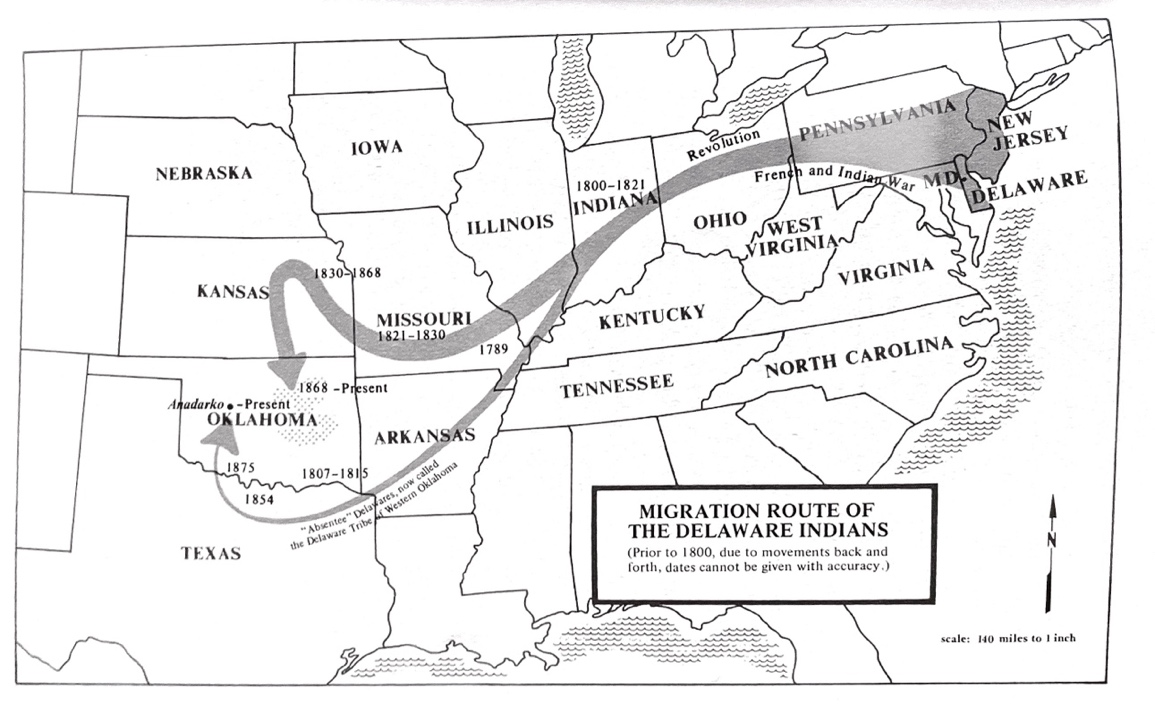
Figure 1. Migrations of the Delaware Indians, in C. A. Weslager, The Delaware Indian Westward Migration: With Texts of Two Manuscripts, 1821–22, Responding to General Lewis Cass’s Inquiries about Lenape Culture and Language (New Castle: Middle Atlantic Press, 1978), 231.

Figure 1. Migrations of the Delaware Indians, in C. A. Weslager, The Delaware Indian Westward Migration: With Texts of Two Manuscripts, 1821–22, Responding to General Lewis Cass’s Inquiries about Lenape Culture and Language (New Castle: Middle Atlantic Press, 1978), 231.

Despite the breadth of Weslager’s archival research, his account lacks archival maps documenting these historic relocations. While more recent scholars have updated the continental map of Lenape diasporic movements,3 further work is needed to explore the relationships among Lenape dispossessions, archival maps, and colonial documents featuring Lenape voices. This article brings together a chronological series of colonial maps and contemporaneous archival accounts, as a means to recover Lenape histories, even within documents that were themselves tools of dispossession. Toponyms (place names) from each map are listed—many of these names can be connected to Lenape history, and still appear on contemporary maps today.
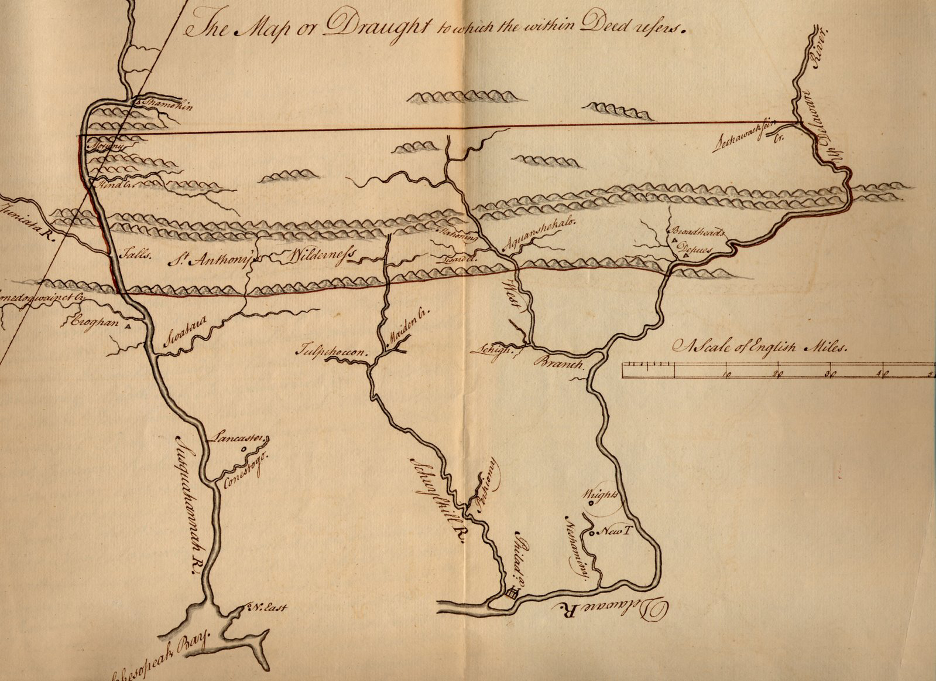
Figure 2. Map made after the Treaty at Easton, 1756, in Chew Family Papers, Historical Society of Pennsylvania, Philadelphia, PA.

Figure 2. Map made after the Treaty at Easton, 1756, in Chew Family Papers, Historical Society of Pennsylvania, Philadelphia, PA.

By the early 1800s, a century of settler invasions by Dutch, Swedish, and English colonists had already forced Lenape people to relocate to the forks of the Delaware River and the Lehigh River, among other locations, displaced by colonial violence. Following the fraudulent Walking Purchase of 1737, Lenape people were dispossessed of much of their ancestral homeland in eastern Pennsylvania and across New Jersey. During the negotiations that followed the Treaty of Easton in 1756 (see fig. 2), for example, the 3,044-acre Brotherton Reservation was created in Burlington County, New Jersey.4

The Lenape leader Teedyuscung (1700–1763) played a prominent role in negotiations with the Pennsylvania colonial government. Teedyuscung began the Condolence Ceremony at the Treaty of Easton on November 13, 1756, in a traditional manner, by “metaphorically wip[ing] tears from Pennsylvanians’ eyes and blood from their bodies and from the ground…[before] he then proceeded to talk about the origins of the war.”5 Teedyuscung recalled positive relations with William Penn but decried the recent deceit of the colonial government. Addressing Governor William Denny, he declared, pounding his foot: “this very ground that is under me was my land and inheritance, and it is taken from me by fraud.” Teedyuscung then detailed the lands that had been improperly seized by the perpetrators of the Walking Purchase: “When I say this ground, I mean all the land between Tohiccon Creek and Wyoming on the Susquehanna.” 6 According to historian James H. Merrell, Teedyuscung, who had several years of experience dealing “with clerks and copies, with translators and transcripts… blamed the conflicts between natives and newcomers on scribes.” 7 When Teedyuscung revisited Easton shortly before his death, he remarked: “‘Somebody must have wrote wrong… and that makes the Land all bloody.’”8

Teedyuscung’s criticisms of the Walking Purchase are among the most well-known, but many other Lenape people contested settler encroachment during this period. Records of many Lenape place names (toponyms) from this region first appear in writing in the form of legal challenges made by Lenape individuals against Pennsylvania’s colonial government. For example, Mahoning in today’s Carbon County, Pennsylvania (from mahóni, “a deer lick,” and mahonink, “at the lick,” depicted in figure 2) first appears in a November 12, 1740, letter expressing the Lenape’s belief that they were being wrongfully removed from lands that did not fall “within the limits of the Walking Purchase.” 9

Toponyms: Perkiomy (elsewhere Perkioming, from pakihm-omeak, “the cranberry place” or pakiomink, “the place where the cranberries grow” now known as the Perkiomen River; Tulpehoccon (from tûlpewihacki, “the land abounding with turtles, turtle country” or tulpehaking, “turtle land”); Neshaminy (from neshâmhanne, “two streams making one”); Lehigh (from lěcháwâk, “fork,” as in a parting of roads or streams); Mahoning (from mahóni, “a deer lick,” and mahonink, “at the lick”); Aquanshekalo (elsewhere Aquashicola, from achquonschícola, “the brush net fishing creek, the creek where we catch fish by means of a net made with brush”); Lechawacksein Cr. (elsewhere Lackawaxan, from lechauweksink, “the forks of the road, or the part of the road” or eenda lxawahkwsiing, “where there is a forked tree… where there are forked trees”); Shamokin (from shahamóki, shahamókink, and schacheméki, “the place of eels”).10
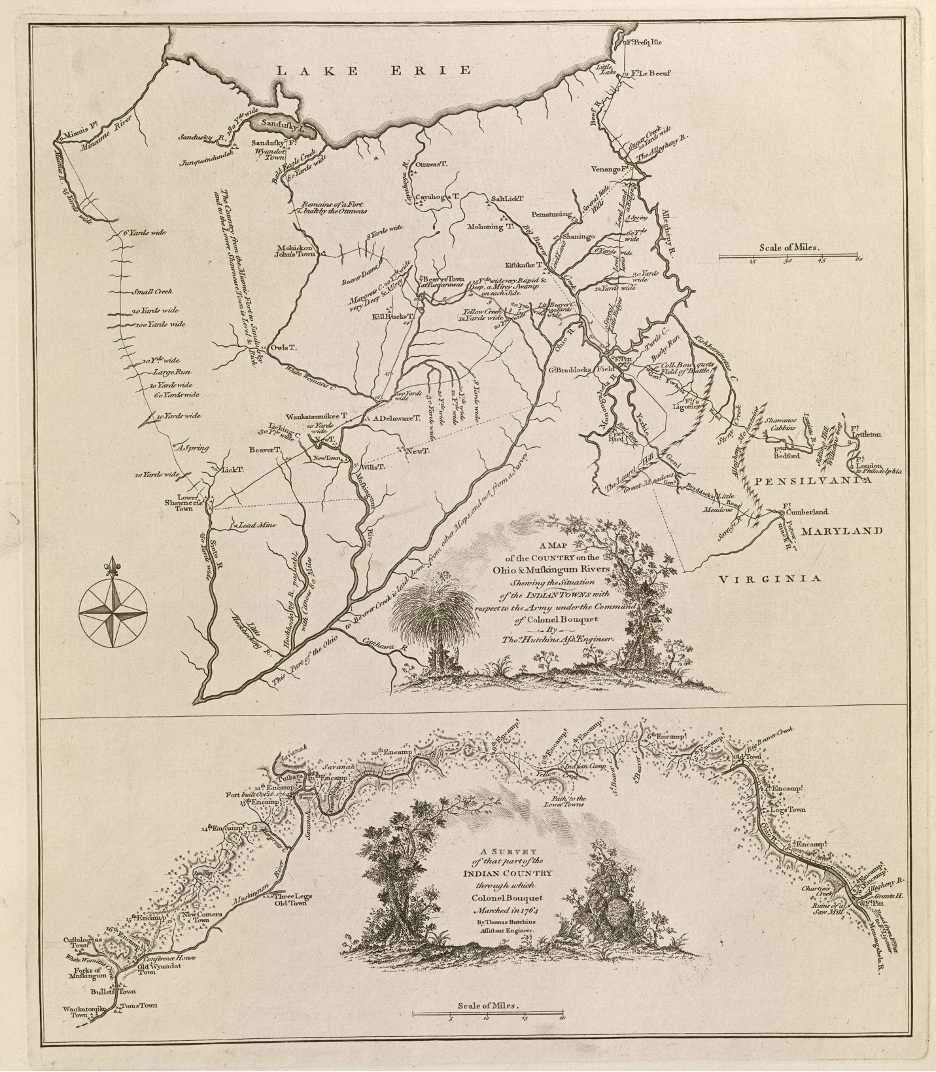
Figure 3. A map of the country on the Ohio and Muskingum Rivers: Shewing the situation of the Indian towns with respect to the army under the command of Colonel Bouquet, by Thomas Hutchins (1730–1789) London: Printed for Robert Sayer and Thomas Jefferys, 1764. Map reproduction courtesy of the Norman B. Leventhal Map & Education Center at the Boston Public Library.

Figure 3. A map of the country on the Ohio and Muskingum Rivers: Shewing the situation of the Indian towns with respect to the army under the command of Colonel Bouquet, by Thomas Hutchins (1730–1789) London: Printed for Robert Sayer and Thomas Jefferys, 1764. Map reproduction courtesy of the Norman B. Leventhal Map & Education Center at the Boston Public Library.

During the Seven Years’ War (also known as the French and Indian War, 1754–63), many Lenape people relocated from Western Pennsylvania to Tuscarawas country in today’s Ohio. The largest Delaware community here, home to about 600–700 people, was Gekelmukpechunk (“The water that is always still”), founded by the Delaware leader Netawatwees (1686–1776). As the above map shows (see fig. 3), Gekelmukpechunk was also called “Newcomerstown,” in reference to Netawatwees’s nickname, “Newcomer.” This name persists to the present in Tuscarawas County.11

In 1764, surveyor and military engineer Thomas Hutchins (1730–1789) charted Newcomerstown on his map of the region spanning Lake Erie and the Ohio River. Colonel Bouquet (whose army is referenced on the map) led a party of troops into Ohio Country with the goal of stopping the pan-Indian uprisings later known as Pontiac’s Rebellion. Pontiac, an Ottawa leader in the Great Lakes region, was likely inspired by the Delaware prophet Neolin (“the enlightened one”). In 1760, a French colonist recorded Neolin’s speech, which reads, in part:

Whence comes it that ye permit the Whites upon your lands? Can ye not live without them?…Ye could live as ye did live before knowing them—before those whom ye call your brothers had come upon your lands… But when I saw that ye were given up to evil, I led the wild animals to the depths of the forest so that ye had to depend upon your brothers to feed and shelter you. Ye have only to become good again and do what I wish, and I will send back the animals for your Food… But as to those who come to trouble your lands—drive them out, make war upon them. I do not love them at all; they know me not, and are my enemies, and the enemies of your brothers. Send them back to the lands which I have created for them and let them stay there.12

These remarks show the importance of Indigenous self-determination after nearly two centuries of alienation and forced removals from their homelands. In 1774, Lenape people left Gekelmukpechunk and established a new community they called Coshocton on the site of a former Wyandot village by the Forks of the Muskingum River. This remained a key settlement for Ohio Delawares until April 19, 1781, when Colonel Daniel Brodhead and his troops set fire to the town and murdered several captive prisoners. Despite this devastating loss, the Delaware—along with other Indigenous allies—continued to resist American encroachment, successfully defending their lands in battles against American troops in 1789 and 1791. However, their efforts culminated in a hard-fought defeat at the Battle of Fallen Timbers in 1794, where Delaware fighters, led by Miami leader Little Turtle and Shawnee leader Blue Jacket, were ultimately overcome. They, along with many other Native Nations, signed the 1795 Treaty of Greenville, which forced the Delaware to give up the majority of their land in present-day Ohio.13 In 1802, colonial settlers established “Tuscarawastown” at the former site of Coshocton; the Lenape name was restored in 1811, when the town became the county seat of the newly established Coshocton County.14

Toponyms: Waukatatumikee (Waukatomike) Town; Custologas Town (the name of a Delaware leader); Old Wyandot Town; New T., NewTown, NewComers Town; Three Legs Old Town; Mahoning (from mahoni, salt lick); Beaver T.; “A Delaware Town;” Muskingum River; Lower Shawneetown; Hockhocking River (“place of bottle gourds”); Little Hockhocking River; Nemenshehela Creek (elsewhere Nimishellin); Indian Camp; Yellow Creek; Old Town; Longs Town; Monongahela River; Kishkustke T., Cayahoga T.; Mohickon John’s Town (inhabited from 1760–1778 by refugee Mohican, Delaware and Stockbridge peoples).15
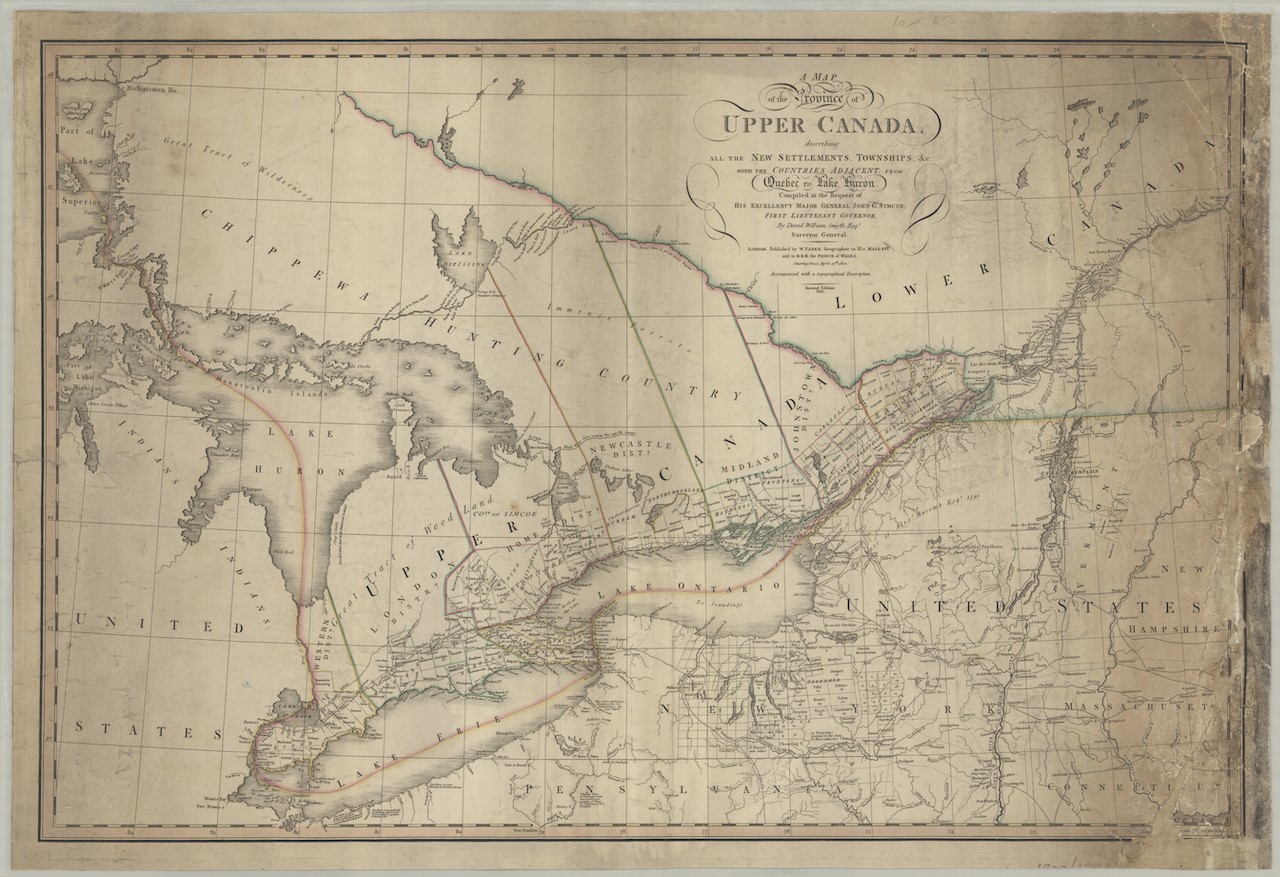
Figure 4. A map of the province of Upper Canada, describing all the new settlements, townships, &c.: with the countries adjacent, from Quebec to Lake Huron (original and cropped detail), by David William Smyth (1764–1837), London: William Faden (1749–1836), 2nd ed. 1813 [orig. pub. 12 April 1800], McMaster University: Hodsoll Collection Digital Archive.

Figure 4. A map of the province of Upper Canada, describing all the new settlements, townships, &c.: with the countries adjacent, from Quebec to Lake Huron (original and cropped detail), by David William Smyth (1764–1837), London: William Faden (1749–1836), 2nd ed. 1813 [orig. pub. 12 April 1800], McMaster University: Hodsoll Collection Digital Archive.

Another major diasporic movement during the late eighteenth century was the path of Christianized Moravian Lenape people. Pressed by colonial and inter-tribal violence from warring factions across Ohio, a sizeable number of Lenape people chose to join Moravian Missions from 1740 to 1815, including Schoenbrunn, Gnaddenhutten, and Lichtenau. In 1792, 150 Delaware Indians, alongside the Moravian missionary David Zeisberger (1721–1808), left Ohio and resettled along what is now called the Thames River in today’s southwestern Ontario, where they established a town called “Schonfeld” (Fairfield). The Moravian Lenape community petitioned for this land based on a 1790 treaty also signed by leaders of the Chippewas, Ottawas, Potawatomies, and Hurons.16

An 1813 map (see fig. 4) includes the toponyms “Delewars” and “Chippewa” in a cluster below the town of London, Ontario, not far from Lake Erie. During the War of 1812, a combined force of Indigenous First Nation and British allied forces led by Chief Tecumseh held off American troops at the Battle of the Thames (October 5, 1813), despite being greatly outnumbered.17 Tecumseh was mortally wounded in this battle, and the American troops destroyed Fairfield. After the Peace of 1814, the Moravian Indian community reestablished their settlement as “New Fairfield” on the opposite side of the Thames River. Today, the area that once encompassed New Fairfield is known as Moraviantown, and a small portion of this land is home to the Lenape (Lunaapeew) People of the Delaware Nation at Moraviantown; their nineteenth-century mission house and church are still standing.18

Although his words are filtered through a settler perspective, Zeisberger’s journal records how some Delaware people reflected upon the hardships they endured when defending their lands from the United States government:

Wednesday, 15 [October] 1794

Chippewa and Delaware Indians arrived [at Fairfield on the Thames] from the Miami. There are general disturbances among the Indians and want of unity. The Delaware fully intend to leave this part of America, and to flee to the south and New Spain, but are not all agreed about this, but some go away secretly and come here. They have spoken the truth straight out to their fathers, namely: “Thou hast always hitherto urged us to go to war against the States. We have followed thee to our great loss. Look at the graves on the Miami, look farther on, where the bones of the young folk lie, you whom the beasts have fed. Thou art the cause of their death. Thou hast always preached to us and said: ‘Behold, the States are taking away your land. Be brave, act like men. Let not your land be taken from you. Fight for your land.’ But now we have got at the truth. The States have struck thee to the ground and overcome thee. Therefore hast thou given them our land in order to have peace from them, but thou tellest us to fight for it, so that we may all be blotted out… Thou mayest carry on war alone. We will no longer be deceived by thee.”19

Toponyms: Shawanese Township; Moravian Village; Delaware; “Delewars,”; Chippewas.

Conclusion

These cartographic traces and archival fragments offer glimpses into Lenape experiences, but they by no means tell a complete story. Colonial documents are, by their very nature biased, partial, and problematic records; Native place names are often approximations inscribed on maps and deeds by colonists who sought to appropriate Indigenous lands. Military officers and government officials mapped the locations of newly formed Lenape towns, like “Newcomerstown,” as conflicts between settler and Native communities worsened. Stitched together, these episodic accounts show how Lenape people responded to dispossession. Importantly, Lenape voices, experiences, and histories of place over nearly two centuries of forced relocations are not lost; they resonate in social memory, in the colonial archive, and on the landscape itself, within and beyond their ancestral homeland.

Although settler perspectives are amplified within dominant historical narratives, they are deeply intertwined with the Native histories resonate throughout the colonial archive. Native leaders like Teedyuscung openly accused English settlers of defrauding Lenape people after the deceitful Walking Purchase of 1737. The Delaware prophet Neolin shaped a major pan-tribal movement that advocated for Indigenous self-determination and decried the violence of settler dispossessions. As Lenape people were pushed further from their ancestral home, they told new stories and established new place names, like Coshocton in present-day Ohio. Across the United States and Canada, Lenape place names and their approximations represent deep and enduring worlds of meaning that persist despite colonial erasures. Their prevalence underscores both the Lenape’s profound connection to the land and the histories of their dispossession. It is past time that these histories be acknowledged in their full scope, both on and beyond the settler maps where their traces can be still followed.

Bibliography

Baker, Joe, Hadrien Coumans, and Joel Whitney, eds. Lenapehoking: An Anthology. New York: Lenape Center & Brooklyn Public Library, 2022.

Chew, Benjamin. Map from Treaty at Easton. 1762. Benjamin Chew Family Papers [2050], Box 42, Folder 4, Historical Society of Pennsylvania. Philadelphia, PA. Accessed June 1, 2024. https://discover.hsp.org/Record/dc-6299.

Grumet, Robert S. Beyond Manhattan: A Gazetteer of Delaware Indian History Reflected in Modern-Day Place Names. Albany: New York State Museum, 2014.

Grumet, Robert S. Manhattan to Minisink: American Indian Place Names of Greater New York and Vicinity. Norman: University of Oklahoma Press, 2013.

Hutchins, Thomas. A map of the country on the Ohio and Muskingum Rivers: shewing the situation of the Indian towns with respect to the army under the command of Colonel Bouquet. London: Printed for Robert Sayer and Thomas Jefferys, 1764. Norman B. Leventhal Map & Education Center, Boston Public Library, Boston, MA. Accessed June 1, 2024. https://collections.leventhalmap.org/search/commonwealth:q524n480v.

Merrell, James H. “‘I Desire All That I Have Said… May Be Taken down Aright’: Revisiting Teedyuscung’s 1756 Treaty Council Speeches,” The William and Mary Quarterly 63, no. 4 (2006): 777–826.

Navarre, Robert. Journal of Pontiac’s Conspiracy, edited by M. Agnes Burton, translated by R. C. Ford Detroit, MI, 1912.

Obermeyer, Brice. Delaware Tribe in a Cherokee Nation. Norman: University of Nebraska Press, 2009.

Scharf, J. Thomas and Thompson Wescott. History of Philadelphia, 1609–1884. Philadelphia: L. H. Everts & Co, 1884.

Smyth, David William. A map of the province of Upper Canada, describing all the new settlements, townships, &c.: with the countries adjacent, from Quebec to Lake Huron. London: Printed by William Faden, 1813 [orig. pub. 12 April 1800]. McMaster University: Hodsoll Collection Digital Archive, McMaster University, Hamilton, Ontario, Canada.

Weslager, Clinton Alfred. The Delaware Indian Westward Migration: With Texts of Two Manuscripts, 1821–22, Responding to General Lewis Cass’s Inquiries about Lenape Culture and Language. New Castle: Middle Atlantic Press, 1978.

Zeisberger, David. Diary of David Zeisberger, reprint, volume 2. Hamburg, MI: North American Books, 2006.


  1. The name “Lenapehoking” was promoted by Lenape historian Nora Thompson Dean. See The Lenape Talking Dictionary, https://www.talk-lenape.org/detail?id=13931. For more on Lenapehoking, see Joe Baker, Hadrien Coumans, and Joel Whitney, eds., Lenapehoking: An Anthology (New York: Lenape Center & Brooklyn Public Library, 2022). ↩︎

  2. Virtually all of the land west of the Mississippi River was considered “Indian Territory” until 1834, when that designation was restricted to the new state of Oklahoma. In 1866, the United States opened the western part of the continent to white settlers, placing both resident and relocated Native communities in direct competition for land. See “Indian Territory,” Encyclopedia Brittanica, https://www.britannica.com/place/Indian-Territory. ↩︎

  3. See, for example, the map of Delaware and Cherokee Removal by Rebecca Dobbs in Brice Obermeyer, Delaware Tribe in a Cherokee Nation (Norman: University of Nebraska Press, 2009), 46–47. See also “Delaware,” in Bruce Trigger and William Sturtevant, eds., Handbook of North American Indians, vol. 15: Northeast (Washington, DC: Smithsonian Institution, 1978), 214 and 222. ↩︎

  4. In 1802, Lenape people still living on the reservation joined Stockbridge Indians in Oneida County, New York, and later removed to Wisconsin. Presently the area that encompassed the Brotherton Reservation is called Indian Mills. See Clinton A. Weslager, The Delaware Indian Westward Migration: With Texts of Two Manuscripts, 1821–22, Responding to General Lewis Cass’s Inquiries about Lenape Culture and Language, (New Castle: Middle Atlantic Press, 1978), 10; See also “The Brotherton Indians of New Jersey, 1780,” Gilder Lehrman Institute of American History, https://www.gilderlehrman.org, accessed May 20, 2024. ↩︎

  5. Easton Treaty Texts, July 29, 1756, pt.1, quoted in James H. Merrell, “‘I Desire All That I Have Said … May Be Taken down Aright’: Revisiting Teedyuscung’s 1756 Treaty Council Speeches,” The William and Mary Quarterly 63, no. 4 (2006): 820. ↩︎

  6. J. Thomas Scharf and Thompson Wescott, History of Philadelphia, 1609–1884 (Philadelphia: L. H. Everts & Co., 1884), 44. ↩︎

  7. Merrell, “‘I Desire All That I Have Said,” 824. ↩︎

  8. From “Teedyuscung’s final visit to Easton for a treaty council” in Sullivan et al., Papers of Sir William Johnson, vol. 3: 767, quoted in Merrell, “‘I Desire All That I Have Said,’” 824. ↩︎

  9. See, for example, a November 12, 1740 letter, American Philosophical Society, Logan Papers, vol. 4: 71–72, in Robert S. Grumet, Manhattan to Minisink: American Indian Place Names of Greater New York and Vicinity (Norman: University of Oklahoma Press, 2013), 71. ↩︎

  10. Toponym translations from Robert S. Grumet, Beyond Manhattan: A Gazetteer of Delaware Indian History Reflected in Modern-Day Place Names (Albany: New York State Museum, 2014), 80–106. ↩︎

  11. Population estimates for Gekelmukpechunk in Weslager, Delaware Indian Westward Migration, 28, 26. ↩︎

  12. The Delaware Prophet, Neolin, 1760, in Robert Navarre, Journal of Pontiac’s Conspiracy, ed. M. Agnes Burton, trans. R. C. Ford (Detroit, MI: 1912), 22–32. ↩︎

  13. Grumet, Beyond Manhattan, 123. ↩︎

  14. Coshocton is located where the Tuscarawas meets the Walhonding and becomes the Muskingum River. See Weslager, Delaware Indian Westward Migration, 28. Some have proposed an English translation of Coshocton as “river crossing” or “gathering place.” See Grumet, Beyond Manhattan, 122–23. ↩︎

  15. Toponyms from Grumet, Beyond Manhattan, 123–126. ↩︎

  16. The Delaware Nation at Moraviantown, “Our Story,” http://delawarenation.on.ca/about/, accessed June 5, 2022. ↩︎

  17. Also known as the Battle of Moraviantown. ↩︎

  18. “Our Story,” http://delawarenation.on.ca/about/. ↩︎

  19. David Zeisberger, Diary of David Zeisberger, reprint, vol. 2 (Hamburg, MI: North American Books, 2006): 378–79. ↩︎

Citation

Leech, Molly. 2024. 'Mapping Lenape Relocations: Archival Traces and Histories of Place'. Dispossessions in the Americas. https://dia.upenn.edu/en/content/LeechM001/
Reading in Spanish

Narrative 1756 - 1813

Cartografiando los traslados de los Lenape: Vestigios de archivo e historias de lugar

  • Leech, Molly

Published: 2024

Detalle de [*Un mapa del país a orillas de los ríos Ohio y Muskingum: mostrando la situación de los pueblos indios con respecto al ejército bajo el mando del coronel Bouquet*](https://collections.leventhalmap.org/search/commonwealth:q524n480v), por Thomas Hutchins (1730–1789), London: Impreso para Robert Sayer y Thomas Jefferys, 1764. Reproducción del mapa por cortesía del Norman B. Leventhal Map & Education Center at the Boston Public Library.

Detalle de Un mapa del país a orillas de los ríos Ohio y Muskingum: mostrando la situación de los pueblos indios con respecto al ejército bajo el mando del coronel Bouquet, por Thomas Hutchins (1730–1789), London: Impreso para Robert Sayer y Thomas Jefferys, 1764. Reproducción del mapa por cortesía del Norman B. Leventhal Map & Education Center at the Boston Public Library.

Reading in Portuguese

Narrative 1756 - 1813

Mapeando as Realocações Lenape: Vestígios Arquivísticos e Histórias de Lugares

  • Leech, Marian

Published: 2024

Detalhe de [*Um mapa da região entre os rios Ohio e Muskingum: mostrando a localização das aldeias indígenas em relação ao exército sob o comando do Coronel Bouquet*](https://collections.leventhalmap.org/search/commonwealth:q524n480v), por Thomas Hutchins (1730–1789), Londres: Impresso por Robert Sayer e Thomas Jefferys, 1764. Reprodução do mapa por cortesia de Norman B. Leventhal Map & Education Center da Biblioteca Pública de Boston.

Detalhe de Um mapa da região entre os rios Ohio e Muskingum: mostrando a localização das aldeias indígenas em relação ao exército sob o comando do Coronel Bouquet, por Thomas Hutchins (1730–1789), Londres: Impresso por Robert Sayer e Thomas Jefferys, 1764. Reprodução do mapa por cortesia de Norman B. Leventhal Map & Education Center da Biblioteca Pública de Boston.

Resumo

Este ensaio reconstrói os nomes de lugares e os deslocamentos históricos do povo lenape, analisando uma série de mapas de arquivo e relatos escritos que datam de 1756 a 1813. Ele expande o trabalho de Clinton A. Weslager, “Delaware Indian Westward Migration” (1978), que mapeou alguns dos principais deslocamentos forçados das comunidades lenape de suas terras ancestrais, conhecidas como Lenapehoking (abrangendo partes do atual leste da Pensilvânia, norte de Delaware, Nova Jersey, sul de Nova Iorque e uma porção do oeste de Connecticut), para locais tão distantes quanto os atuais estados de Oklahoma, Kansas e Ontário. Este estudo explora as relações entre as desapropriações dos lenapes, mapas de arquivo e documentos coloniais escritos contendo vozes lenapes. Lidas em conjunto, essas fontes oferecem uma visão sobre como o povo lenape lidou com as desapropriações coloniais e as criticou. Ao remapear essas realocações históricas por meio de registros de arquivo, este trabalho enfatiza a persistência das histórias culturais lenape na paisagem, tanto dentro quanto além de suas terras ancestrais.

Em 1978, o historiador Clinton A. Weslager publicou “Delaware Indian Westward Migration”, um livro que reconta os principais caminhos das migrações forçadas dos lenapes pela América do Norte, do final do século XVII ao início do século XIX. A área que hoje abrange o leste da Pensilvânia, o nordeste de Delaware, Nova Jersey, o sul de Nova Iorque e uma pequena porção do oeste de Connecticut é a terra ancestral dos povos Lenape, que também podem se identificar como Delaware ou Munsee. Esta terra é conhecida como Lenapehoking, de Lënapehòkink, que significa “Terra dos Lenape”.1 A desapropriação histórica do povo Lenape não foi um movimento de massa único; em vez disso, indivíduos e famílias lenapes se realocaram em pequenos grupos ao longo do tempo (às vezes indo e voltando várias vezes), o que dificulta as estimativas populacionais. O mapa de Weslager sugere os caminhos ou cursos d’água seguidos por esses grupos lenapes e documenta a formação de novas cidades lenapes no oeste do “Território Indígena”2, onde refugiados lenapes formaram novas comunidades, juntaram-se a missões morávias ou se fundiram com outros grupos nativo. A pesquisa de arquivo de Weslager culminou em um novo mapa que retrata os principais movimentos do povo Lenape (ou Delaware) para o que hoje é o oeste da Pensilvânia, Ohio, Missouri, Kansas e Oklahoma (Figura 1).

Figura 1. Migrações dos Índios Delaware, em C. A. Weslager, The Delaware Indian Westward Migration: With Texts of Two Manuscripts, 1821–22, Responding to General Lewis Cass’s Inquiries about Lenape Culture and Language (New Castle: Middle Atlantic Press, 1978), 231.

Figura 1. Migrações dos Índios Delaware, em C. A. Weslager, The Delaware Indian Westward Migration: With Texts of Two Manuscripts, 1821–22, Responding to General Lewis Cass’s Inquiries about Lenape Culture and Language (New Castle: Middle Atlantic Press, 1978), 231.

Apesar da abrangência da pesquisa de arquivo de Weslager, seu relato carece de mapas de arquivo que documentem essas realocações históricas. Embora estudiosos mais recentes tenham atualizado o mapa continental dos movimentos diaspóricos lenapes,3 mais pesquisas são necessárias para explorar as relações entre as desapropriações lenapes, os mapas de arquivo e os documentos coloniais contendo vozes lenapes. Este artigo reúne uma série cronológica de mapas coloniais e relatos de arquivo contemporâneos, como forma de recuperar as histórias dos Lenape, mesmo dentro de documentos que foram, eles próprios, instrumentos de desapropriação. Os topônimos (nomes de lugares) de cada mapa são listados — muitos desses nomes podem ser relacionados à história lenape e ainda aparecem em mapas contemporâneos.

Figure 2. Mapa feito depois do Tratado de Easton, 1756, em Chew Family Papers, Historical Society of Pennsylvania, Filadélfia, PA.

Figure 2. Mapa feito depois do Tratado de Easton, 1756, em Chew Family Papers, Historical Society of Pennsylvania, Filadélfia, PA.

No início do século XIX, um século de invasões de colonizadores holandeses, suecos e ingleses já havia forçado o povo Lenape a se realocar para a confluência dos rios Delaware e Lehigh, entre outros locais, deslocados pela violência colonial. Após a fraudulenta Walking Purchase de 1737, o povo Lenape foi desapropriado de grande parte de suas terras ancestrais no leste da Pensilvânia e em Nova Jersey. Durante as negociações que se seguiram ao Tratado de Easton em 1756 (Figura 2), por exemplo, foi criada a Reserva Brotherton, com 3.044 acres, no Condado de Burlington, Nova Jersey.4

O líder lenape Teedyuscung (1700–1763) desempenhou um papel proeminente nas negociações com o governo colonial da Pensilvânia. Teedyuscung iniciou a Cerimônia de Condolências pelo Tratado de Easton em 13 de novembro de 1756 de maneira tradicional, “enxugando metaforicamente as lágrimas dos olhos dos habitantes da Pensilvânia e o sangue de seus corpos e do chão… [antes de] prosseguir falando sobre as origens da guerra”.5 Teedyuscung recordou as relações positivas com William Penn, mas lamentou a recente fraude do governo colonial. Dirigindo-se ao governador William Denny, ele declarou, batendo o pé: “Esta mesma terra que está sob meus pés era minha terra e herança, e me foi tomada por fraude”. Teedyuscung então detalhou as terras que haviam sido indevidamente tomadas pelos perpetradores da Walking Purchase: “Quando digo este terreno, refiro-me a toda a terra entre Tohiccon Creek e Wyoming, no rio Susquehanna.6 Segundo o historiador James H. Merrell, Teedyuscung, que tinha vários anos de experiência lidando “com escrivães e cópias, com tradutores e transcrições… atribuiu os conflitos entre nativos e recém-chegados aos escribas”. 7 Quando Teedyuscung revisitou Easton pouco antes de sua morte, ele comentou: “Alguém deve ter escrito errado… e isso deixa a Terra toda ensanguentada”.8

As críticas de Teedyuscung à Walking Purchase estão entre as mais conhecidas, mas muitos outros membros do povo Lenape contestaram a invasão dos colonizadores durante esse período. Os registros de muitos nomes de lugares (topônimos) lenapes desta região aparecem pela primeira vez por escrito na forma de contestações judiciais movidas por indivíduos lenapes contra o governo colonial da Pensilvânia. Por exemplo, Mahoning, no atual Condado de Carbon, Pensilvânia (de mahóni, “depósito mineral dos veados”, e mahonink, “no depósito mineral”, representados na Figura 2), aparece pela primeira vez em uma carta de 12 de novembro de 1740, expressando a crença dos Lenape de que estavam sendo removidos injustamente de terras que não se encontravam “dentro dos limites da Walking Purchase”.9

Topônimos: Perkiomy (em alguns lugares, Perkioming, de pakihm-omeak, “o lugar do oxicoco” ou pakiomink, “o lugar onde os oxicocos crescem” hoje conhecido como Rio Perkiomen; Tulpehoccon (de tûlpewihacki, “a terra abundante em tartarugas, o país das tartarugas” ou tulpehaking, “terra das tartarugas”); Neshaminy (de neshâmhanne, “dois córregos formando um”); Lehigh (de lěcháwâk, “bifurcação”, como em estradas ou riachos); Mahoning (de mahóni, “depósito mineral dos veados” and mahonink, “no depósito mineral”); Aquanshekalo (em alguns lugares, Aquashicola, de achquonschícola, “o riacho de pesca com rede de galhos, o riacho onde pescamos usando uma rede feita com galhos”); Lechawacksein Cr. (em alguns lugares, Lackawaxan, de lechauweksink, “as bifurcações da estrada, ou a parte da estrada” ou eenda lxawahkwsiing, “onde há uma árvore bifurcada… onde há árvores bifurcadas”); Shamokin (de shahamóki, shahamókink, and schacheméki, “o lugar das enguias”).10

Figura 3. Um mapa da região entre os rios Ohio e Muskingum: mostrando a localização das aldeias indígenas em relação ao exército sob o comando do Coronel Bouquet, por Thomas Hutchins (1730–1789), Londres: Impresso por Robert Sayer e Thomas Jefferys, 1764. Reprodução do mapa por cortesia de Norman B. Leventhal Map & Education Center da Biblioteca Pública de Boston.

Figura 3. Um mapa da região entre os rios Ohio e Muskingum: mostrando a localização das aldeias indígenas em relação ao exército sob o comando do Coronel Bouquet, por Thomas Hutchins (1730–1789), Londres: Impresso por Robert Sayer e Thomas Jefferys, 1764. Reprodução do mapa por cortesia de Norman B. Leventhal Map & Education Center da Biblioteca Pública de Boston.

Durante a Guerra dos Sete Anos (também conhecida como Guerra Franco-Indígena, 1754-1763), muitos lenapes migraram do oeste da Pensilvânia para o território Tuscarawas, no atual estado de Ohio. A maior comunidade Delaware aqui, lar de cerca de 600 a 700 pessoas, era Gekelmukpechunk (“A água que está sempre parada”), fundada pelo líder delaware Netawatwees (1686-1776). Como mostrado no mapa acima (Figura 3), Gekelmukpechunk também era chamada de “Newcomerstown,” em referência ao apelido de Netawatwees’s, “Newcomer” (em português, “recém-chegado”). Esse nome persiste até os dias atuais no Condado de Tuscarawas.11

Em 1764, o topógrafo e engenheiro militar Thomas Hutchins (1730–1789) incluiu Newcomerstown em seu mapa da região abrangendo o Lago Erie e o Rio Ohio. O Coronel Bouquet (cujo exército é mencionado no mapa) liderou um grupo de tropas para o Território de Ohio com o objetivo de deter as revoltas pan-indígenas que mais tarde ficaram conhecidas como Rebelião de Pontiac. Pontiac, um líder Ottawa na região dos Grandes Lagos, provavelmente foi inspirado pelo profeta delaware Neolin (“o iluminado”). Em 1760, um colono francês registrou o discurso de Neolin, que dizia, em parte:

De onde vem a ideia de que vocês permitem a presença dos brancos em suas terras? Vocês não podem viver sem eles?… Vocês poderiam viver como viviam antes de conhecê-los — antes que aqueles a quem chamam de irmãos tivessem chegado às suas terras… Mas quando vi que vocês estavam entregues ao mal, conduzi os animais selvagens para o interior da floresta, para que vocês tivessem que depender de seus irmãos para se alimentarem e se abrigarem. Basta que vocês voltem a ser bons e façam o que eu desejo, e eu enviarei os animais de volta para o seu Alimento… Mas quanto àqueles que vêm perturbar suas terras — expulsem-nos, façam guerra contra eles. Não os amo de forma alguma; eles não me conhecem, são meus inimigos e inimigos dos seus irmãos. Envie-os de volta às terras que criei para eles e deixem que lá permaneçam.12

Essas observações demonstram a importância da autodeterminação dos povos indígenas após quase dois séculos de alienação e remoções forçadas de suas terras ancestrais. Em 1774, os lenapes deixaram Gekelmukpechunk e estabeleceram uma nova comunidade chamada Coshocton no local de uma antiga aldeia Wyandot, perto da confluência do rio Muskingum. Este local permaneceu um assentamento fundamental para os delawares de Ohio até 19 de abril de 1781, quando o Coronel Daniel Brodhead e suas tropas incendiaram a cidade e assassinaram vários prisioneiros. Apesar dessa perda devastadora, os delawares — juntamente com outros aliados indígenas — continuaram a resistir à invasão americana, defendendo com sucesso suas terras em batalhas contra as tropas americanas em 1789 e 1791. No entanto, seus esforços culminaram em uma dura derrota na Batalha de Fallen Timbers em 1794, quando os guerreiros delaware, liderados pelo líder miami Little Turtle e pelo líder shawnee Blue Jacket, foram finalmente derrotados. Eles, juntamente com muitas outras nações indígenas, assinaram o Tratado de Greenville de 1795, que obrigou os delawares a ceder a maior parte de suas terras no atual estado de Ohio.13 Em 1802, colonos estabeleceram “Tuscarawastown” no antigo local de Coshocton; o nome lenape foi restaurado em 1811, quando a cidade se tornou a sede do recém-criado Condado de Coshocton.14

Topônimos: Waukatatumikee (Waukatomike) Town; Custologas Town (o nome de um líder delaware); Old Wyandot Town; New T., NewTown, NewComers Town; Three Legs Old Town; Mahoning (de mahoni, depósito mineral); Beaver T.; “uma cidade delaware”; Rio Muskingum; Lower Shawneetown; Rio Hockhocking (“lugar de cabaças”); Rio Little Hockhocking; Nemenshehela Creek (em outros lugares, Nimishellin); Indian Camp; Yellow Creek; Old Town; Longs Town; Rio Monongahela; Kishkustke T., Cayahoga T.; Mohickon John’s Town (habitada entre 1760 e 1778 por refugiados dos povos Mohican, Delaware e Stockbridge).15

Figura 4. AUm mapa da província do Alto Canadá, descrevendo todos os novos assentamentos, municípios etc.: com os territórios adjacentes, de Quebec ao Lago Huron (original e detalhe recortado), por David William Smyth (1764–1837), Londres: William Faden (1749–1836), 2ª ed. 1813 [publicação original em 12 de abril de 1800], McMaster University: Hodsoll Collection Digital Archive.

Figura 4. AUm mapa da província do Alto Canadá, descrevendo todos os novos assentamentos, municípios etc.: com os territórios adjacentes, de Quebec ao Lago Huron (original e detalhe recortado), por David William Smyth (1764–1837), Londres: William Faden (1749–1836), 2ª ed. 1813 [publicação original em 12 de abril de 1800], McMaster University: Hodsoll Collection Digital Archive.

Outro importante movimento diaspórico no final do século XVIII foi o dos lenapes morávios cristianizados. Pressionados pela violência colonial e intertribal de facções rivais em Ohio, um número considerável de lenapes optou por se juntar às Missões Morávias de 1740 a 1815, incluindo Schoenbrunn, Gnaddenhutten e Lichtenau. Em 1792, 150 indígenas delawares, juntamente com o missionário morávio David Zeisberger (1721–1808), deixaram Ohio e se reassentaram ao longo do que hoje é chamado de rio Tâmisa, no sudoeste de Ontário, onde fundaram uma cidade chamada “Schonfeld” (Fairfield). A comunidade Lenape morávia solicitou essas terras com base em um tratado de 1790, também assinado por líderes dos chippewas, ottawas, potawatomis e hurons.16

Um mapa de 1813 (Figura 4) inclui os topônimos “Delewars” e “Chippewa” agrupados abaixo da cidade de London, Ontário, não muito longe do Lago Erie. Durante a Guerra de 1812, uma força combinada de indígenas das Primeiras Nações e forças aliadas britânicas, liderada pelo cacique Tecumseh, resistiu às tropas americanas na Batalha do Tâmisa (5 de outubro de 1813), apesar de estar em grande desvantagem numérica.17 Tecumseh foi mortalmente ferido nessa batalha, e as tropas americanas destruíram Fairfield. Após a Paz de 1814, a comunidade indígena morávia restabeleceu seu assentamento como “Nova Fairfield”, na margem oposta do rio Tâmisa. Hoje, a área que antes abrangia Nova Fairfield é conhecida como Moraviantown, e uma pequena porção dessa terra abriga o povo Lenape (Lunaapeew) da Nação Delaware em Moraviantown; sua casa de missão e igreja do século XIX ainda estão de pé.18

Embora suas palavras estejam filtradas pela perspectiva de um colono, o diário de Zeisberger registra como alguns delawares refletiram sobre as dificuldades que enfrentaram ao defender suas terras do governo dos Estados Unidos:

Quarta-feira, 15 [de outubro] de 1794

Os indígenas chippewa e delaware chegaram [a Fairfield-on-the-Thames] vindos dos miami. Há distúrbios generalizados entre os indígenas e desejo de unidade. Os Delaware têm a firme intenção de deixar esta parte da América e fugir para o sul, para a Nova Espanha, mas nem todos concordam com isso; alguns partem secretamente e vêm para cá. Eles falaram a verdade diretamente aos seus pais, a saber: “Até agora, tu sempre nos incitaste a entrar em guerra contra os Estados. Seguimos-te para nossa grande perda. Olhem para as sepulturas dos miami, olhem mais adiante, onde jazem os ossos dos jovens, vocês que foram alimentados pelas feras. Tu és a causa da morte deles. Tu sempre pregaste para nós e disseste: ‘Eis que os Estados estão tomando suas terras. Sejam corajosos, ajam como homens. Não deixem que suas terras sejam tomadas. Lutem por suas terras’. Mas agora chegamos à verdade. Os Estados te derrubaram e te venceram. Portanto, tu lhes deste a nossa terra para que tivéssemos paz com eles, mas nos dizes para lutarmos por ela, para que sejamos todos exterminados… Podes prosseguir com a guerra sozinho. Não nos deixaremos mais enganar por ti.”19

Topônimos: Shawanese Township; Moravian Village; Delaware; “Delewars,”; Chippewas.

Conclusão

Esses vestígios cartográficos e fragmentos de arquivo oferecem vislumbres das experiências Lenape, mas de forma alguma contam toda a história. Os documentos coloniais são, por sua própria natureza, registros tendenciosos, parciais e problemáticos; os nomes de lugares nativos são frequentemente aproximações inscritas em mapas e escrituras por colonos que buscavam se apropriar de terras indígenas. Oficiais militares e funcionários do governo mapearam a localização de cidades lenapes recém-formadas, como “Newcomerstown”, à medida que os conflitos entre colonos e comunidades indígenas se intensificavam. Reunidos, esses relatos episódicos mostram como o povo Lenape reagiu à desapropriação. É importante ressaltar que as vozes, experiências e histórias de lugares dos lenapes ao longo de quase dois séculos de deslocamentos forçados não se perderam; elas ressoam na memória social, no arquivo colonial e na própria paisagem, dentro e além de sua terra ancestral.

Embora as perspectivas coloniais sejam amplificadas dentro das narrativas históricas dominantes, elas estão profundamente interligadas com as histórias indígenas que ressoam em todo o arquivo colonial. Líderes indígenas como Teedyuscung acusaram abertamente os colonos ingleses de fraudar o povo Lenape após a enganosa Walking Purchase de 1737. O profeta delaware, Neolin, moldou um importante movimento pan-tribal que defendia a autodeterminação indígena e denunciava a violência das desapropriações por parte dos colonizadores. À medida que o povo Lenape era empurrado para mais longe de sua terra ancestral, eles contavam novas histórias e estabeleciam novos nomes de lugares, como Coshocton, no atual estado de Ohio. Nos Estados Unidos e no Canadá, os nomes de lugares lenapes e suas aproximações representam mundos de significado profundos e duradouros que persistem apesar dos apagamentos coloniais. Sua prevalência ressalta tanto a profunda conexão dos lenapes com a terra quanto as histórias de sua desapropriação. Já passou da hora de essas histórias serem reconhecidas em sua totalidade, tanto nos mapas dos colonizadores quanto além deles, onde seus vestígios ainda podem ser seguidos.

Bibliografia

Baker, Joe, Hadrien Coumans e Joel Whitney, eds. Lenapehoking: An Anthology. Nova Iorque: Lenape Center & Brooklyn Public Library, 2022.

Chew, Benjamin. Map from Treaty at Easton. 1762. Benjamin Chew Family Papers [2050], Caixa 42, Pasta 4, Historical Society of Pennsylvania. Filadélfia, PA. Acesso em 1º de junho de 2024. https://discover.hsp.org/Record/dc-6299.

Grumet, Robert S. Beyond Manhattan: A Gazetteer of Delaware Indian History Reflected in Modern-Day Place Names. Albany: New York State Museum, 2014.

Grumet, Robert S. Manhattan to Minisink: American Indian Place Names of Greater New York and Vicinity. Norman: University of Oklahoma Press, 2013.

Hutchins, Thomas. A map of the country on the Ohio and Muskingum Rivers: shewing the situation of the Indian towns with respect to the army under the command of Colonel Bouquet. London: Impresso por Robert Sayer e Thomas Jefferys, 1764. Norman B. Leventhal Map & Education Center, Boston Public Library, Boston, MA. Acesso em 1º de junho de 2024. https://collections.leventhalmap.org/search/commonwealth:q524n480v.

Merrell, James H. “‘I Desire All That I Have Said… May Be Taken down Aright’: Revisiting Teedyuscung’s 1756 Treaty Council Speeches,” The William and Mary Quarterly 63, no. 4 (2006): 777–826.

Navarre, Robert. Journal of Pontiac’s Conspiracy, editado por M. Agnes Burton, traduzido por R. C. Ford Detroit, MI, 1912.

Obermeyer, Brice. Delaware Tribe in a Cherokee Nation. Norman: University of Nebraska Press, 2009.

Scharf, J. Thomas and Thompson Wescott. History of Philadelphia, 1609–1884. Filadélfia: L. H. Everts & Co, 1884.

Smyth, David William. A map of the province of Upper Canada, describing all the new settlements, townships, &c.: with the countries adjacent, from Quebec to Lake Huron. Londres: Impresso por William Faden, 1813 [publicação original em 12 de abril de 1800]. McMaster University: Hodsoll Collection Digital Archive, McMaster University, Hamilton, Ontario, Canada.

Weslager, Clinton Alfred. The Delaware Indian Westward Migration: With Texts of Two Manuscripts, 1821–22, Responding to General Lewis Cass’s Inquiries about Lenape Culture and Language. New Castle: Middle Atlantic Press, 1978.

Zeisberger, David. Diary of David Zeisberger, reimpressão, volume 2. Hamburg, MI: North American Books, 2006.


  1. O nome “Lenapehoking” foi promovido pela historiadora Lenape Nora Thompson Dean. Ver The Lenape Talking Dictionary, https://www.talk-lenape.org/detail?id=13931. Para saber mais sobre Lenapehoking, ver Lenapehoking: An Anthology, dos editores Joe Baker, Hadrien Coumans e Joel Whitney (Nova Iorque: Centro Lenape and Biblioteca Pública do Brooklyn, 2022). ↩︎

  2. Praticamente todas as terras a oeste do rio Mississippi eram consideradas “Território Indígena” até 1834, quando essa designação passou a ser restrita ao novo estado de Oklahoma. Em 1866, os Estados Unidos abriram a parte ocidental do continente para colonos brancos, colocando as comunidades nativas, tanto as residentes quanto as realocadas, em competição direta por terras. Ver “Indian Territory”, Encyclopedia Brittanica, https://www.britannica.com/place/Indian-Territory. ↩︎

  3. Ver, por exemplo, o mapa da Remoção Delaware e Cherokee, por Rebecca Dobbs em Brice Obermeyer, Delaware Tribe in a Cherokee Nation (Norman: University of Nebraska Press, 2009), 46–47. Ver também “Delaware,” em Handbook of North American Indians, vol. 15: Northeast, dos editores Bruce Trigger e William Sturtevant (Washington, DC: Smithsonian Institution, 1978), 214 e 222. ↩︎

  4. Em 1802, os lenapes que ainda viviam na reserva se juntaram aos indígenas Stockbridge no Condado de Oneida, Nova Iorque, e posteriormente foram para Wisconsin. Atualmente, a área que abrangia a Reserva Brotherton é chamada de Indian Mills. Ver Clinton A. Weslager, The Delaware Indian Westward Migration: With Texts of Two Manuscripts, 1821–22, Responding to General Lewis Cass’s Inquiries about Lenape Culture and Language, (New Castle: Middle Atlantic Press, 1978), 10; Ver também “The Brotherton Indians of New Jersey, 1780,” Gilder Lehrman Institute of American History, https://www.gilderlehrman.org, acesso em 20 de maio de 2024. ↩︎

  5. Easton Treaty Texts, 29 de julho de 1756, pt.1, citado em James H. Merrell, “‘I Desire All That I Have Said … May Be Taken down Aright’: Revisiting Teedyuscung’s 1756 Treaty Council Speeches,” The William and Mary Quarterly 63, no. 4 (2006): 820. ↩︎

  6. J. Thomas Scharf e Thompson Wescott, History of Philadelphia, 1609–1884 (Filadélfia: L. H. Everts & Co., 1884), 44. ↩︎

  7. Merrell, “‘I Desire All That I Have Said,” 824. ↩︎

  8. De “Teedyuscung’s final visit to Easton for a treaty council” em Sullivan et al., Papers of Sir William Johnson, vol. 3: 767, citado em Merrell, “‘I Desire All That I Have Said,’” 824. ↩︎

  9. Ver, por exemplo, uma carta de 12 de novembro de 1740, American Philosophical Society, Logan Papers, vol. 4: 71–72, em Robert S. Grumet, Manhattan to Minisink: American Indian Place Names of Greater New York and Vicinity (Norman: University of Oklahoma Press, 2013), 71. ↩︎

  10. Traduções dos topônimos de Robert S. Grumet, Beyond Manhattan: A Gazetteer of Delaware Indian History Reflected in Modern-Day Place Names (Albany: New York State Museum, 2014), 80–106. ↩︎

  11. Estimativas populacionais para Gekelmukpechunk em Weslager, Delaware Indian Westward Migration, 28, 26. ↩︎

  12. The Delaware Prophet, Neolin, 1760, em Robert Navarre, Journal of Pontiac’s Conspiracy, ed. M. Agnes Burton, trans. R. C. Ford (Detroit, MI: 1912), 22–32. ↩︎

  13. Grumet, Beyond Manhattan, 123. ↩︎

  14. Coshocton está localizada onde o rio Tuscarawas encontra o rio Walhonding e se torna o rio Muskingum. Ver Weslager, Delaware Indian Westward Migration, 28. Alguns propuseram uma tradução de Coshocton para o inglês como “travessia de rio” ou “local de encontro”. Ver Grumet, Beyond Manhattan, 122–23. ↩︎

  15. Topônimos de Grumet, Beyond Manhattan, 123–126. ↩︎

  16. The Delaware Nation at Moraviantown, “Our Story,” http://delawarenation.on.ca/about/, acesso em 5 de junho de 2022. ↩︎

  17. Também conhecida como Batalha de Moraviantown. ↩︎

  18. “Our Story,” http://delawarenation.on.ca/about/. ↩︎

  19. David Zeisberger, Diary of David Zeisberger, reimpressão, vol. 2 (Hamburg, MI: North American Books, 2006): 378–79. ↩︎

Citation

Leech, Marian. 2024. 'Mapeando as Realocações Lenape: Vestígios Arquivísticos e Histórias de Lugares'. Dispossessions in the Americas. https://dia.upenn.edu/pt/content/LeechM001/

Related Content

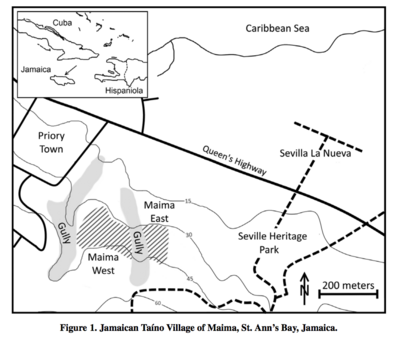
Jamaican Taíno Village of Maima, St. Ann’s Bay, Jamaica

Jamaican Taíno Village of Maima, St. Ann’s Bay, Jamaica

Map 1500 - 1599
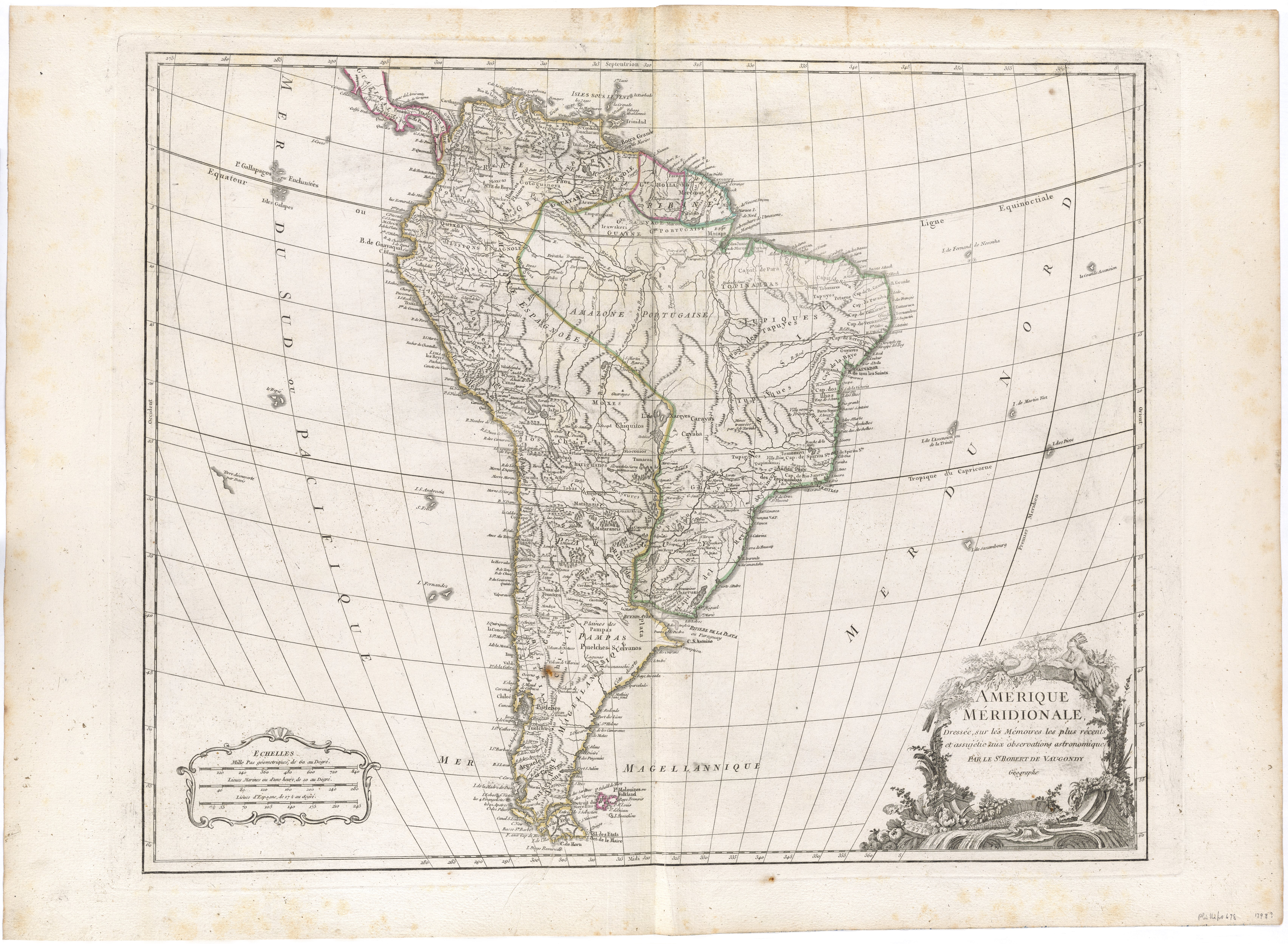
Amerique Méridionale, Dressée, sur les Mémoires les plus récents et assujétie aux observations astronomique

Amerique Méridionale, Dressée, sur les Mémoires les plus récents et assujétie aux observations astronomique

Map 1786
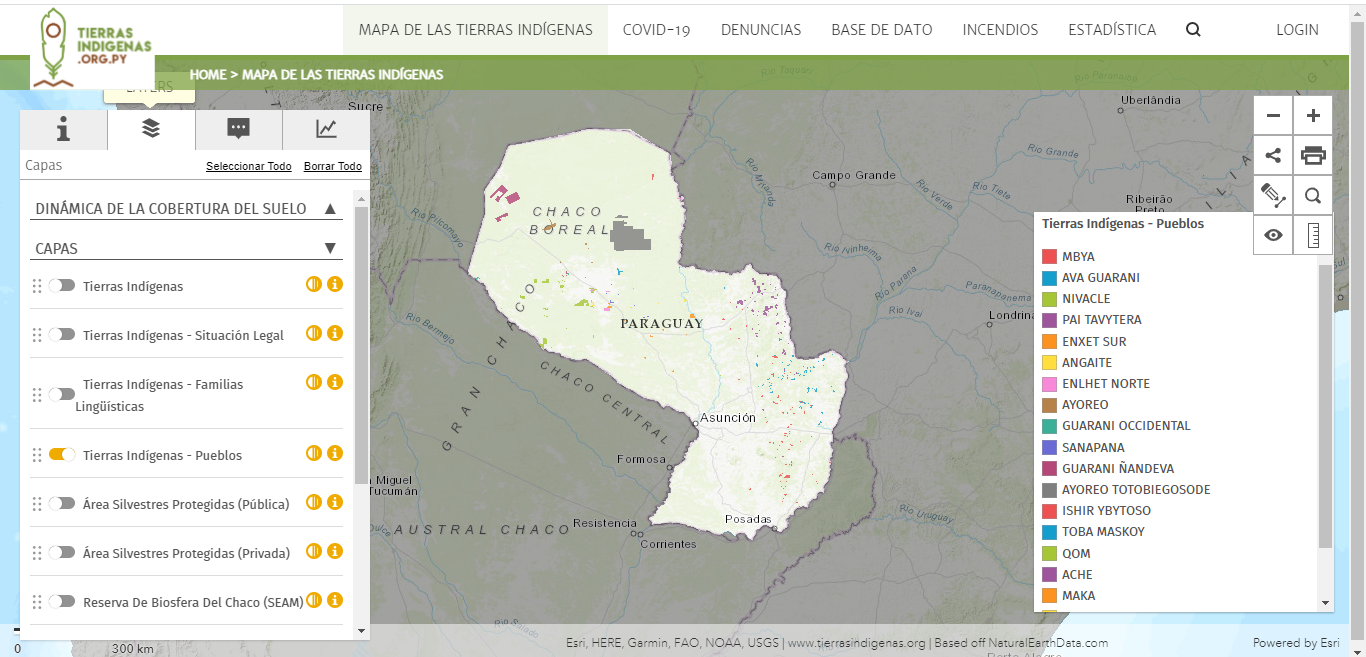
Mapa de las tierras indígenas - Pueblos

Mapa de las tierras indígenas - Pueblos

Map 2017
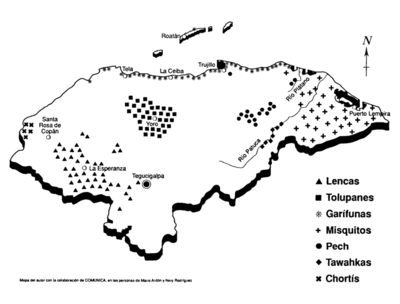
Los antiguos dueños de la tierra: Pueblos indígenas y garífuna de Honduras, una caracterización socio-económica, política y cultural

Los antiguos dueños de la tierra: Pueblos indígenas y garífuna de Honduras, una caracterización socio-económica, política y cultural

Map
"Mapa de lo principal de la Provincia de Nicaragua;su Laguna;y desagüe de ella;por el Río de San Juan;Poblasones [sic] de los enemigos Zambos e yngleses en Puntagorda y Mosquitos;y las costas y parajes;adonde hazen daños y prezas".

"Mapa de lo principal de la Provincia de Nicaragua;su Laguna;y desagüe de ella;por el Río de San Juan;Poblasones [sic] de los enemigos Zambos e yngleses en Puntagorda y Mosquitos;y las costas y parajes;adonde hazen daños y prezas".

Map 1700 - 1716
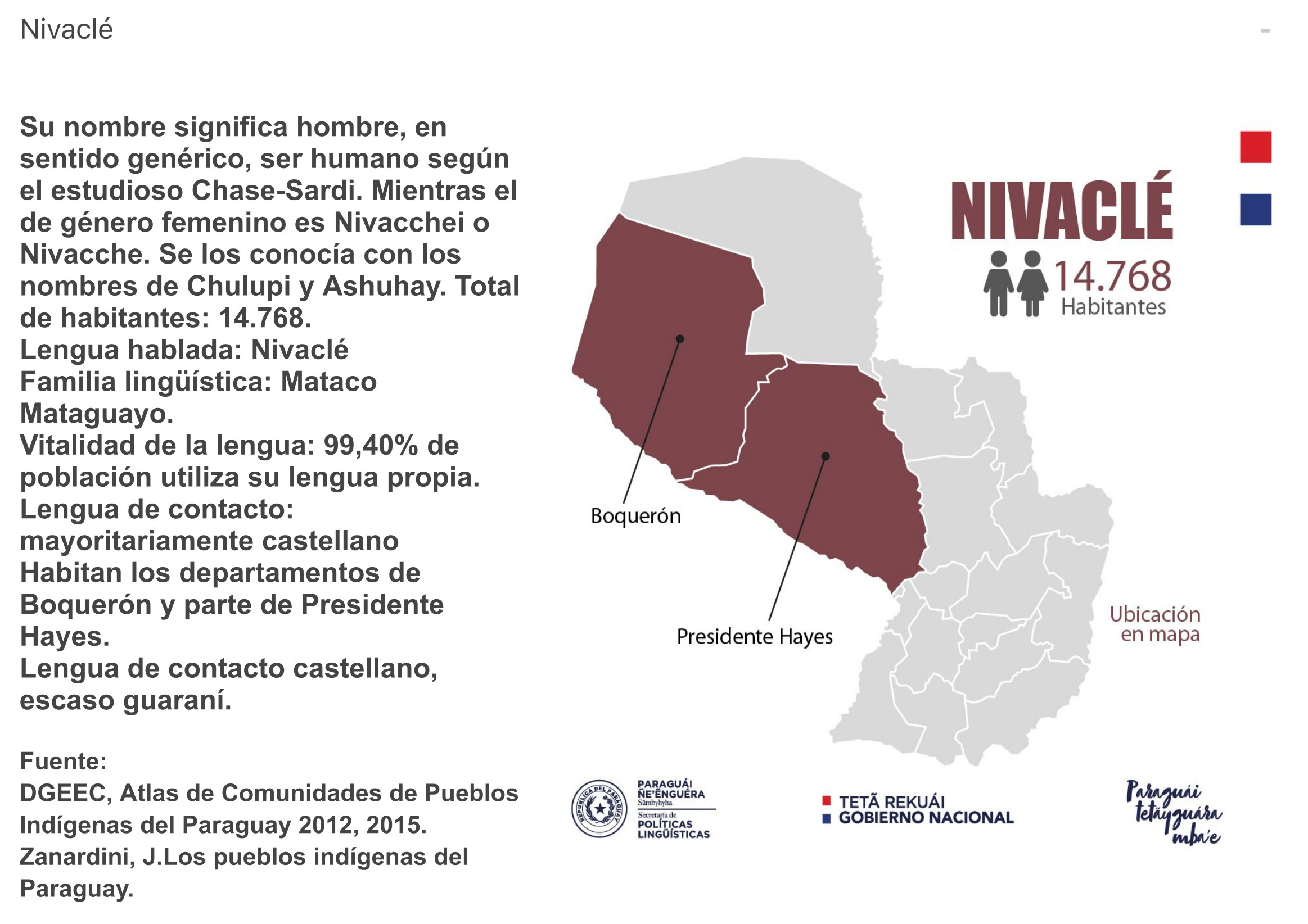
NIVACLÉ

NIVACLÉ

Map 2015
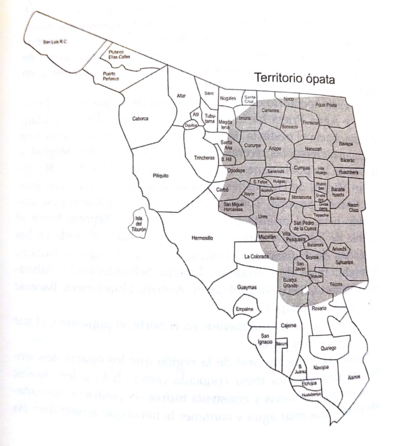
Territorio ópata

Territorio ópata

Map 2015
PUEBLO NAHUA DEL EDO DE MEXICO

PUEBLO NAHUA DEL EDO DE MEXICO

Map 2020

Dispossessions in the Americas

A project by

University of Pennsylvania

Copyright 2024

With support from

Mellon Foundation

Site design & development

Element 84

Art Credits

Detail of A map of the country on the Ohio and Muskingum Rivers: shewing the situation of the Indian towns with respect to the army under the command of Colonel Bouquet, by Thomas Hutchins (1730–1789), London: Printed for Robert Sayer and Thomas Jefferys, 1764. Map reproduction courtesy of the Norman B. Leventhal Map & Education Center at the Boston Public Library.

Site Pages

  • Home
  • Explore
  • About
  • Authors
  • Art
  • Bodies
  • Curricula
  • Cultural Heritage
  • Maps
  • Territories