Dispossesions in the Americas

Dispossesions in the Americas

  • Home
  • Explore
  • About
  • Authors
  • Art
  • Bodies
  • Curricula
  • Cultural Heritage
  • Maps
  • Territories
Back to Explore
Map Commentary 1594 - 1598

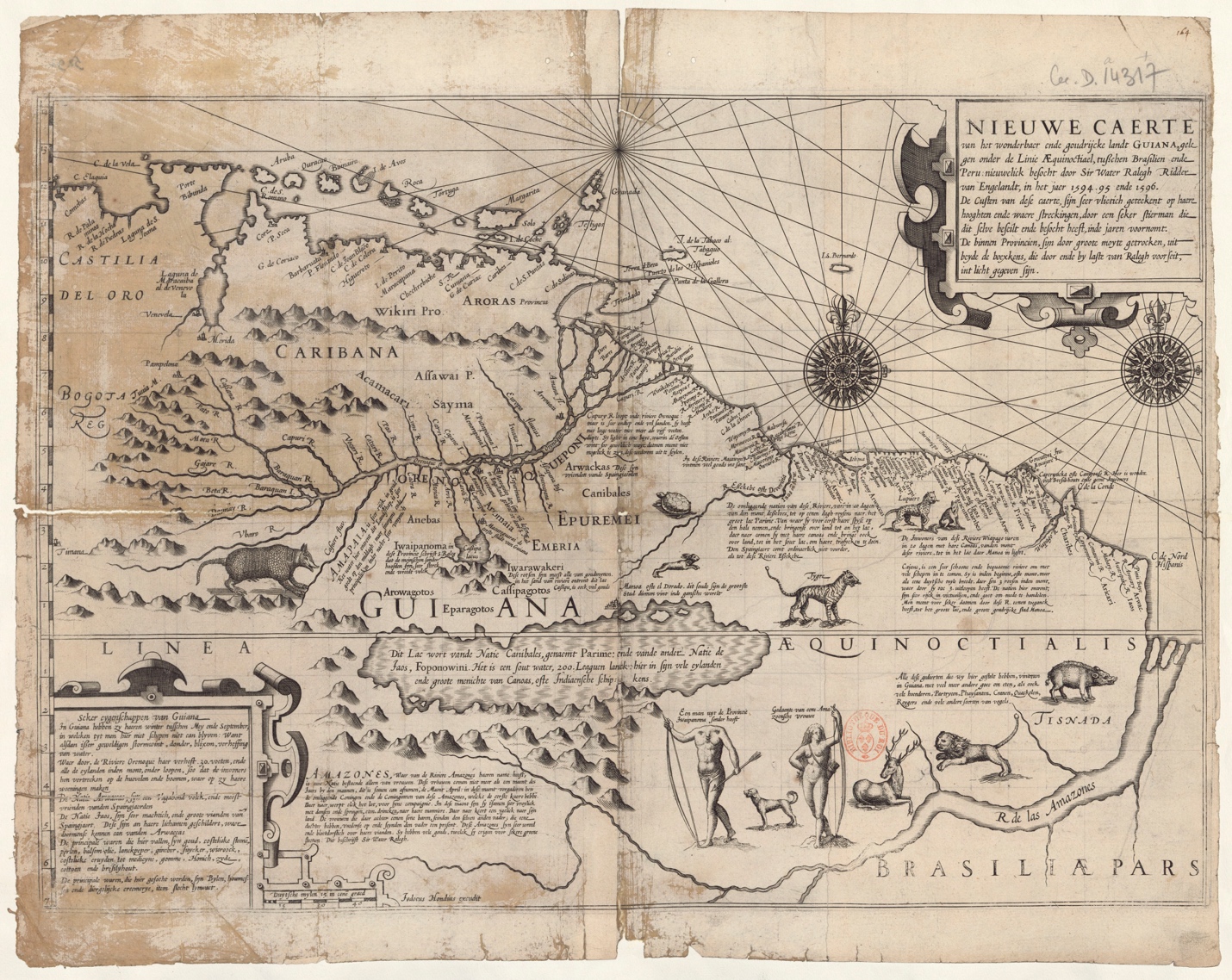
New Map of the Wonderful, Large and Rich Land of Guiana. Amsterdam, 1598

  • Ardila Gutiérrez, Javier Ricardo

Published: 2024

  • Download Image
Raleigh, Walter,  Nieuwe Caerte van het wonderbaer ende goudrijcke landt Guiana, gelegen onder de Linie Aequinoctiael tusschen Brasilien ende Péru. Gallica. Last modified: November 6, 2012. Accessed, August 1, 2023.  https://gallica.bnf.fr/ark:/12148/btv1b531217166

Raleigh, Walter, Nieuwe Caerte van het wonderbaer ende goudrijcke landt Guiana, gelegen onder de Linie Aequinoctiael tusschen Brasilien ende Péru. Gallica. Last modified: November 6, 2012. Accessed, August 1, 2023. https://gallica.bnf.fr/ark:/12148/btv1b531217166

Abstract


This map represents Guiana after the expedition of Walter Raleigh (1553-1618) between 1594 and 1595 and the publication of his memoir in 1596. Raleigh’s narrative acquired graphical representation in 1598 in this map crafted by the Dutch engraver Jodocus Hondius (1563-1612).

The publication of this map in Amsterdam was not fortuitous, as the Netherlands was highly interested in the Guiana’s region at the time.1 In the 16th century, the Spanish and the Portuguese had established in the densely populated areas of the Americas and delayed settling in Guiana. Three compelling reasons explain their delay and hesitancy. First, the fierce dominion of the Caribe people over the region and their vehement rejection of the colonizers. Second, the challenge of imposing a system of taxation and control over nomadic or semi-nomadic Indigenous groups. Third, the tropical forest’s uneasy conditions.

However, the Americas encountered a second wave of colonization in the late 16th century. British, Dutch, and French explorers sought to establish colonial settlements in “unclaimed” territories, such as Guiana. The ambition of possessing America’s richness fueled European empires. Walter Raleigh stands among those explorers. He received Queen Elizabeth’s authorization to conquer territories under her name in 1584. Besides commissioning explorations to North America in 1584 and 1587, he traveled and commanded two missions to the region of Guiana, in 1595 and 1617. Raleigh published the memoirs of his first trip in the Discovery of the Large, Rich, and Beautiful Empire of Guiana of 1596.2 In his book, Raleigh emphasized Guiana’s richness and stressed the assumed existence of the city of El Dorado.

Jodocus’ map broadly summarizes Raleigh’s narrative, locating it in the Guiana Shield. This geographical and geological region includes the current countries of Surinam, British Guiana, French Guiana, and parts of southeastern Venezuela, northern Brazil, and eastern Colombia. The map combines fictional and veritable data. On the one hand, aligned with Raleigh’s fixation with the myth of El Dorado, the map includes this fictional city by the shores of the also imagined Parime Lake, and it describes its purposed population’s customs, resources, and how to access them. The map presents legendary humans as headless men and a narrative about the Amazonas Kingdom.3

On the other hand, beyond this fantastic construction, the map mentions the human and natural conditions of the territory. In Raleigh’s narrative, the British explorer includes accounts of his encounters with locals and their reports about the location of other Indigenous communities, of which there is information nowadays.4 Archeological research confirms that people on the coast were mainly from Caribe and Arawak linguistic families, with nomadic and semi-nomadic groups from the Tupi-Guarani family in the interior. Moreover, the map also includes images of detailed American fauna, such as turtles by the Orinoco River or armadillos or the natural resources of Cayenne.5

The power of the Raleigh’s narrative and Hondius’ cartographic and pictorial representation of it will be long-lasting. For instance, the depiction of the mythic Parime Lake in maps of South America will remain commonplace for over two centuries, all the way to the 19th century.6 In fact, this map will be the reference from which most Europeans envisioned the land of Guiana and one of the earliest accounts of its population.7

Map citation:

Jodocus Hondius. Nieuwe Caerte van het wonderbaer ende goudrijcke landt Guiana, gelegen onder de Linie Aequinoctiael tusschen Brasilien ende Péru. Map, 36,5 x 52 cm. Amsterdam, 1598. Bibliothèque Nationale de France - Gallica. Accessed August 1, 2023. https://gallica.bnf.fr/ark:/12148/btv1b531217166


  1. Marion F. Godfroy, Kourou and the Struggle for a French America (Houndmills, Basingstoke, Hampshire: Palgrave Macmillan, 2015), 44. ↩︎

  2. Walter Raleigh, Discoverie of The Large, Rich, And Bevvtifvl Empire of Gviana, With A Relation of The Great And Golden Citie Of Manoa (Which The Spanyards Call El Dorado) (London: Imprinted at London by Robert Robinson. 1596). In the digital collection *Early English Books Online Demo. *https://quod.lib.umich.edu/e/eebodemo/arz7311.0001.001. University of Michigan Library Digital Collections. Accessed July 7, 2024. ↩︎

  3. The description located under the Essequibo River reads: “The surrounding nations/groups of this river traveled in a few days from the mouth of the same river to a day’s journey to the Great Lake Parime. From there, they first brought the goods over their shoulders overland to the lake. After that, they travel with their canoes and carried their goods overland again to the Salt Lake to trade. Usually, the Spaniards do not adventure further than the Essequibo river.” (I thank the historian Miguel Durango for his help with this translation.) ↩︎

  4. Pluchon and Abénon, Histoire Des Antilles Et De La Guyane, 36-37; Serge Mam-Lam-Fouck and Apollinaire Anakesa-Kululuka, Nouvelle Histoire De La Guyane Française: Des Souverainetés Amérindiennes Aux Mutations De La Société (Matoury, Guyane: Ibis rouge, 2013), 28. ↩︎

  5. The second paragraph under the representation of the Oyapok River says: “Cajane is a very clean and suitable river to enter/come with many ships. At its beginning or mouth, it is more than a German mile wide. There are three rocks at the mouth, through which it also has three outflows. The nations around here are very rich in provisions and good at trading. It is believed, for sure, that by means of these rivers, one could access the great lake and the city of Manoa, which is very rich in wood/timber.” (I thank the historian Miguel Durango for his help with this translation.) ↩︎

  6. See, for instance: CNT0010, CNT0018, CNT0061, CNT0062, CNT0063, CNT0066, CNY0074, VEN0052, VEN0056, VEN0058, VEN0068, VEN0099. ↩︎

  7. Godfroy, Kourou, 41. ↩︎

Citation

Ardila Gutiérrez, Javier Ricardo. 2024. 'New Map of the Wonderful, Large and Rich Land of Guiana. Amsterdam, 1598'. Dispossessions in the Americas. https://dia.upenn.edu/en/content/CNT0183Y/
  • Download Image

Reading in Spanish

Map Commentary 1594 - 1598

Nuevo mapa de la maravillosa, grande y rica tierra de Guayana. Ámsterdam, 1598

  • Ardila Gutiérrez, Javier Ricardo

Published: 2024

Jodocus Hondius. Nieuwe *Caerte van het wonderbaer ende goudrijcke landt Guiana, gelegen onder de Linie Aequinoctiael tusschen Brasilien ende Péru*. Ámsterdam, 1598. Fuente: Gallica.

Jodocus Hondius. Nieuwe Caerte van het wonderbaer ende goudrijcke landt Guiana, gelegen onder de Linie Aequinoctiael tusschen Brasilien ende Péru. Ámsterdam, 1598. Fuente: Gallica.

Reading in Portuguese

Map Commentary 1594 - 1598

Novo mapa da maravilhosa, grande e rica terra da Guiana.

  • Ardila Gutiérrez, Javier Ricardo

Published: 2024

Jodocus Hondius. Nieuwe *Caerte van het wonderbaer ende goudrijcke landt Guiana, gelegen onder de Linie Aequinoctiael tusschen Brasilien ende Péru*. Amsterdã, 1598. Fonte: Gallica.

Jodocus Hondius. Nieuwe Caerte van het wonderbaer ende goudrijcke landt Guiana, gelegen onder de Linie Aequinoctiael tusschen Brasilien ende Péru. Amsterdã, 1598. Fonte: Gallica.

Resumo

Este documento representa a Guiana, segundo os comentários e notícias recuperados por Walter Raleigh (1553-1618) durante sua expedição pela região, de 1594 a 1595, e publicados como memórias em 1596. O gravador neerlandês Joost de Hondt (1563-1612) tomou os dados proporcionados por Raleigh para elaborar este mapa, impresso em 1598.

A publicação deste mapa em Amsterdã não é fortuita. Naquele momento, os Países Baixos, em meio da guerra pela independência do império espanhol, estavam muito interessados na região da Guiana.1 Se desde os alvores do século XVI, espanhóis e portugueses se estabeleceram nas áreas densamente povoadas das Américas, eles postergaram seu assentamento na Guiana. Três razões explicam a demora e a hesitação: primeiro, o domínio do povo Caribe na região e sua oposição aos colonizadores. Segundo, a dificuldade para impor um sistema de tributação e controle sobre os grupos indígenas nômades ou seminômades. Terceiro, as difíceis condições da selva tropical sul-americana.

Ora bem, as Américas experimentaram uma segunda onda de colonização em finais do século XVI. Exploradores britânicos, neerlandeses e franceses buscaram estabelecer assentamentos coloniais em territórios “não reclamados”, como a Guiana. A ambição de possuir as riquezas da América conduziu as monarquias europeias a enviar expedições militares. A de Walter Raleigh se destaca entre elas: em 1584 ele recebeu a autorização da rainha Isabel para conquistar territórios em seu nome. Além de encarregar explorações na América do Norte em 1584 e 1587, ele viajou e comandou duas missões na região da Guiana, em 1595 e 1617. Raleigh publicou as memórias de sua primeira viagem em El Descubrimiento del gran, rico y hermoso Imperio de Guayana de 1596.2 No livro, Raleigh enfatizou a riqueza da Guiana e destacou a suposta existência de El Dorado.

O mapa de Hondt resume amplamente o relato de Raleigh e inclui uma representação do brasão da Guiana. Esta região geográfica e geológica compreende os atuais países de Suriname, Guiana britânica, Guiana francesa e partes do sudeste da Venezuela, norte do Brasil e leste da Colômbia. Assim, o mapa combina dados fictícios e reais. De um lado, em sintonia com a fixação de Raleigh com o mito de El Dorado, o mapa situa esta cidade fictícia à beira do —também imaginário— lago Parima. Além disso, descreve os costumes, recursos e acesso da suposta população, de acordo às memórias de Raleigh. O mapa também menciona histórias sobre homens sem cabeça e uma narração sobre o Reino das Amazonas.3

Por outro lado, independentemente desta construção fantástica, o mapa apresenta as condições humanas e naturais do território. Na narração, o explorador britânico incluiu relatos dos encontros que teve com os nativos e suas descrições sobre a localização de outras comunidades indígenas das quais hoje se tem informação fidedigna.4 As pesquisas arqueológicas confirmam que as pessoas no litoral atlântico eram principalmente das famílias linguísticas Caribe e Arawak, com grupos nômades e seminômades da família Tupi-guarani, no interior. O mapa também inclui imagens detalhadas da fauna americana, como tartarugas do rio Orinoco, tatus e recursos naturais de Cayena.5

O atrativo da narração de Raleigh e a representação cartográfica de Hondt deixaram profunda marca nos imaginários sobre a Guiana. Por exemplo, a representação do mítico lago Parima na América do Sul foi utilizado até o século XIX.6 Portanto, este mapa é uma referência a partir da qual muitos europeus imaginaram a Guiana e é um dos primeiros relatos sobre sua população.7

Legenda do mapa:

Jodocus Hondius. Nieuwe Caerte van het wonderbaer ende goudrijcke landt Guiana, gelegen onder de Linie Aequinoctiael tusschen Brasilien ende Péru. Mapa, 36,5 x 52 cm. Amsterdã, 1598. Bibliothèque Nationale de France - Gallica. Acessado no dia 1 de agosto de 2023. https://gallica.bnf.fr/ark:/12148/btv1b531217166


  1. Marion F. Godfroy, Kourou and the Struggle for a French America (Houndmills, Basingstoke, Hampshire: Palgrave Macmillan, 2015), 44. ↩︎

  2. Walter Raleigh, Discoverie of The Large, Rich, And Bevvtifvl Empire of Gviana, With A Relation of The Great And Golden Citie Of Manoa (Which The Spanyards Call El Dorado) (Londres: Imprinted at London by Robert Robinson. 1596). Há uma versão digitalizada em: *Early English Books Online Demo. *https://quod.lib.umich.edu/e/eebodemo/arz7311.0001.001. University of Michigan Library Digital Collections. Consultado no dia 7 de julho de 2024. ↩︎

  3. Na descrição que aparece embaixo da imagem do rio Esequibo se lê: “Os grupos/as nações circundantes a este rio viajam durante vários dias, começando por um trajeto de um dia, a partir da desembocadura do mesmo rio até o grande lago Parima. Dali, primeiro trazem sobre os ombros os produtos trazidos de longe até o lago. Depois, viajam com suas canoas e levam os produtos trazidos de longe de novo até o lago Salado para comerciar. Frequentemente, os espanhóis não avançam além do rio Esequibo”. (Agradeço ao historiador Miguel Durango por sua ajuda na tradução deste fragmento) ↩︎

  4. Pluchon y Abénon, Histoire Des Antilles Et De La Guyane, 36-37; Serge Mam-Lam-Fouck and Apollinaire Anakesa-Kululuka, Nouvelle Histoire De La Guyane Française: Des Souverainetés Amérindiennes Aux Mutations De La Société (Matoury, Guiana francesa: Ibis rouge, 2013), 28. ↩︎

  5. No segundo parágrafo embaixo da representação do rio Oyapoco se lê: “Cayena é um rio aberto e muito adequado para entrar com numerosos barcos. Sua desembocadura mede mais que uma milha germana. Há três rochas na entrada, entre as quais passa a correnteza. As nações vizinhas são muito ricas em provisões e boas para o comércio. Acredita-se, sem dúvida, que por meio deste rio é possível ter acesso ao grande lago e à cidade de Manoa, que é muito rica em madeira”. (Agradeço ao historiador Miguel Durango por sua ajuda na tradução deste fragmento) ↩︎

  6. Ver, por exemplo: CNT0010, CNT0018, CNT0061, CNT0062, CNT0063, CNT0066, CNY0074, VEN0052, VEN0056, VEN0058, VEN0068, VEN0099. ↩︎

  7. Godfroy, Kourou, 41. ↩︎

Citation

Ardila Gutiérrez, Javier Ricardo. 2024. 'Novo mapa da maravilhosa, grande e rica terra da Guiana.'. Dispossessions in the Americas. https://dia.upenn.edu/pt/content/CNT0183Y/

Related Content

Nieuwe Caerte van het wonderbaer ende goudrijcke landt Guiana, gelegen onder de Linie Aequinoctiael tusschen Brasilien ende Péru.

Nieuwe Caerte van het wonderbaer ende goudrijcke landt Guiana, gelegen onder de Linie Aequinoctiael tusschen Brasilien ende Péru.

Map 1500 - 1599
Mapa Coro-Grafico de la Nueva Andalucia;provincias de Cumaná;y Guyana;Vertientes del Orinoco;su cierto origen;comunicación con el de las Amazonas;situación de la Laguna Parime;y nuevas Poblaciones

Mapa Coro-Grafico de la Nueva Andalucia;provincias de Cumaná;y Guyana;Vertientes del Orinoco;su cierto origen;comunicación con el de las Amazonas;situación de la Laguna Parime;y nuevas Poblaciones

Map 1778
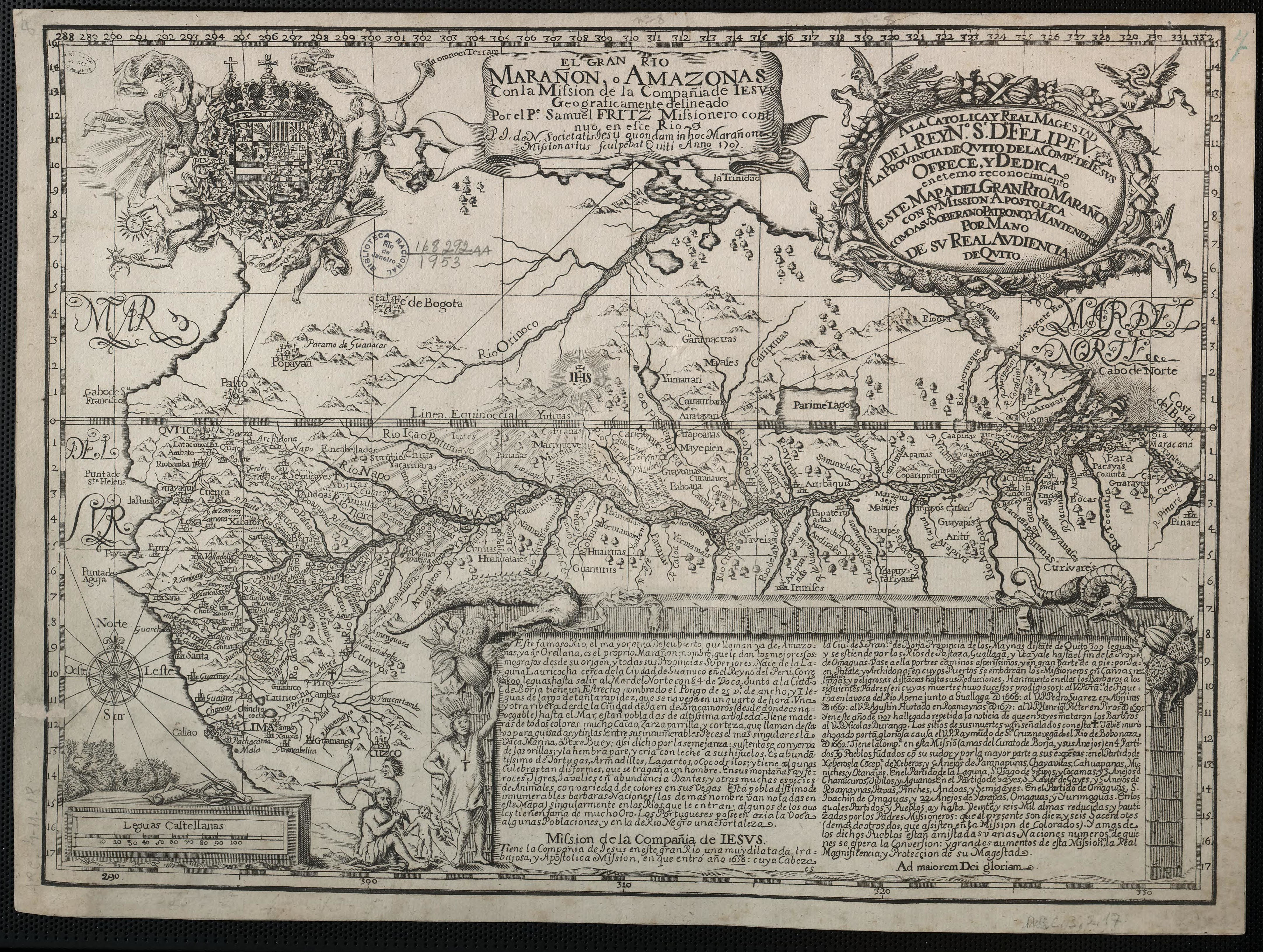
The Marañon or Amazon River with the Mission of the Society of Jesus

The Marañon or Amazon River with the Mission of the Society of Jesus

Map 1686 - 1707
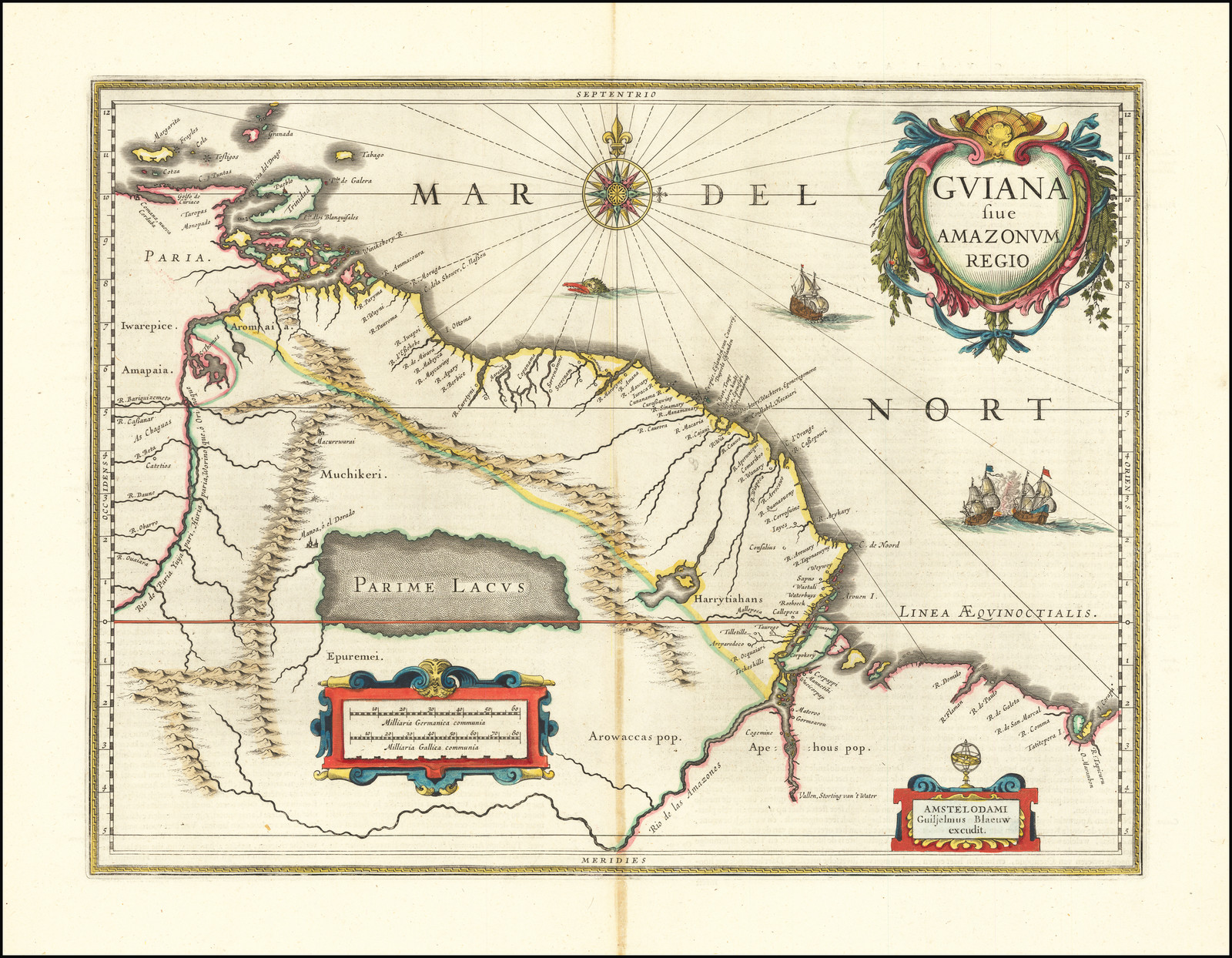
GUIANA sive AMAZONUM REGIO

GUIANA sive AMAZONUM REGIO

Map 1600 - 1699
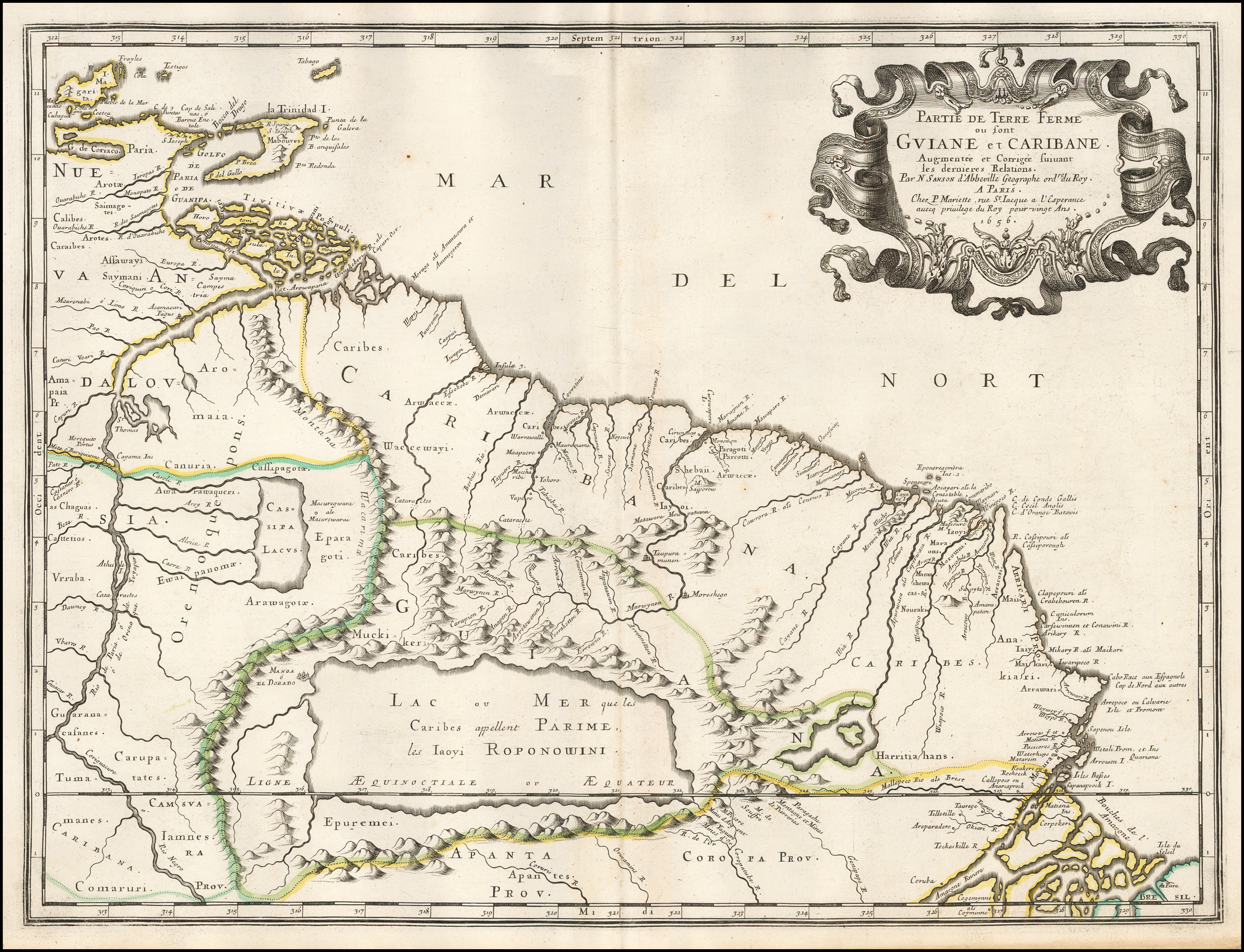
Partie de Terre Ferme ou sont Guiane et Caribane. Augmentée et Corrigée suivant les dernières Relations

Partie de Terre Ferme ou sont Guiane et Caribane. Augmentée et Corrigée suivant les dernières Relations

Map 1594 - 1596
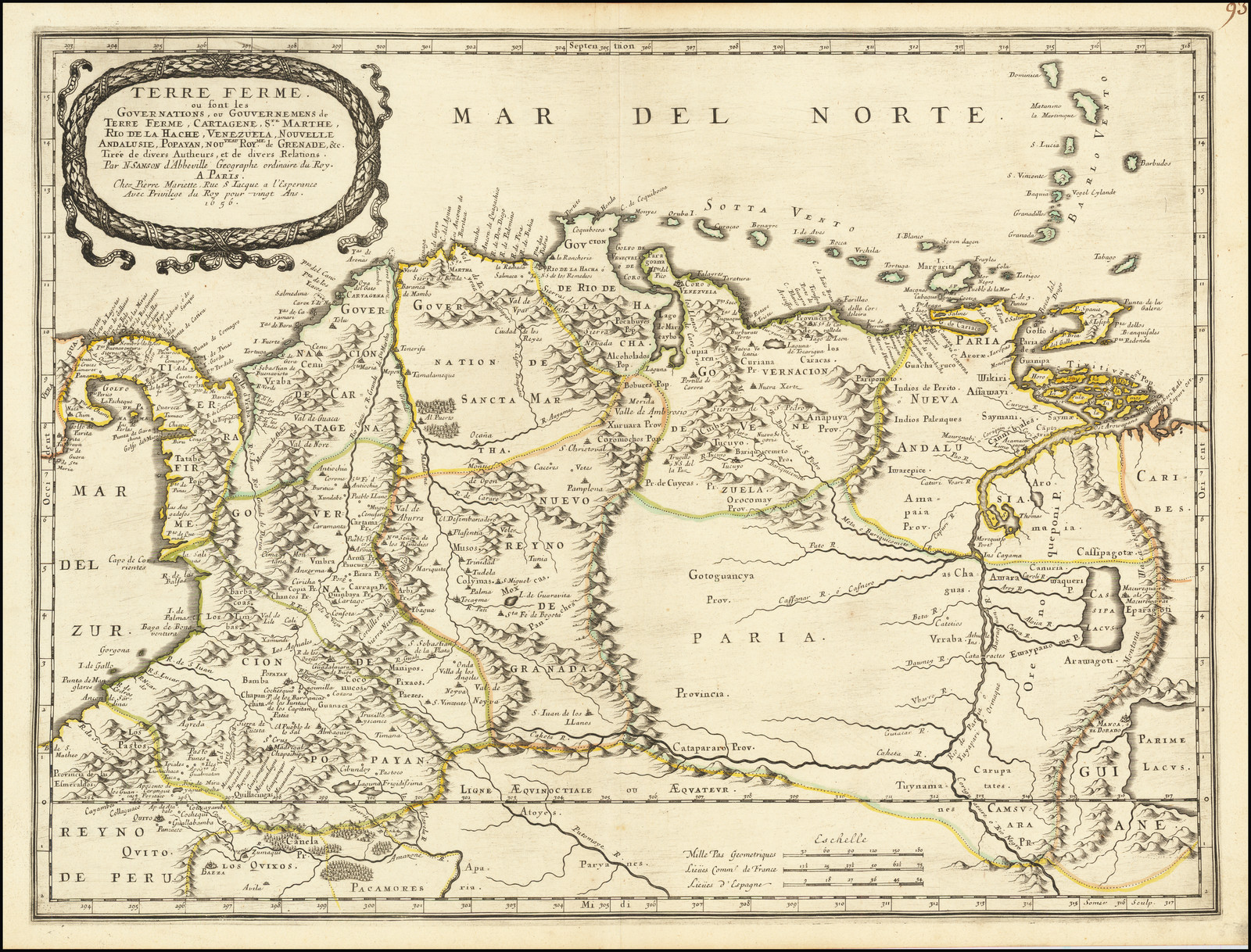
TERRE FERME ou sont les governations ou gouvernemens de Terre ferme;Cartagene Ste. Marthe;Rio de la Hache;Venezuela;nouvelle Andalusie Popayein;nouveau royme de Grenade;&c

TERRE FERME ou sont les governations ou gouvernemens de Terre ferme;Cartagene Ste. Marthe;Rio de la Hache;Venezuela;nouvelle Andalusie Popayein;nouveau royme de Grenade;&c

Map 1656
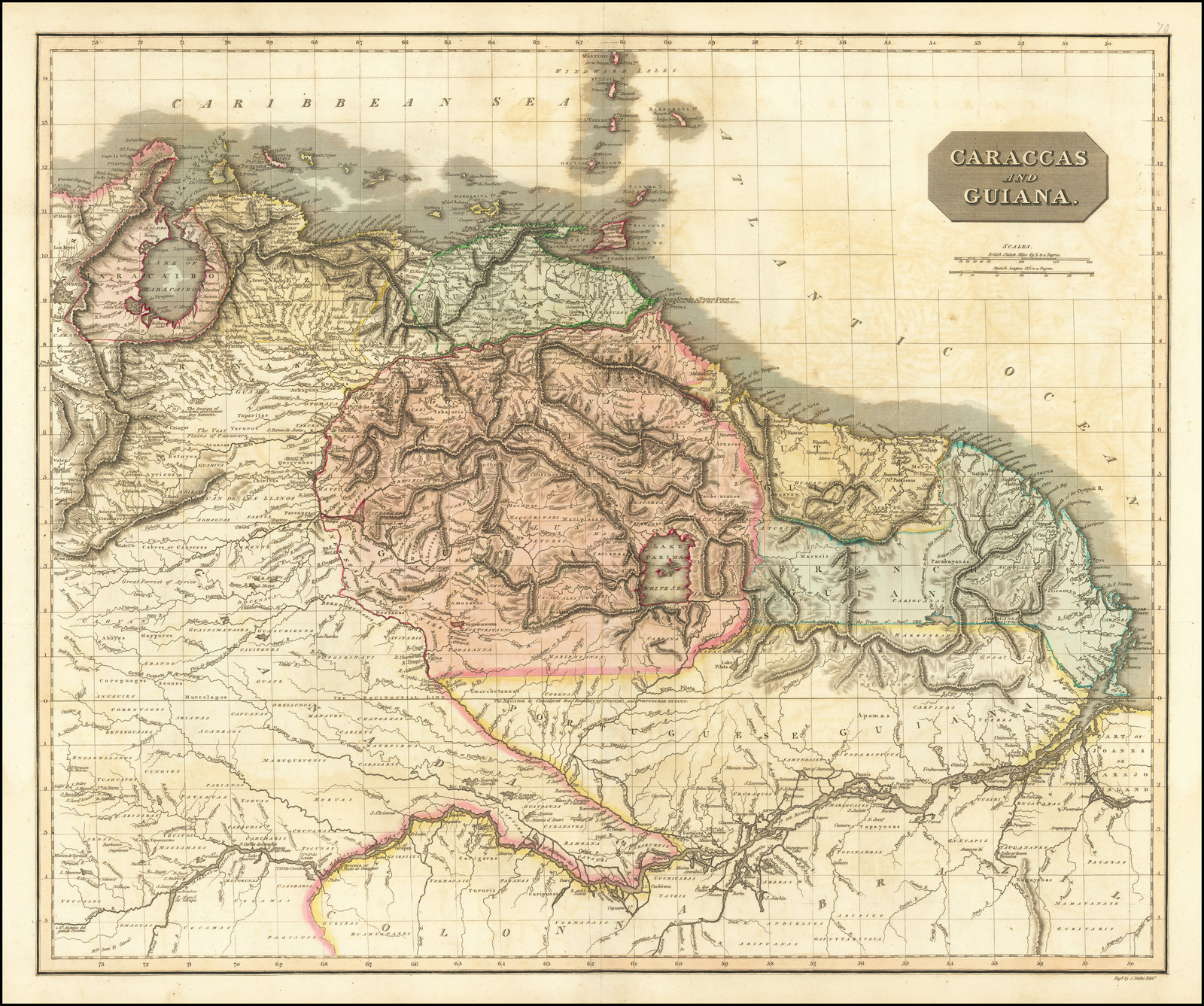
CARACCAS AND GUIANA

CARACCAS AND GUIANA

Map 1814
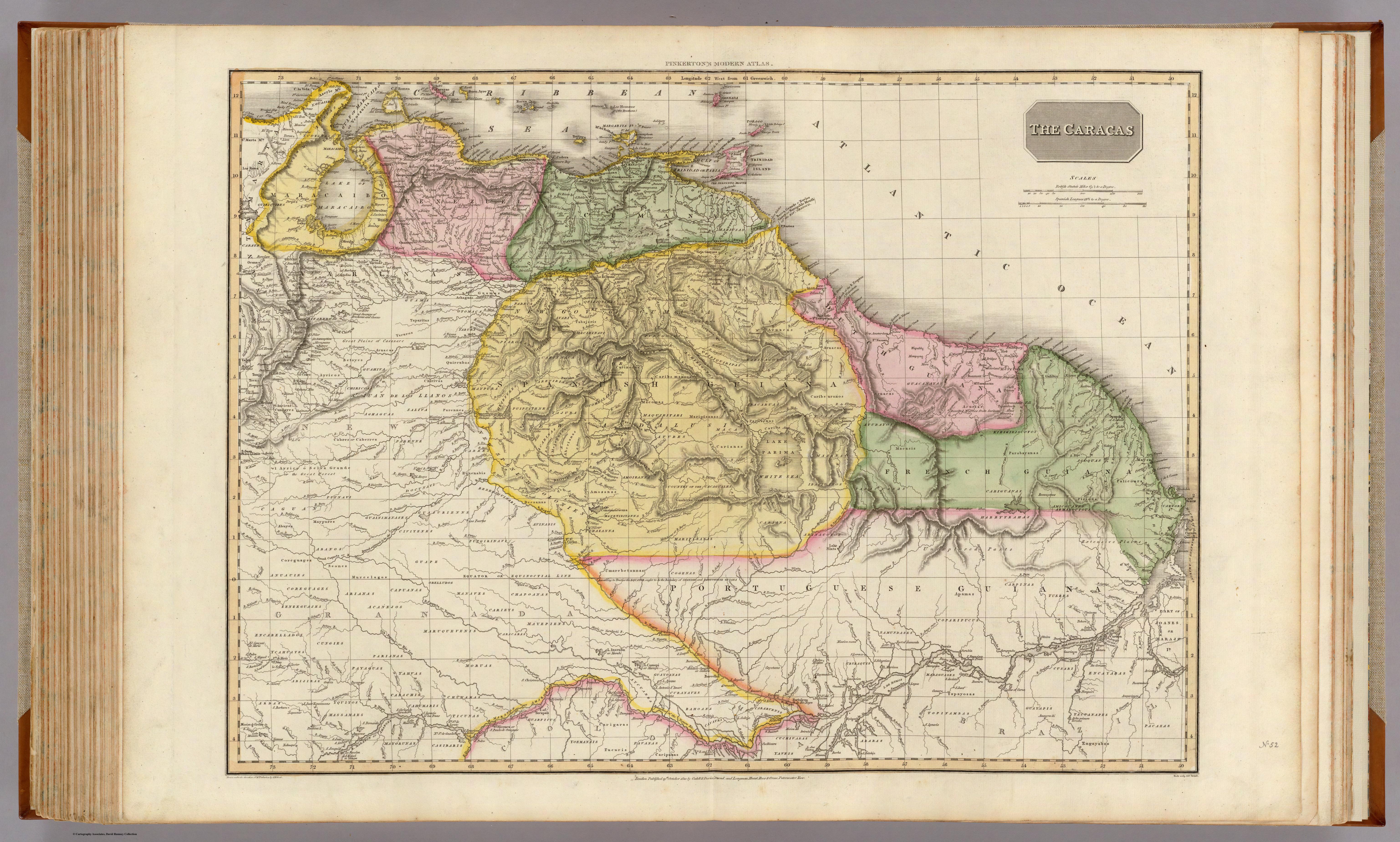
THE CARACAS

THE CARACAS

Map 1810
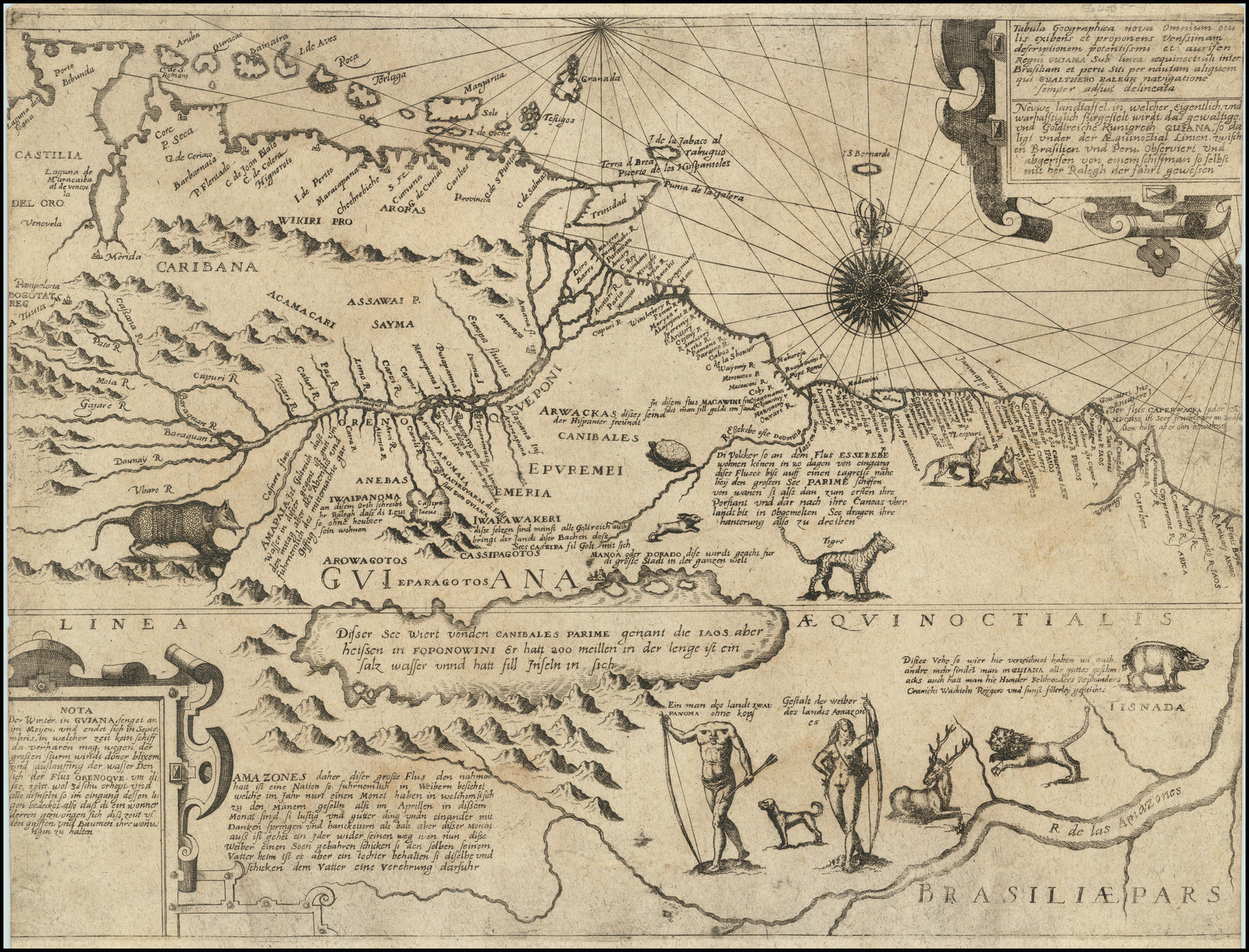
Tabula Geographica nova Omnium oculis exibens et proponens Venssimam descriptionem potentissimi et aurifen Regni Guiana Sub linea aequinoctiuli iner Brasiliam et eru Situ per nautam aliquem qui Gualthero Ralegh navigatione Semper Adsuit delineata

Tabula Geographica nova Omnium oculis exibens et proponens Venssimam descriptionem potentissimi et aurifen Regni Guiana Sub linea aequinoctiuli iner Brasiliam et eru Situ per nautam aliquem qui Gualthero Ralegh navigatione Semper Adsuit delineata

Map 1594 - 1596
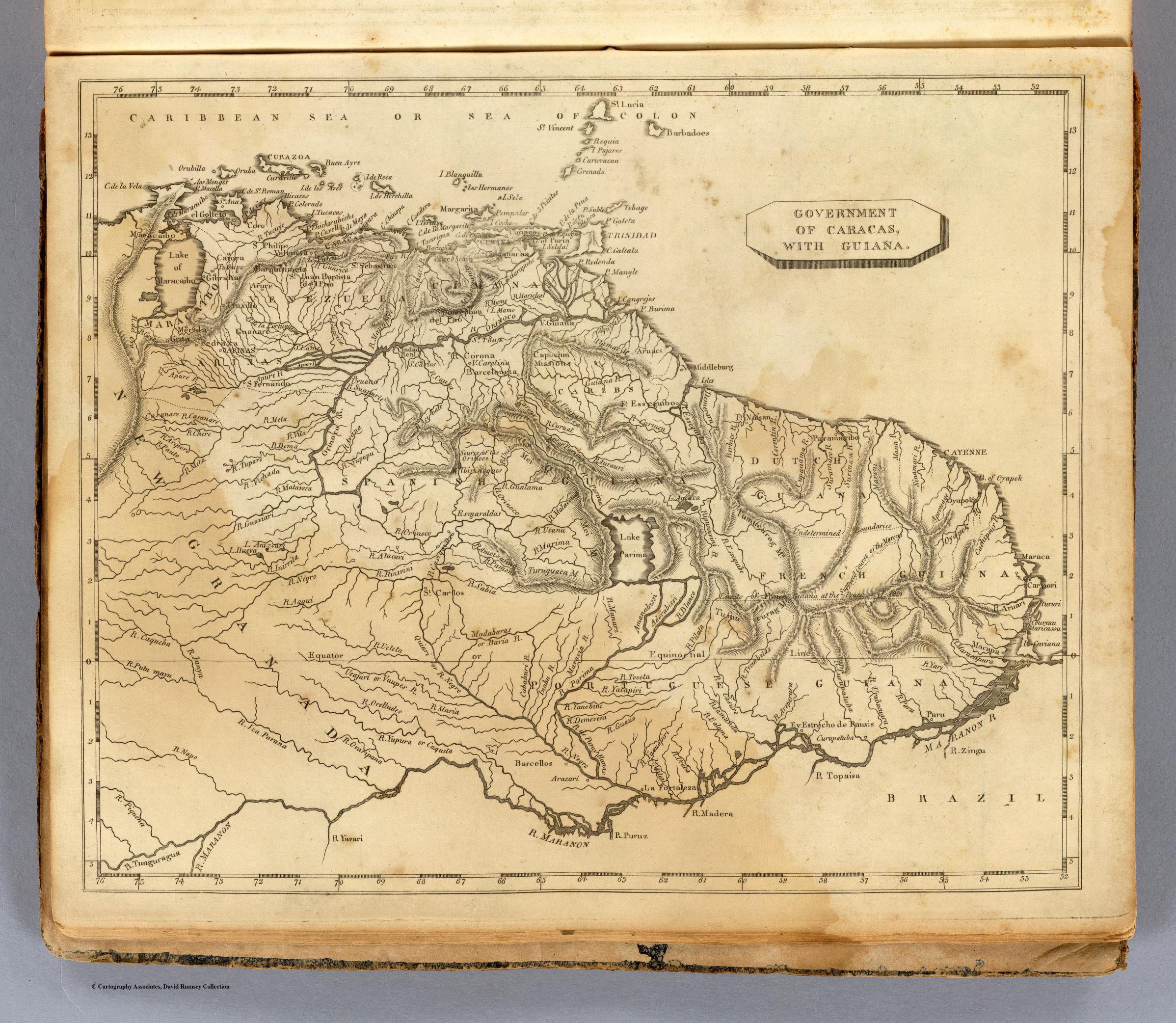
GOVERNMENT OF CARACAS;WITH GUIANA.

GOVERNMENT OF CARACAS;WITH GUIANA.

Map 1812
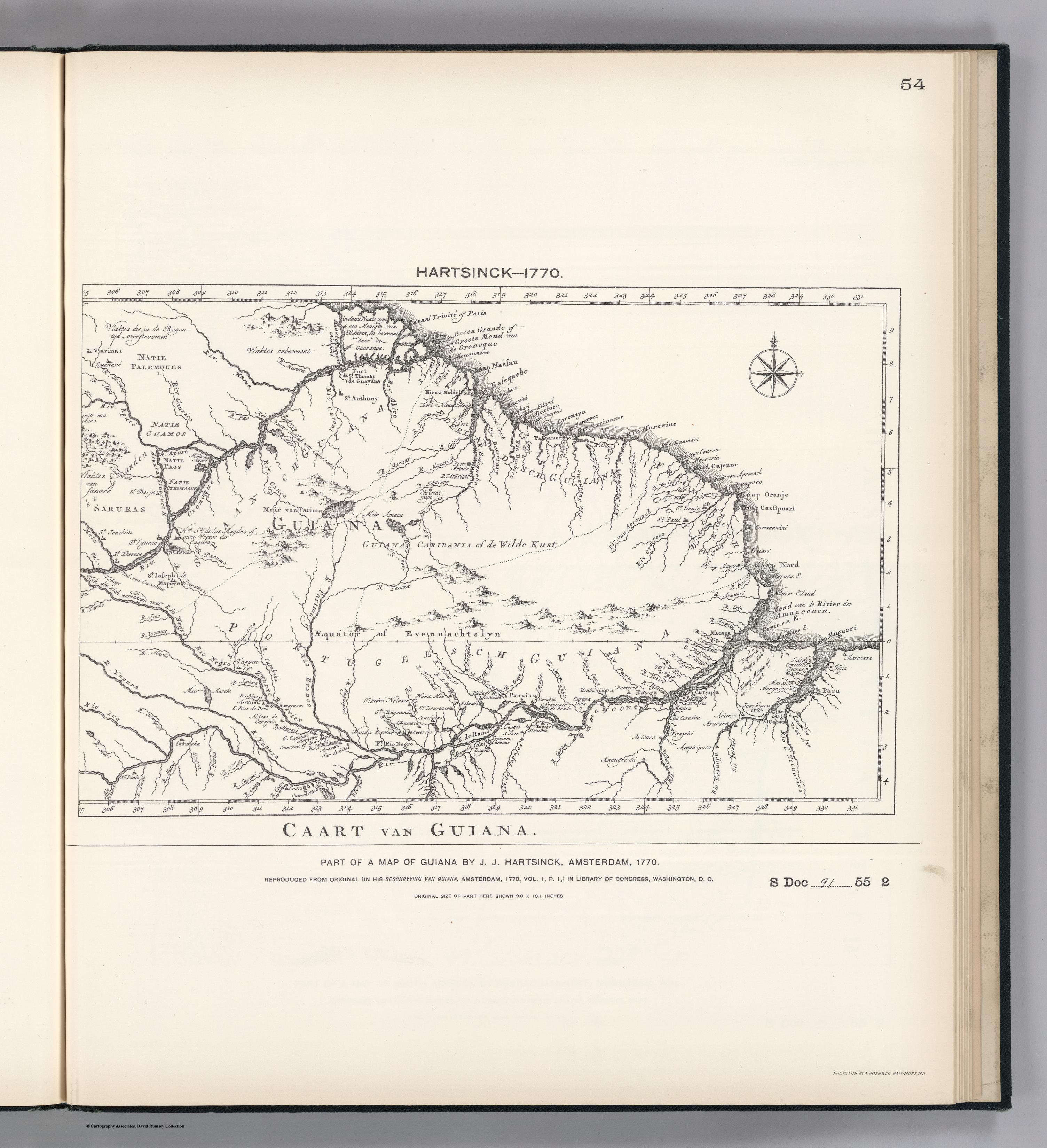
PART OF A MAP OF GUIIANA BY J.J. HARTSINCK

PART OF A MAP OF GUIIANA BY J.J. HARTSINCK

Map 1770
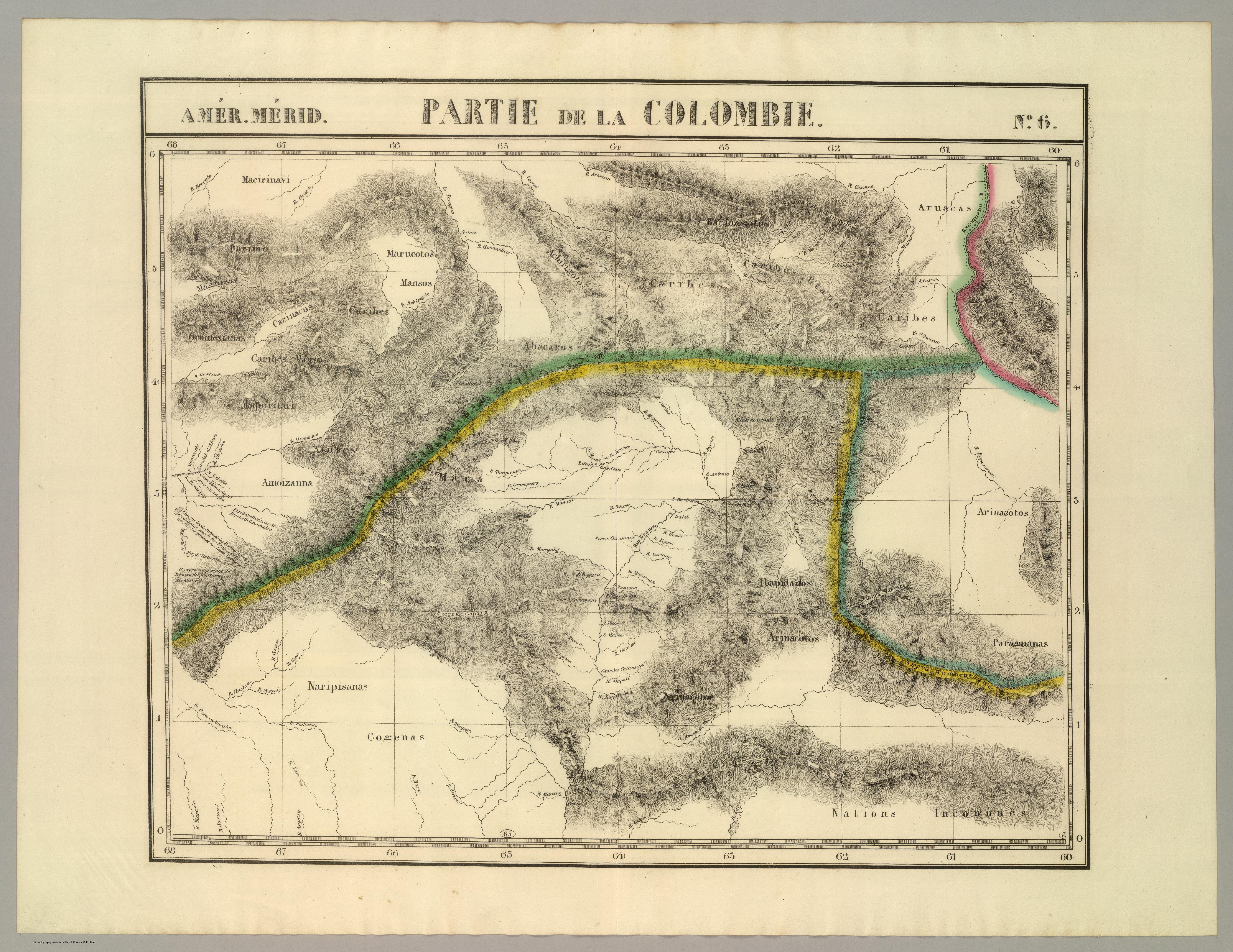
PARTIE DE LA COLOMBIE

PARTIE DE LA COLOMBIE

Map 1827
Specialkarte von A. v. HUMBOLDT’S REISEN in VENEZUELA und am ORINOKO-STROM

Specialkarte von A. v. HUMBOLDT’S REISEN in VENEZUELA und am ORINOKO-STROM

Map 1799 - 1800

Dispossessions in the Americas

A project by

University of Pennsylvania

Copyright 2024

With support from

Mellon Foundation

Site design & development

Element 84

Art Credits

Raleigh, Walter, Nieuwe Caerte van het wonderbaer ende goudrijcke landt Guiana, gelegen onder de Linie Aequinoctiael tusschen Brasilien ende Péru. Gallica. Last modified: November 6, 2012. Accessed, August 1, 2023. https://gallica.bnf.fr/ark:/12148/btv1b531217166

Site Pages

  • Home
  • Explore
  • About
  • Authors
  • Art
  • Bodies
  • Curricula
  • Cultural Heritage
  • Maps
  • Territories