Dispossesions in the Americas

Dispossesions in the Americas

  • Home
  • Explore
  • About
  • Authors
  • Art
  • Bodies
  • Curricula
  • Cultural Heritage
  • Maps
  • Territories
Back to Explore
Narrative 2023

MALLKUANKA – Vuelo Surnorte de Colores/The South-North Flight of Colors

  • Bartch, Catherine

  • Roberto 'Mamani Mamani'

Published: 2023

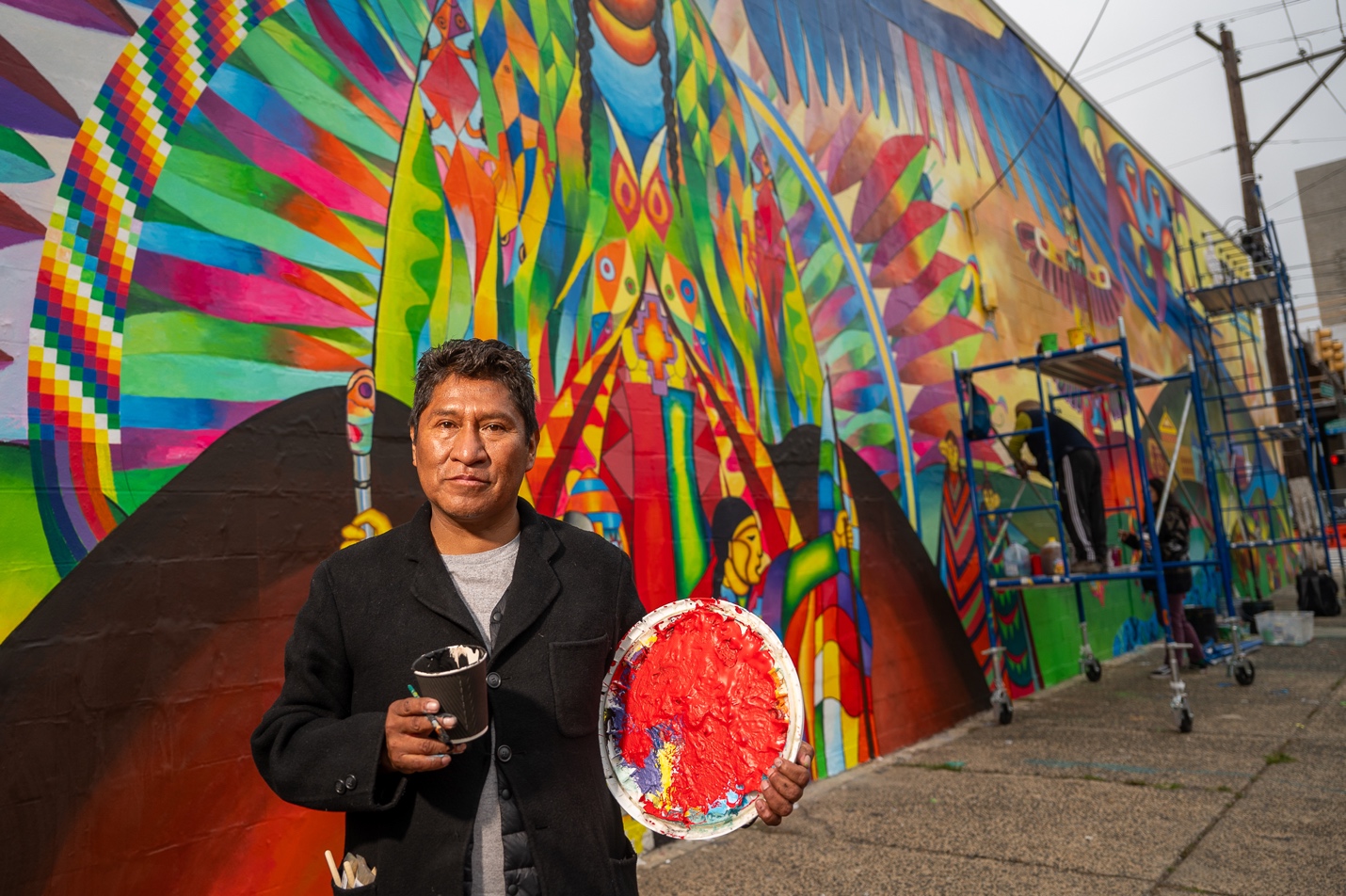
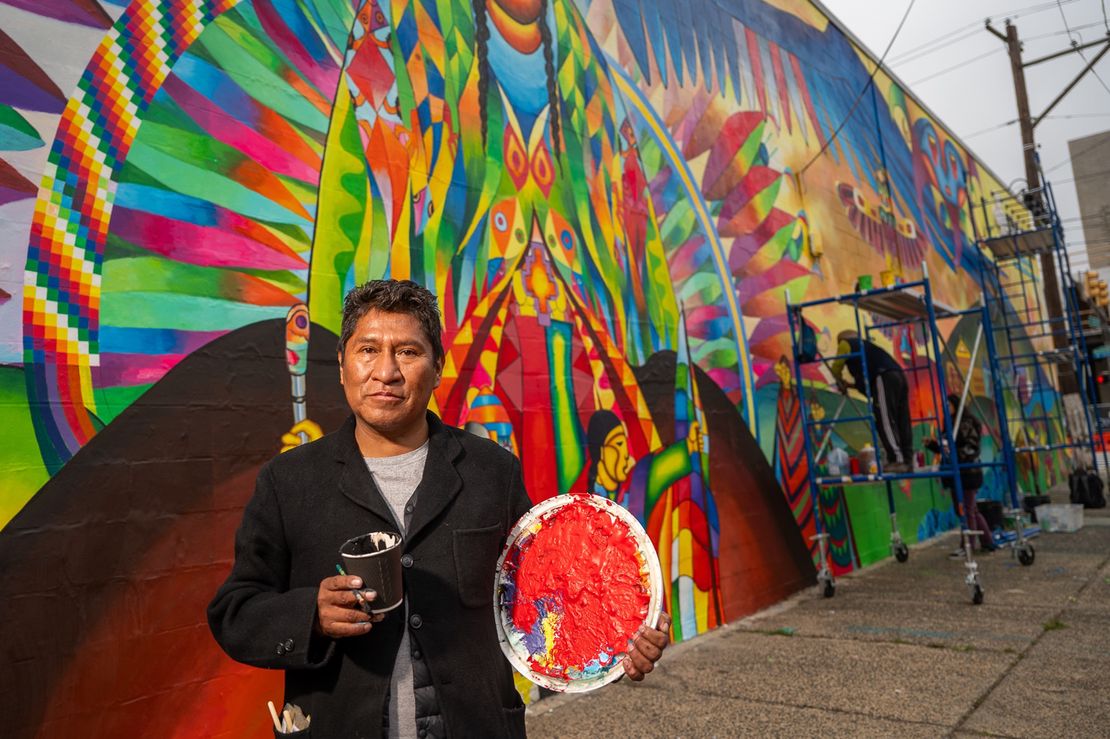
Roberto Mamani Mamani in front of his mural MALLKUANKA – Vuelo Surnorte de Colores/The South-North Flight of Colors, located at 2100 Washington Avenue, Philadelphia, PA on the east side of the Philadelphia Animal Specialty and Emergency (PASE) building. Photo credit: Bryan Karl Lathrop.

Roberto Mamani Mamani in front of his mural MALLKUANKA – Vuelo Surnorte de Colores/The South-North Flight of Colors, located at 2100 Washington Avenue, Philadelphia, PA on the east side of the Philadelphia Animal Specialty and Emergency (PASE) building. Photo credit: Bryan Karl Lathrop.

Abstract

What is MALLKUANKA- Vuelo Surnorte De Colores/ The South-North Flight of Colors?

How do we imagine encounters of people from the south and the north? How do we foster connections between South America and North America, or Latin America and the U.S.? Renowned Bolivian and Aymara artist Roberto Mamani Mamani, with a team of people from Bolivia and Philadelphia, created and painted the vibrant mural MALLKUANKA – Vuelo Surnorte de Colores/The South-North Flight of Colors in Philadelphia, PA, as a way of visualizing unity. The mural’s beauty highlights the interrelationships of people and nature in ways that transcend borders.

MallkuAnka depicts Andean and Philadelphia landscapes, using color to chart encounters among cultures and beings. The mural harmonizes dualities that emerge from meetings: the condor (south) and the eagle (north), the city and the mountains, the sun and the moon, the earthly and the sacred. Painted on the side of a veterinary clinic (PASE), along a long wall (130’ wide/ 20’ high), animals representing South and North America bring together both cultures under the embrace of Pachamama, or Mother Earth — the mural’s central figure. The design shows the importance of unity between two hemispheres, with the flight of the condor and eagle from south to north, and how people from both can live in harmony respecting the Pachamama, and all that she symbolizes, including energy and life.

In the creation of MALLKUANKA – Vuelo Sur-Norte de Colores/The South-North Flight of Colors, Mamani Mamani was assisted by Yody Ruben Quisbert Quispe, Ilampu Adhemar Aguilar Jove, Ilimani Gabriel Aquilar Jove, Emmanuel Amaru Aquilar Jove and Mara Henao.1

Who is Roberto Mamani Mamani?

Roberto Mamani Mamani is an internationally acclaimed Aymara artist and muralist from La Paz and Cochabamba, Bolivia. His extraordinary, vivid artwork depicts symbols of the Andean Indigenous tradition and cosmovision or worldview, conveying strength, pride, and a commitment to sustainable, peaceful, and spiritual living. He weaves in historical themes such as the impact of colonization and how the Aymara-Quechua community, after years of marginalization and oppression, has fought for an empowered collective identity in the region. A self-taught artist, Mamani Mamani has displayed his artwork in approximately 60 exhibitions worldwide, including in Argentina, Brazil, United States, Mexico, Italy, France, and the United Kingdom.  He has participated in World Expos and the La Biennale Di Venezia/ International Art Exhibition in Italy, and he has received numerous national and international accolades over the years.  In addition, Mamani Mamani painted giant, 12-story murals on the Wiphala community housing project in El Alto, Bolivia, a city adjacent to La Paz.

His art brings to life the spirit of “Buen Vivir” (or Sumak Kawsay in Quechua), a movement and philosophy inspired by the Andean cosmovision that calls for living in harmony with the community and environment, and rejecting rampant, unfettered consumerism and capitalism. At a very young age, Mamani Mamani began creating art in his hometown of Cochabamba, and throughout his career the principles of Buen Vivir and the entire Andean cosmovision have driven his work and artistic fervor. He greets everyone with “Jallalla: toda la energía de los Andes,” or may all of the energy of the Andes be with you.

Why commission this mural in Philadelphia?

The mural’s magnificent artwork was produced by Mamani Mamani as part of the Penn-Mellon Dispossessions in the Americas project, with organizational support from the University of Pennsylvania’s Center for Latin American and Latinx Studies, the University of Pennsylvania’s Sachs Program for Arts Innovation, and Mural Arts Philadelphia.

Mural Arts Philadelphia is “dedicated to the belief that art ignites change.” The 50-100 public art projects led annually by Mural Arts are carried out through a participatory process, which aims to “to create art that transforms public spaces and individual lives.”

“Mural Arts Philadelphia envisions a world where all people have a say in the future of their lives and communities; where art and creative practice are respected as critical to sense of self and place; and where cultural vibrancy reflects and honors all human identities and experiences.”2

Mural Arts also emphasizes inquiry-based learning and respectful and mindful collaboration. Their programming spans restorative justice, arts education, and civic engagement.

This collaborative community-university project represents a relatively rare opportunity. In fact, in an interview with Mural Arts Executive Director Jane Golden, she mentioned that university partnerships with Mural Arts have been few, saying one can “count them on one hand.”3 The MallkuAnka initiative also provided an opportunity to invite an international artist to Philadelphia, which “aspires to be a global city”.4

The themes and images of the mural are relevant for communities across the world.png says Eduardo Gudyana, a senior researcher at the Latin American Center for Social Ecology.5 Philadelphia still holds the record for the highest poverty rate among the largest cities of the United States, with an average of 21.7% of people living in poverty, soaring to 33% for Hispanics and 35% for adults with less than a high school diploma, according to the Pew Foundation.6 The Andean cosmovision, with the “buen vivir” concept, is important for Philadelphia and other cities like it, worldwide, that confront poverty, racism, gun violence and other societal problems that threaten health, wellbeing and community.

The mural also highlights the importance of diversity in Philadelphia. Sixteen percent of the approximately 1.5 million people who live in Philadelphia identify as Latino or Hispanic.7 It is also important that the mural captures the importance of Indigenous peoples and their philosophies, because narratives about Indigenous peoples found in education, by leaders, or in mass media often propagate harmful and discriminatory stereotypes.8

Naeemah Patterson, one of the MallkuAnka mural project coordinators with Mural Arts Philadelphia, explained that MallkuAnka sends the message “we’re here,” including everyone who is Indigenous, Latin American, or who finds meaning in the Andean Cosmovision. “It’s a big, bright, obvious sign that we’re here, so children can see that and identify with that, and elders can see that and feel validated and welcome,” said Patterson.9

Delving deeper into the MallkuAnka mural and its symbols:

Condor and Eagle: According to Mamani Mamani, Mallku, or Aymara for condor, represents authority, and is a spiritual guide of the Andes. Anka is Quechua for eagle, North America’s regal bird. The mural’s subtitle refers to the flight from south to north, and the artist uses many different colors to recognize that we are all equal; that we can walk together, and the condor and eagle coming together represent this. The Pachamama shows happiness and sadness for her children and it reflects that all beings are alive - not just humans but also plants, animals, and other creatures.
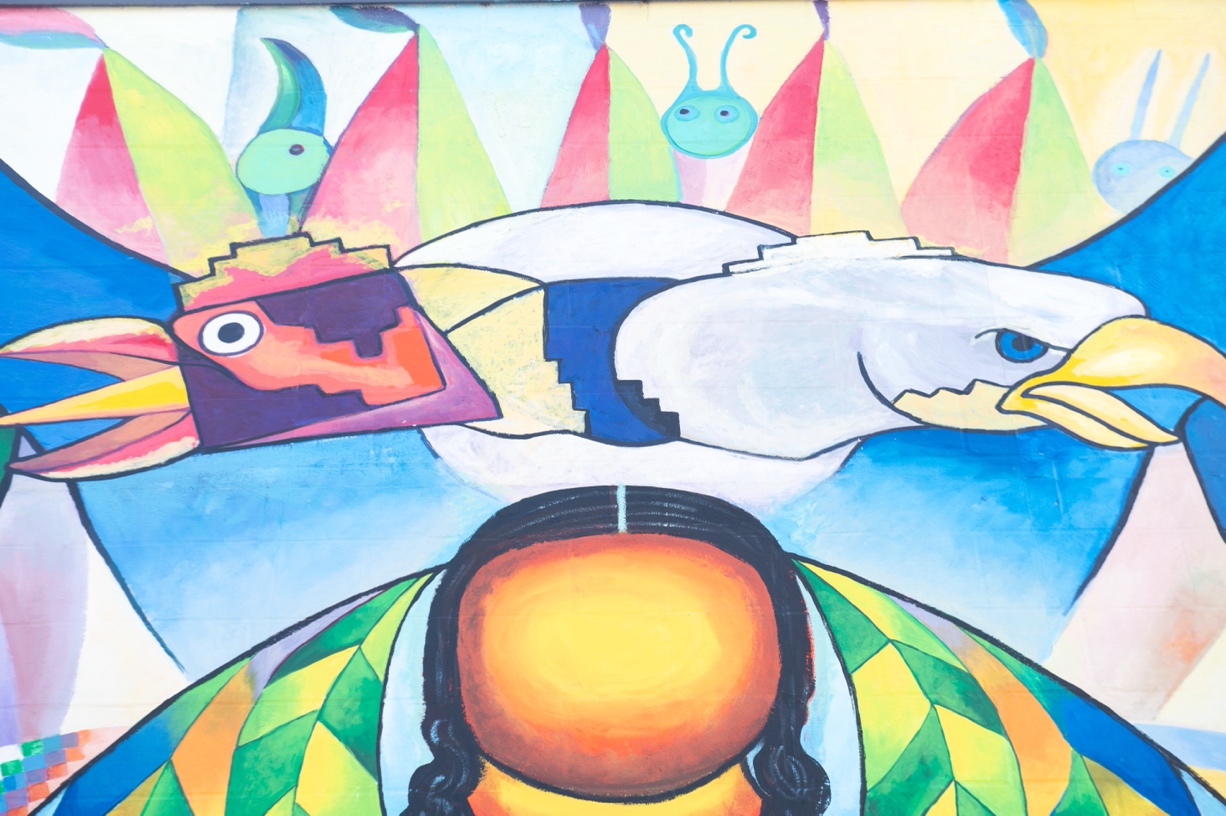
The condor is on the left and the eagle on the right. Photo by Erin Blewett.

The condor is on the left and the eagle on the right. Photo by Erin Blewett.

The wings attached to the condor (on the left side) sport the colors of the Wiphala, and the right side colors, connected to the eagle, reflect the colors of the U.S. flag. Laura González Tinoco, an art historian, who is a scholar of Mamani Mamani’s works, explains:

“The central figure of the mural represents the divinity Pachamama, surrounded by resplendent coca leaves, escorted by a double-headed bird with its wings outstretched. With this gesture, the painter expresses his good will and hopes for unity between the nations, by representing the head of the condor (South America) and the eagle (North America) fused to accompany Mother Earth. This vision corresponds to the embodiment of the popular prophecy that announces a time in which the two birds will come to meet them to accompany their flight, so that the two Americas will meet again in the mythical continent of Abya-yala.”10

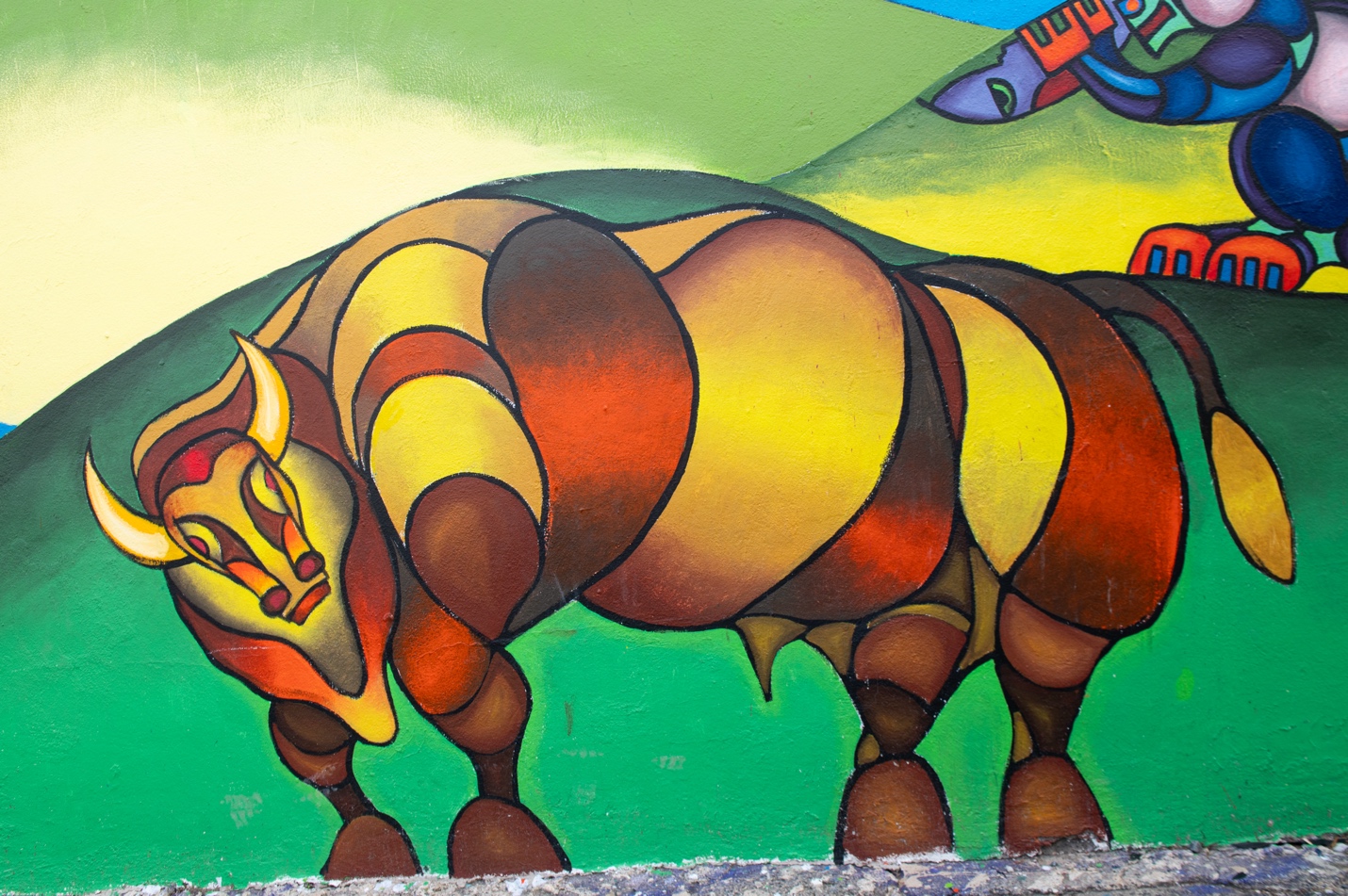
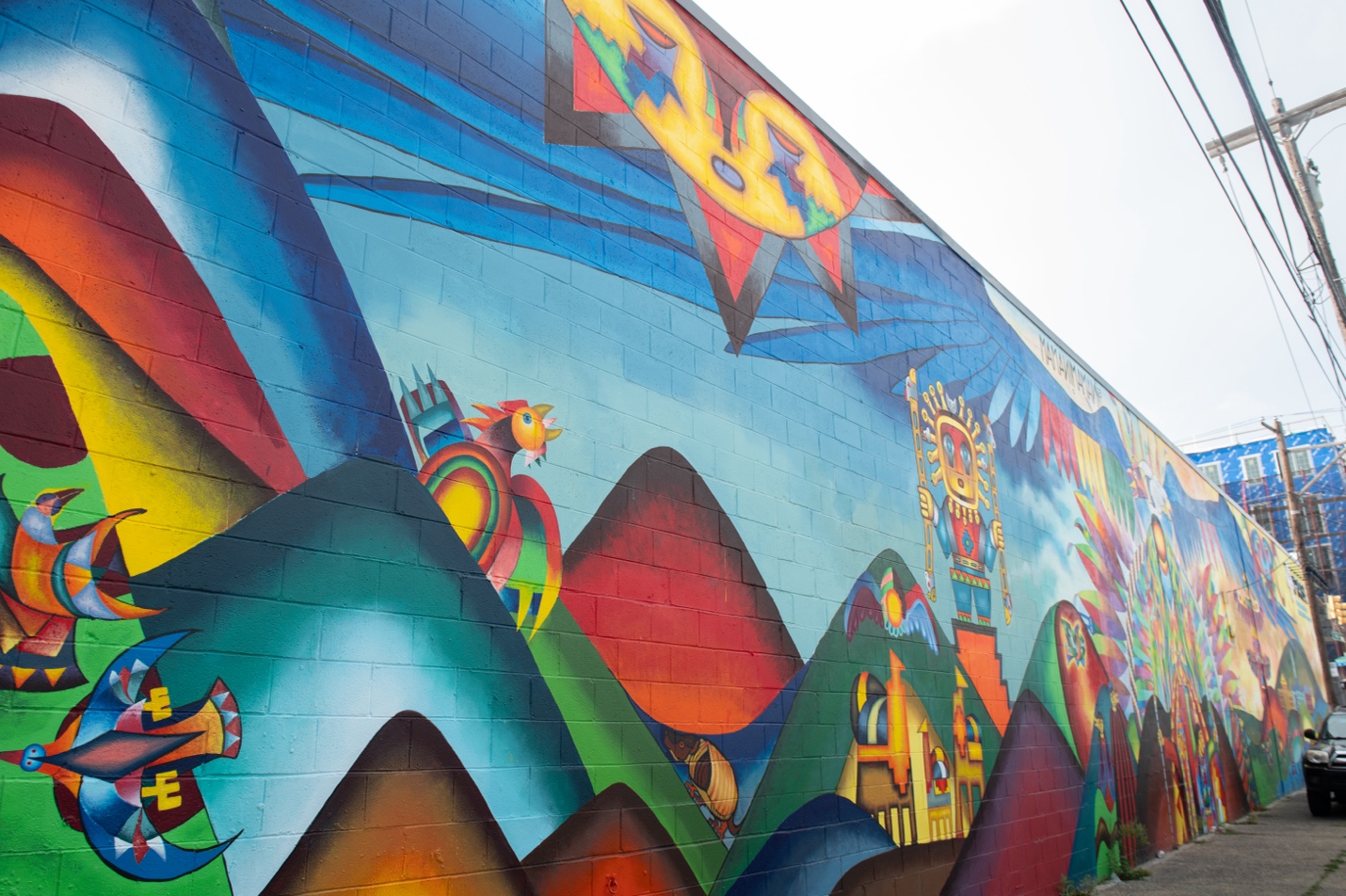
Cosmovision and animals: Mamani Mamani explains that the mural captures a cosmovision in each space, which is the encounter between the Andes and Philadelphia. The animals painted on the Philadelphia side of the mural are endemic to North America, like squirrels, bison or buffalo, wolves, deer, and owls. On the other side, you have bears, llamas, quirquinchos, and vizcachas. The mural reflects the artist’s reverence for animals and nature, including the Andean mountain ranges (on the left side of the mural).

González Tinoco underscores that “the mural also tells us about the importance of animals in the spirituality of Indigenous peoples.” For example, she explains, “the bird refers to the tutelary visit of the spirits of the ancestors, while the llama is another sacred animal” with “prominence in rituality.”11
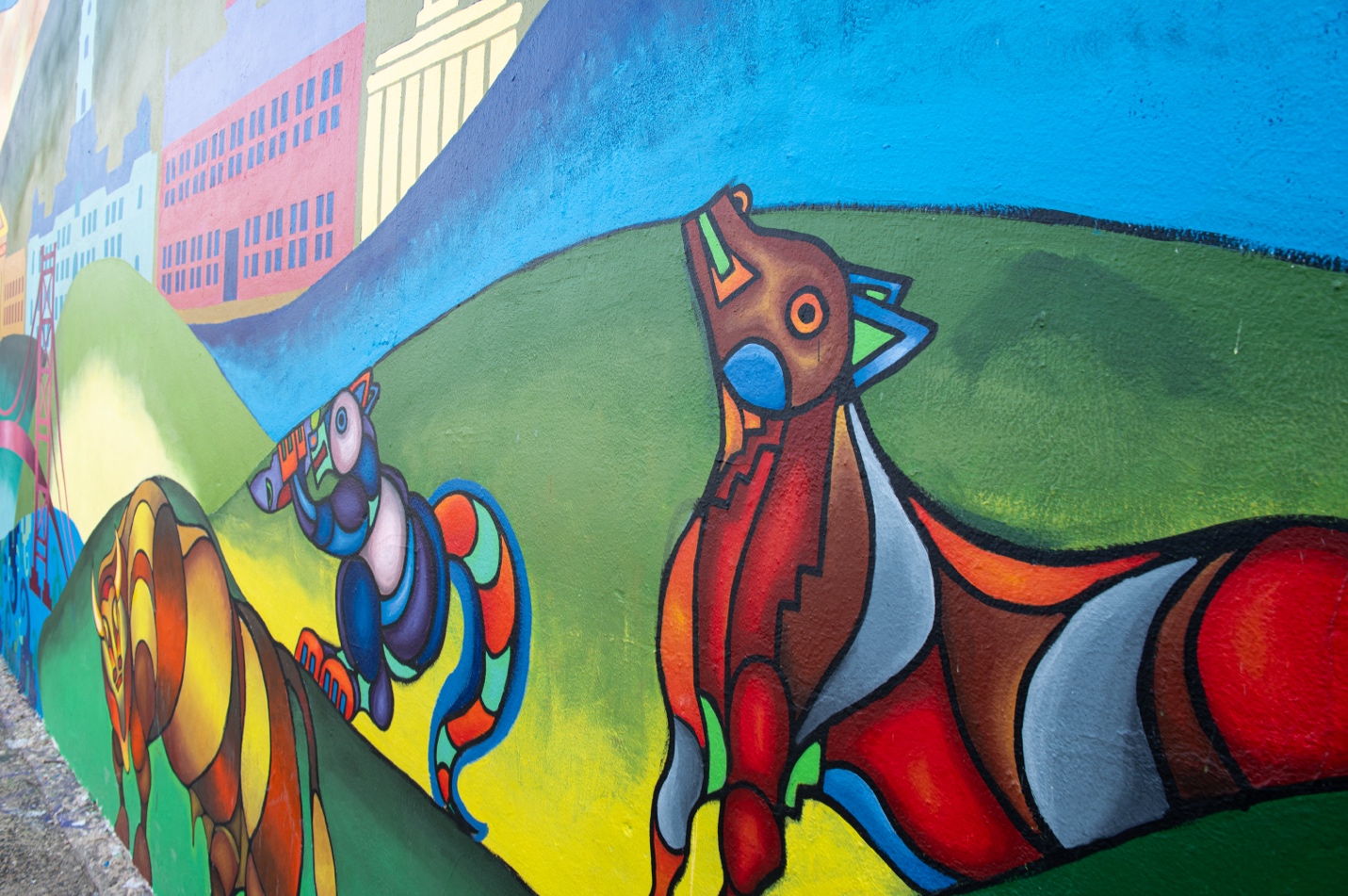
Images of animals on the Philadelphia side of the mural, including buffalo and squirrel. Photo by Erin Blewett.
Images of animals on the Philadelphia side of the mural, including buffalo and squirrel. Photo by Erin Blewett.

A bison or buffalo, native to North America. Photo by Erin Blewett.
A bison or buffalo, native to North America. Photo by Erin Blewett.

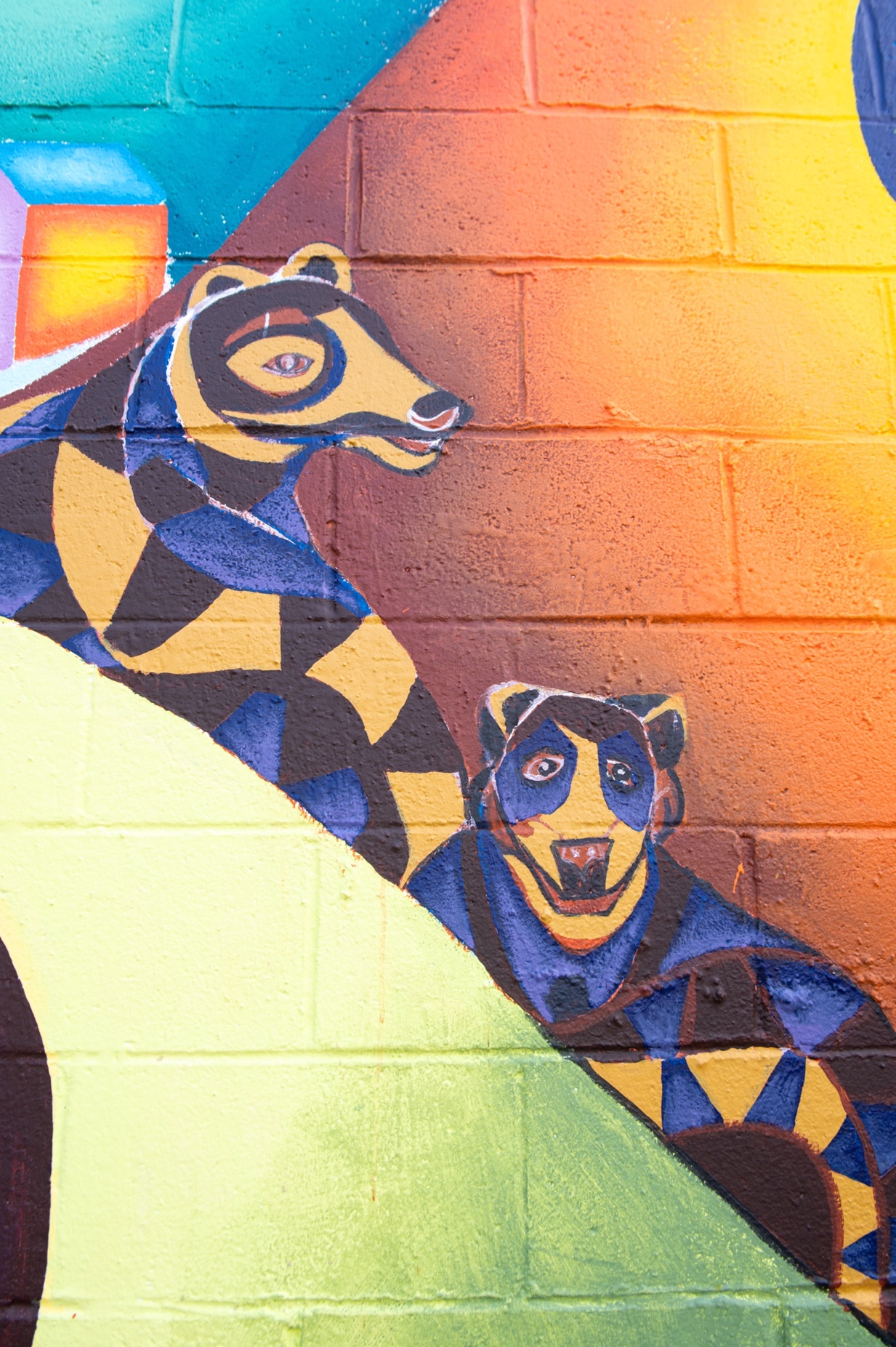
Bears, a mammal inhabiting both North and South America. Photo by Erin Blewett.
Bears, a mammal inhabiting both North and South America. Photo by Erin Blewett.

Beautiful birds, an armadillo or quirquincho and llamas, on the Andean side of the mural. Photo by Erin Blewett.

Beautiful birds, an armadillo or quirquincho and llamas, on the Andean side of the mural. Photo by Erin Blewett.

An armadillo, originally from South America—although there are now many in the United States. In 2022, Bolivia declared the endangered armadillo or the quirquincho, as part of its natural heritage to increase conservation efforts.[^12] Photo by Erin Blewett.

An armadillo, originally from South America—although there are now many in the United States. In 2022, Bolivia declared the endangered armadillo or the quirquincho, as part of its natural heritage to increase conservation efforts.[^12] Photo by Erin Blewett.

Pachamama: The central feature of the mural is the Pachamama. Pacha means earth, cosmos, universe in Quechua and Aymara, and the second part of the word, mama, means mother. She is the Goddess of nature, fertility and crops. An offering to her is an offering to the spiritual world. It’s a term that has important meaning for Indigenous people in the Andes because they see themselves as interconnected with the spiritual and natural world; they are integrated into it. According to González Tinoco, the Pachamama represents time and space, and the importance of earth and the synthesis between humans and nature.

At least 60 percent of Bolivians trace their heritage to Indigenous peoples, and offerings to the Pachamama are commonplace. These can be in the form of flowers, or pourings of drink or coca leaves onto the ground. Bolivians who are Catholic also show respect and offerings to the Pachamama.
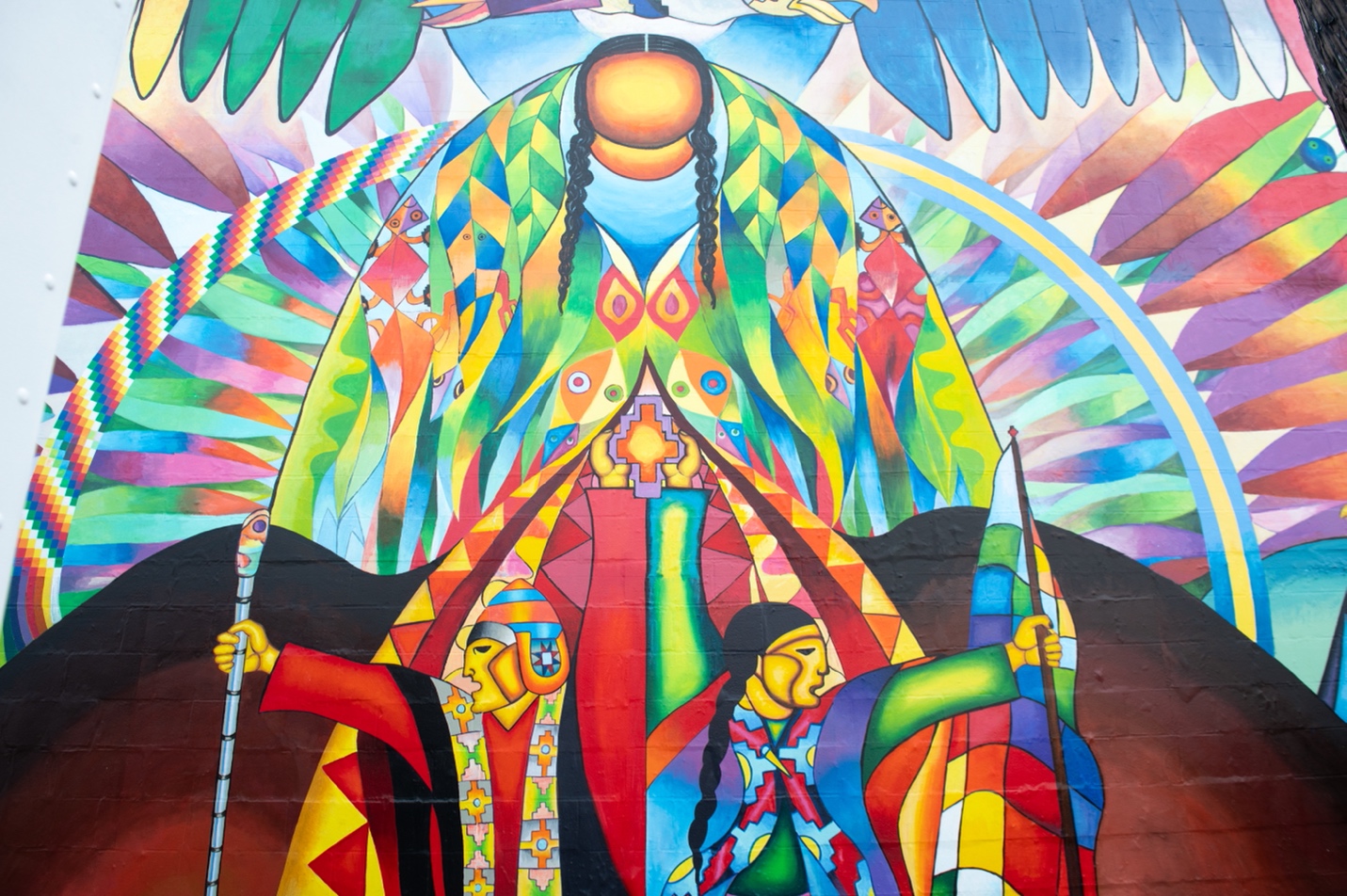
The Pachamama as depicted by Roberto Mamani Mamani. She is painted in the center of the mural, representing the powerful force of Mother Earth. Photo by Erin Blewett.

The Pachamama as depicted by Roberto Mamani Mamani. She is painted in the center of the mural, representing the powerful force of Mother Earth. Photo by Erin Blewett.

Wiphala: Known as the Andean flag, this is a squared representation of the rainbow which is considered sacred in ancient knowledge. In the present, the Wiphala also is a symbol of Indigenous pride. Many communities in the Andes reclaim the Wiphala as a representation of their culture. In the above photo, the female figure of the Chacha Warmi holds the Wiphala.

Nature: There are many elements in nature (sun, moon, thunder, etc.) that are considered part of the Pachamama. Therefore, nature cannot be reduced to commodities; it is sacred. Natural elements complement each other and have spiritual significance. This Andean cosmovision, based on respect for the earth, contributes greatly to contemporary global conversations on how to take care of the planet during times of climate change.

Coca: Coca is a sacred leaf, and it is used as an offering to Mother Earth. In fact, common offerings give coca to various levels of the spiritual world. Coca could be given as an offering for the underworld (Uju Pacha) represented by the powerful, wise serpent or Amaru; Kay Pacha (the surface world that we inhabit as humans (also known as Pacha Mama), symbolized by the mighty puma; or to Janaq Pacha (the upper world), symbolized by the soaring condor. Sometimes shamans – spiritual leaders- believe that coca leaves connect us with the gods of the three worlds.

In the mural, Roberto Mamani Mamani has painted coca leaves on both sides of the arc that adorn the Pachamama. On the left side, the arc is painted the colors of the Wiphala, and on the right side, the arc is painted the colors of the flag of the city of Philadelphia.
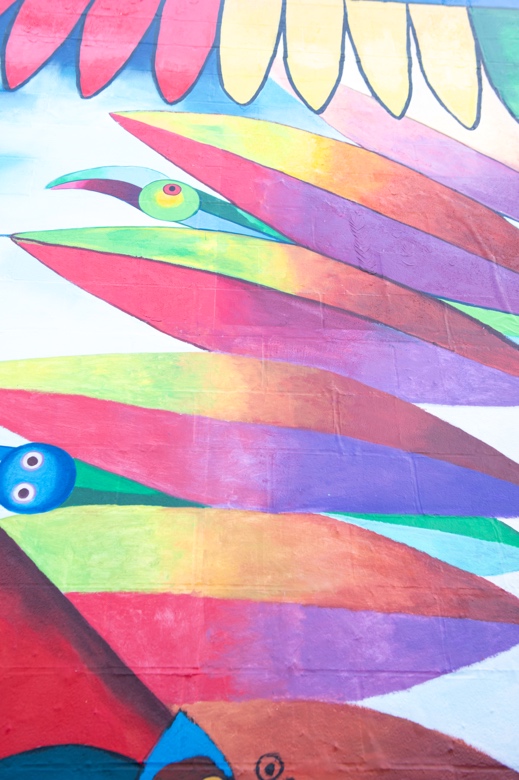
Coca leaves adorning the Pachamama. Photo by Erin Blewett.

Coca leaves adorning the Pachamama. Photo by Erin Blewett.

Inti- In the left corner, one can see Inti, who is the sun god considered the father of the Aymara people and represented by the golden sun. He is a source of warmth, light and life, and he ensures bountiful harvests and prosperity.

Mama Killa- In the right hand corner, one can see Mama Killa, or the moon goddess, who is the sister and wife of Inti. Together with other gods, they represent the foundation of Inca civilization. Mama Killa is associated with fertility, femininity, and cycles of life. She also protects women and children and is invoked during childbirth.

Chacha Warmi- These are the figures at the bottom of the Pachamama. Mamani Mamani says they represents two opposites complementing one another, or man and woman coming from the soil or the earth. The figures reveal the force from each hemisphere to convey there is equilibrium in the world and to call for respect of all that surrounds living things.

González Tinoco emphasizes that the figures reveal the transmutation of animals into people and vice versa. Symbols like the chacha puma (hombre puma) or the chachacondori (hombre condor) speak about the synthesis of humans and animals. Many legends include people who are descendants or kin to sacred animals, and thus, they are half human and half animal as living beings. Some images in the mural capture this belief of animals and humans as one.

González Tinoco further explains the historical significance of these two figures:

The image of the Pachamama houses the figures of an Indigenous man and woman who raise the command of power and the wiphala as leaders who summon the people to their call. Mamani Mamani represents the characters Tupac Katari and Bartolina Sisa as symbols of Indigenous collective rebellion against oppression. It should be remembered that Indigenous insurgency was continuous throughout Spanish colonization, with the Aymara-Quechua rebel cycle of the years 1780-1783 being a precursor to Latin American independence. Various uprisings incited by the Katari brothers, near Charcas; the Tupaq Amaru family, near Cuzco; and Tupac Katari, together with his wife Bartolina Sisa, in La Paz, meant the mobilization of the former kollasuyu against the yoke of colonialism.12

Wiracocha- On the left side of the mural, on the side of the Condor, one can see Wiracocha, or the great creator of the whole Universo Andino (Andean Universe). Rising from water, he is a teacher of the world. Wiracocha was a nomadic God with a magical, messenger bird with gold wings. Wiracocha created men by carving them in stone, and as he gave them names, they took on a life of their own and unfolded in the dark universe before the sun was created.
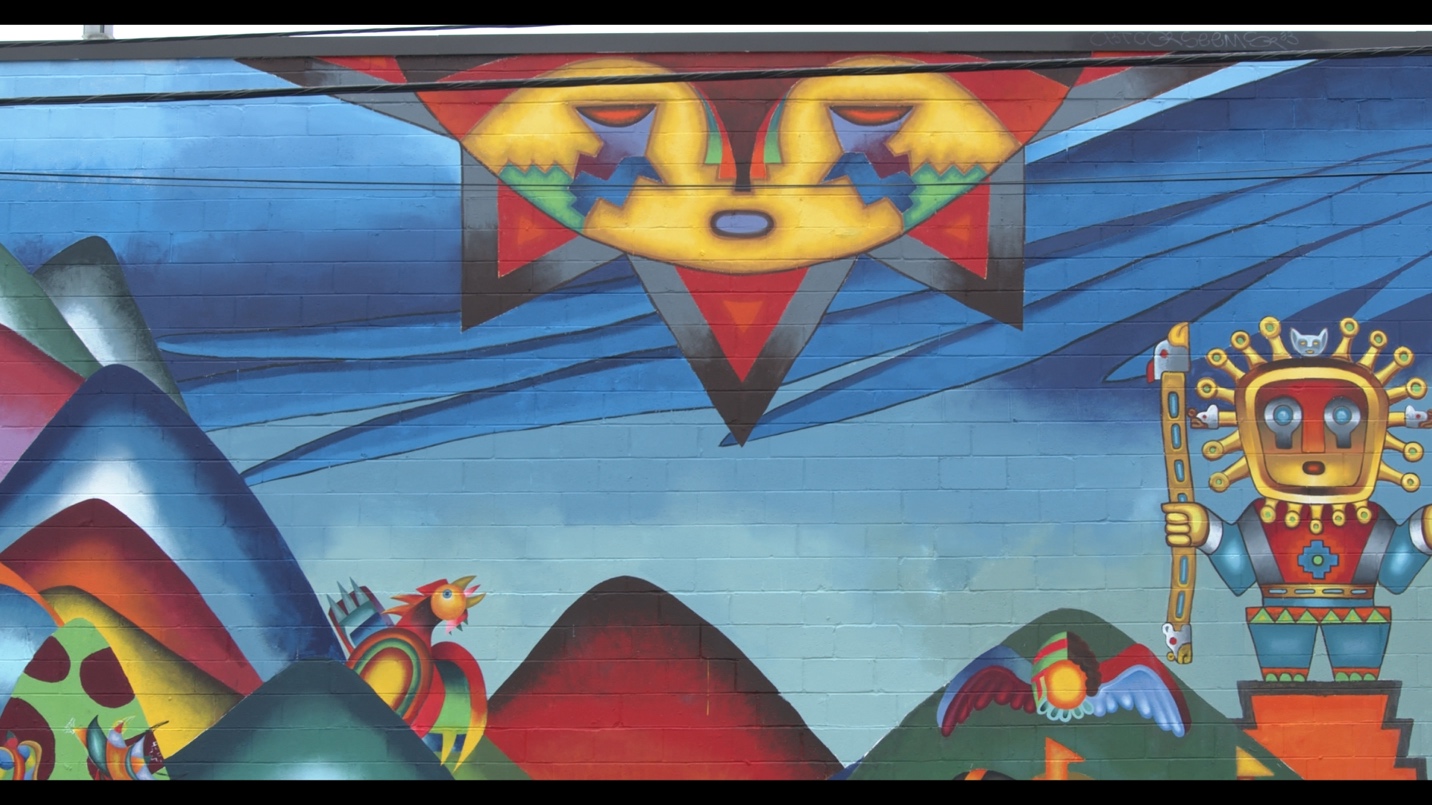
Wiracocha, with Inti, the sun god, above. Photo by Illampu Aguilar Jove.

Wiracocha, with Inti, the sun god, above. Photo by Illampu Aguilar Jove.

Inca Cross or Chakana—In the middle of the Pachamama is the very powerful symbol of Chakana, which has four quadrants and signifies “crossing over” in Quechua. It denotes the interplay between the underground, celestial, and terrestrial or human worlds, as well as the interconnectedness of virtues and values, such as honesty and work.

Symbols of Philadelphia/North America- On the right side, Mamani Mamani painted a skyline of Philadelphia, including Independence Hall, the Philadelphia Art Museum, Ben Franklin Bridge, and other historic buildings. He also included North American Native American symbols such as the Totem Pole.
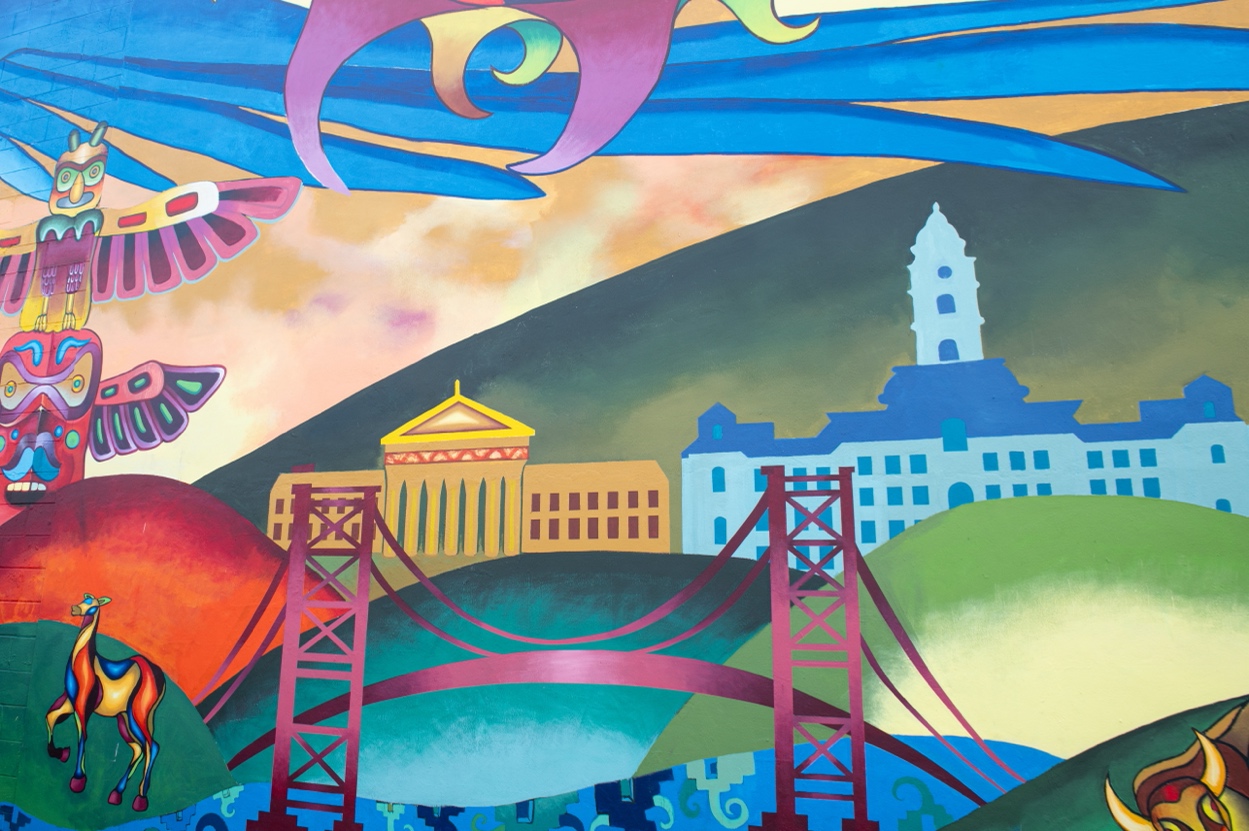
Totem Poles – These are monuments created by Native Americans in the Pacific Northwest to honor Indigenous peoples’ ancestry, history, events. Often they display beings or crest animals to capture histories of families’ rights and privileges. Philadelphia is situated within Lenapehoking, the ancestral homelands of the Lenape peoples.

As you visit the mural, please consider the following questions:

  • What do you see in the mural?

  • What can we learn from the Andean cosmovision? How may understanding the stories behind the various symbols shed light on today’s society, here in Philadelphia, abroad in Bolivia, or anywhere in the world?

  • Why do you think this mural is important for Philadelphia?

  • What else would you like to learn?

  • What other messages do you think the artist and his team were trying to convey with this mural?

  • Send us your pictures! Please send us your pictures of the mural so we can upload them on the “Jallalla” website, which serves as a repository of articles, videos, and other sources that speak to Mamani Mamani’s art and life: https://web.sas.upenn.edu/jallalla/.

Press and references related to the mural:

Acceso Total. “El artista de Bolivia Mamani Mamani muestra el aporte cultural con sus pinturas.” Noticiero 47 Telemundo. October 27, 2023. https://www.telemundo47.com/acceso-total-2/el-artista-de-bolivia-mamani-mamani-muestra-el-aporte-cultural-con-sus-pinturas/2428630/

Center for Latin American and Latinx Studies (CLALS), University of Pennsylvania. “A new mural by Bolivian artist Roberto Mamani Mamani brings the vibrant and powerful energy of the Andes to Philadelphia.” CLALS News. October 4, 2023. https://clals.sas.upenn.edu/news/new-mural-bolivian-artist-roberto-mamani-mamani-brings-vibrant-and-powerful-energy-andes

Center for Latin American and Latinx Studies (CLALS), University of Pennsylvania. “Renowned Bolivian Artist Roberto Mamani Mamani is now in town!” CLALS News. August 30, 2023. https://clals.sas.upenn.edu/news/renowned-bolivian-artist-roberto-mamani-mamani-now-town

Donnelly Johnson, Jenny. “Bolivia’s Roberto Mamani Mamani in Residence.” Mural Arts Website (blog). August 30, 2023. https://www.muralarts.org/blog/bolivias-roberto-mamani-mamani-in-residence/

García, Kristina. “Showcasing an Andean Cosmovision.” Penn Today. October 12, 2023. https://penntoday.upenn.edu/news/Mamani-Mamani-mural-andean-cosmovision-latin-american-studies

González Tinoco, Laura. La Cosmovisión andina y Mamani Mamani. El valor de la imagen como exaltación identitarian indígena. PhD dissertation. Universitat de Barcelona, 2024.

Mikati, Massarah. “Bolivia in Philadelphia: Mural Arts Commissions Renowned Artist Roberto Mamani Mamani.” Philadelphia Inquirer. October 4, 2023. https://www.inquirer.com/arts/roberto-mamino-mural-arts-bolivia-philadelphia-20231004.html

Additional references:

Anez, Arnoldo. “Ideas for Discussion for ‘Applying Andean Philosophies.’” Prepared for a Quechua@Penn and Center for Latin American and Latinx Studies talk on March 19, 2024. Includes cited text about the relationship between the Eagle and the Condor.

Brady, Christy, CPA. City Controller, City of Philadelphia. “Mapping Philadelphia’s Gun Violence Crisis.” 2024. https://controller.phila.gov/philadelphia-audits/mapping-gun-violence/#/?year=2024&map=10.00%2F40.05237%2F-75.15017

Cooper, Kenny. “Philadelphia is America’s Poorest Big City: Here’s What That Actually Means.” WHYY. January 10, 2024. https://whyy.org/articles/philadelphia-americas-poorest-big-city-poverty/#:~:text=Poverty%20is%20as%20synonymous%20with,state%20Senator%20Art%20Haywood%20said.

Ferguson, Britten. “Coca: The Sacred Leaf.” TDA Global Cycling (blog). September 23, 2015, https://tdaglobalcycling.com/2015/09/coca-the-sacred-leaf/

González, Laura Tinoco, 2024. “The value of the indigenous worldview in Mallkuanka. Colorful south-north flight” https://web.sas.upenn.edu/jallalla/. Accessed November 16, 2024.

Gudynas, Eduardo2016. “Buen Vivir: the Social Philosophy Inspiring Movements in South America. https://www.theguardian.com/sustainable-business/blog/buen-vivir-philosophy-south-america-eduardo-gudynas. Accessed November 16, 2024.

Huang, Alice. “What are Totem Poles?” Indigenous Foundations.arts.ubc.ca https://indigenousfoundations.arts.ubc.ca/totem_poles/

Jallalla: Healing and Claiming Indigeneity Through the Arts Website. https://web.sas.upenn.edu/jallalla/

Miniserie. Museo Larco. “Cosmovisión Indígena en las Américas.” https://www.museolarco.org/miniserie/cosmovision-indigena-en-las-americas/ (in English and other languages as well.)

PEW. Philadelphia 2024:The State of the City. https://www.pewtrusts.org/en/research-and-analysis/reports/2024/04/philadelphia-2024
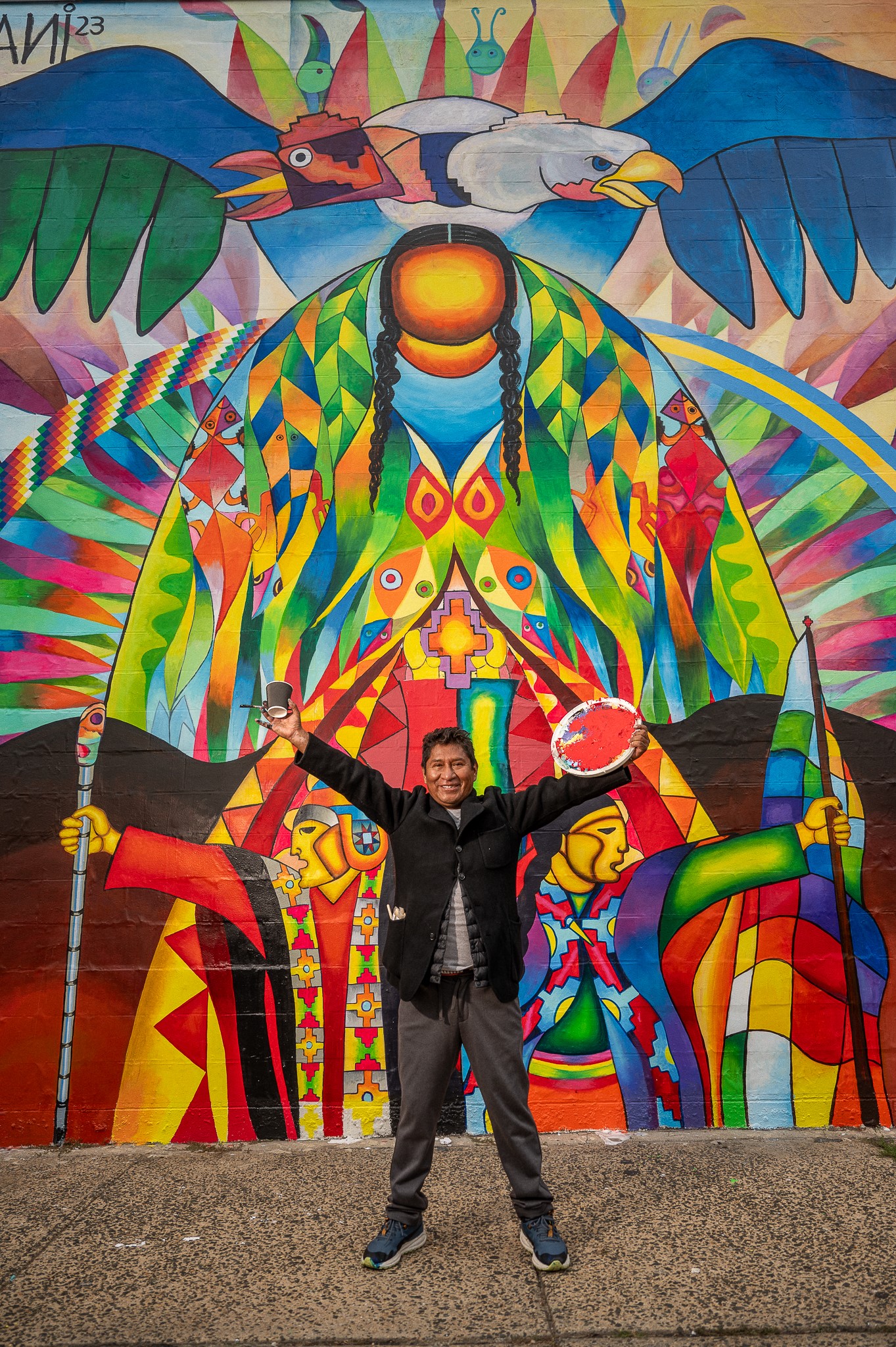
Roberto “Mamami Mamani” in front of his depiction of “Pachamamama,” on top the condor (south) and the eagle (north). Photo credit: Bryan Karl Lathrop.
Roberto “Mamami Mamani” in front of his depiction of “Pachamamama,” on top the condor (south) and the eagle (north). Photo credit: Bryan Karl Lathrop.

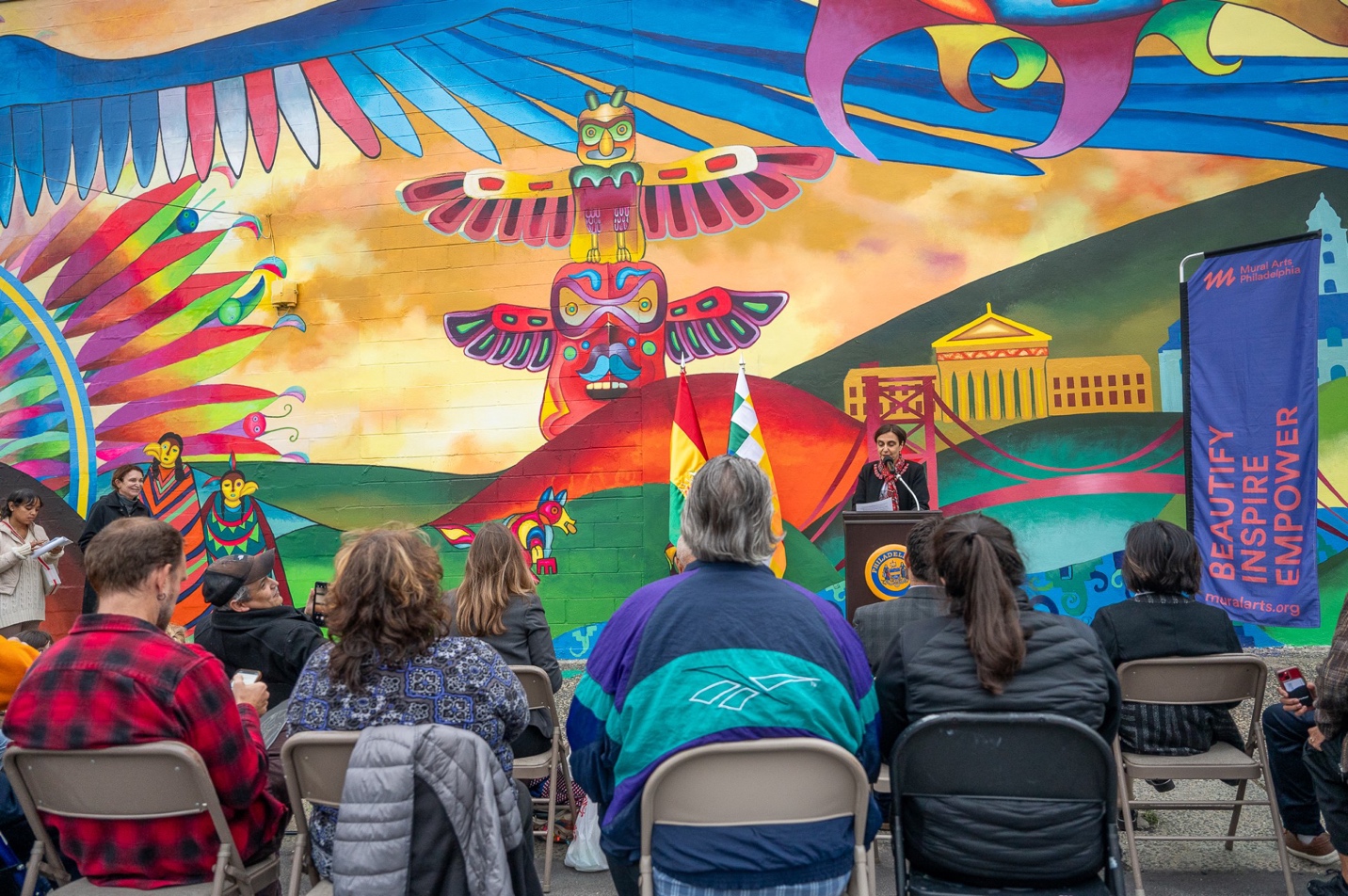
Tulia Falleti, Principal Investigator, speaking at the mural dedication. Photo credit: Bryan Karl Lathrop.
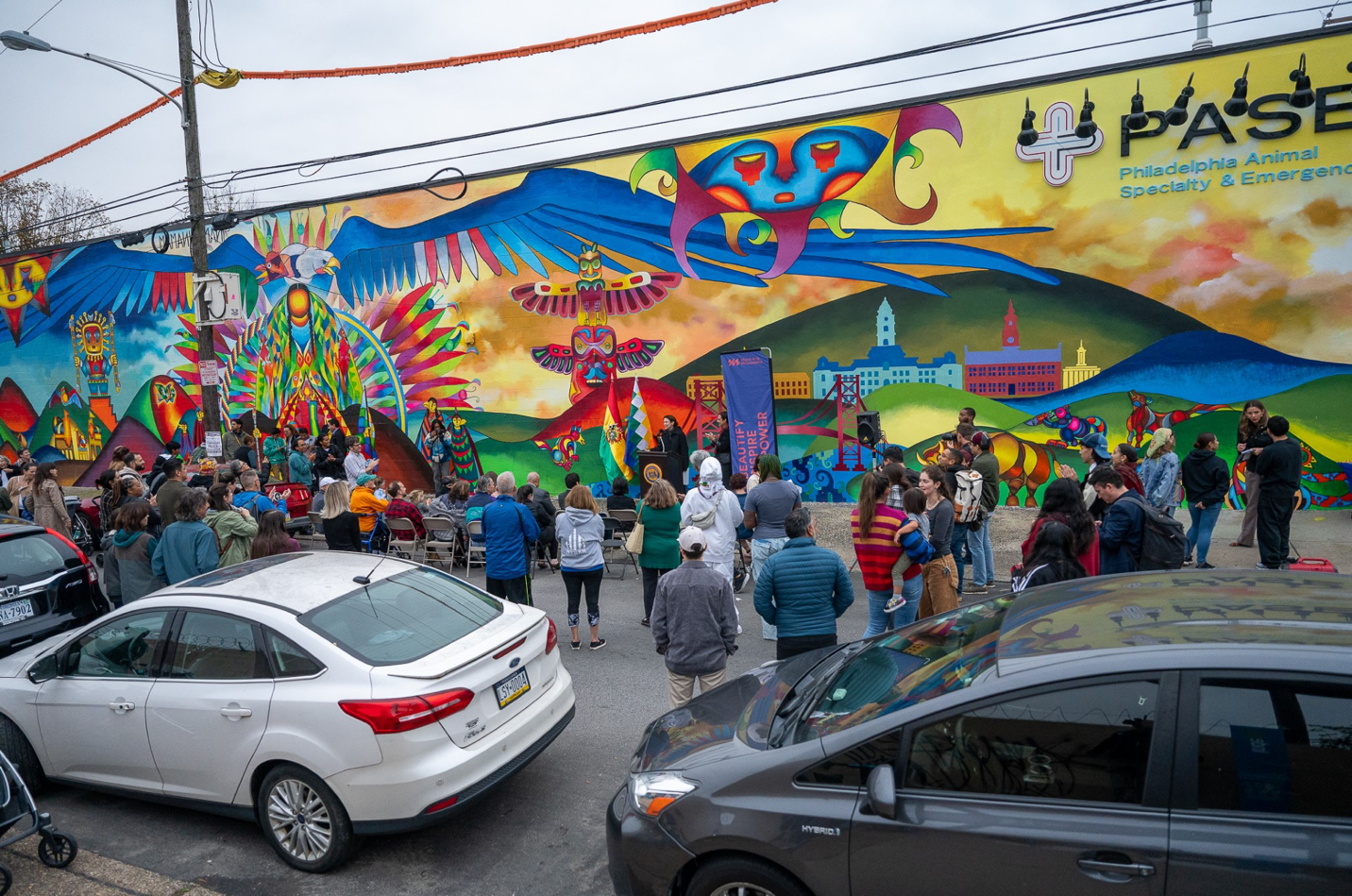
Tulia Falleti, Principal Investigator, speaking at the mural dedication. Photo credit: Bryan Karl Lathrop.

Mural dedication event, September 28, 2023.Photo credit: Bryan Karl Lathrop.
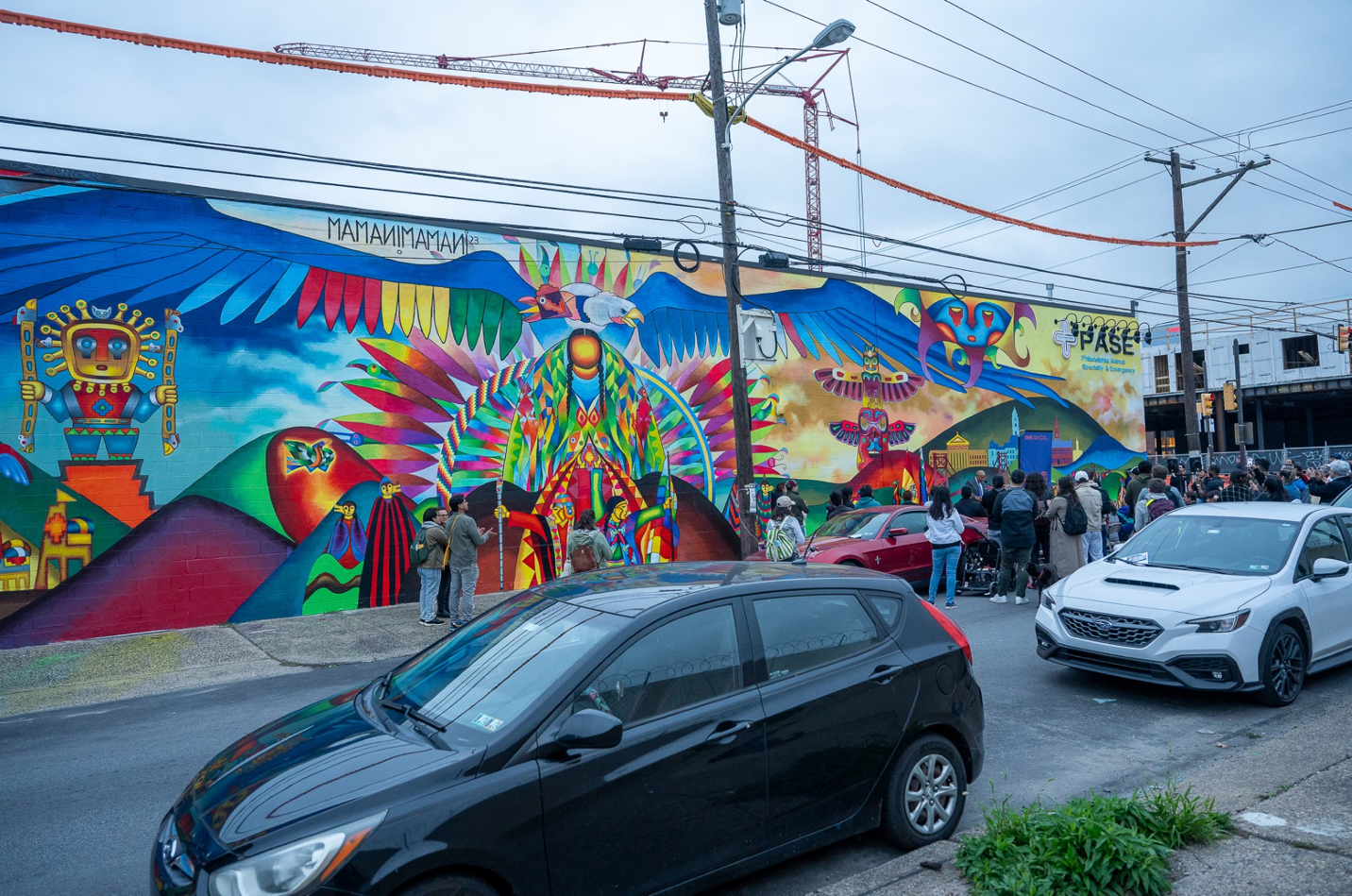
Mural dedication event, September 28, 2023.Photo credit: Bryan Karl Lathrop.

Another view of the mural (it is so large it is hard to capture in single photo!). Photo credit: Bryan Karl Lathrop.
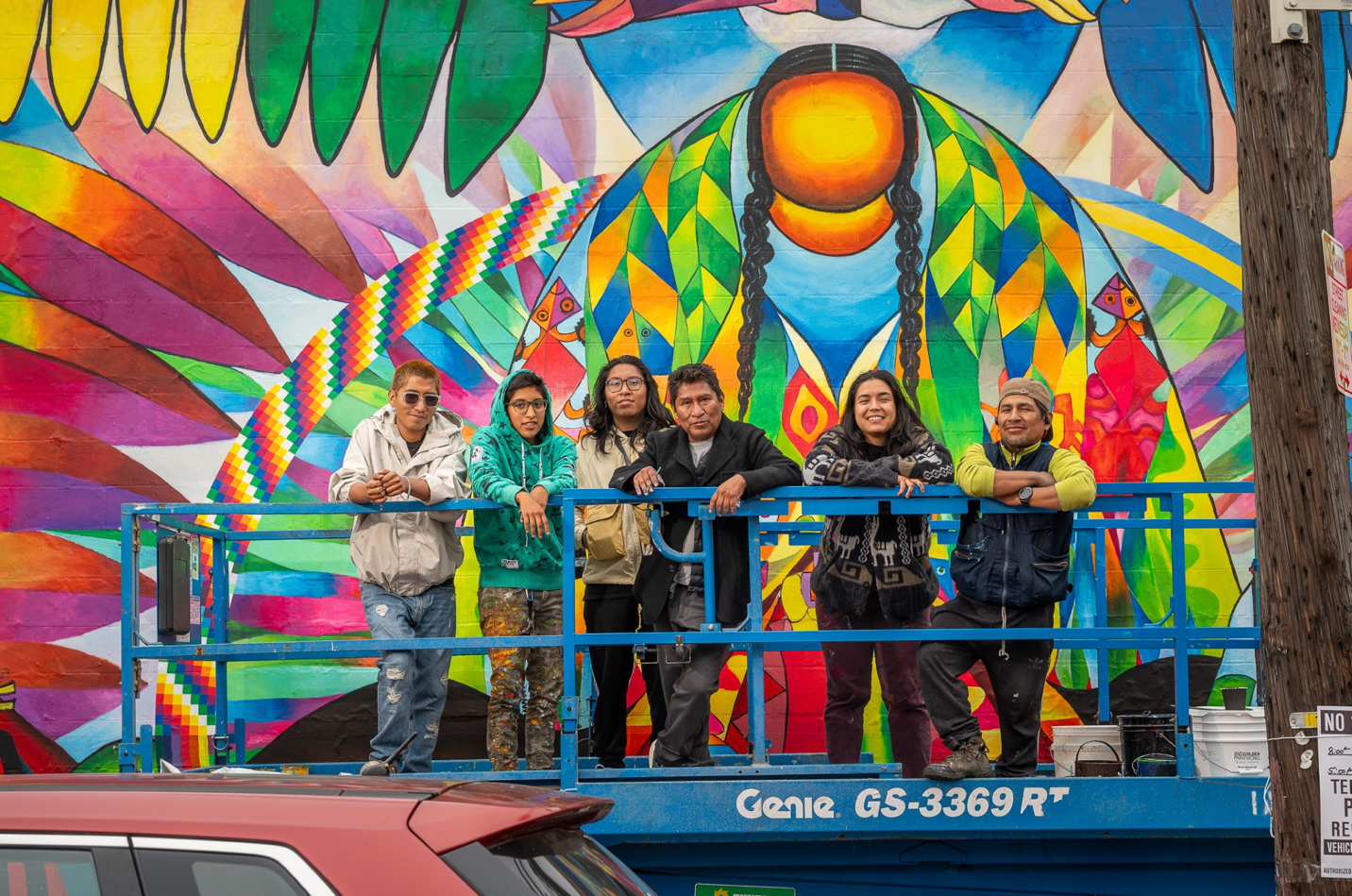
Another view of the mural (it is so large it is hard to capture in single photo!). Photo credit: Bryan Karl Lathrop.

Roberto Mamani Mamani and his collaborators. Photo credit: Bryan Karl Lathrop.

Roberto Mamani Mamani and his collaborators. Photo credit: Bryan Karl Lathrop.


  1. Many thanks to those who contributed ideas, language, editing, and images to this essay, including Américo Mendoza Mori, Arnold Arnez, Dayanna Salas, Bryan Karl Lathrop, Erin Blewett, Ann Farnsworth-Alvear, and Vivian Deidre Rodriguez-Rocha. Special thanks to Laura González Tinoco, an art historian at the University of Barcelona, for her incisive analysis of the mural. ↩︎

  2. Mural Arts Philadelphia. “About.” Accessed November 18, 2024. https://www.muralarts.org/about/ ↩︎

  3. Golden, Jane. Executive Director, Mural Arts Philadelphia. Interview by Cathy Bartch, May 30, 2024. ↩︎

  4. Jane Golden mentioned that only 15% of Mural Arts artists are national or international, as the organization is committed to supporting and commissioning the work of local artists. However, she shared how important it is to bring international artists as well. ↩︎

  5. Oliver Balch, “Buen Vivir: the social philosophy inspiring movements in South America,” The Guardian (London), February, 4, 2013, https://www.theguardian.com/sustainable-business/blog/buen-vivir-philosophy-south-america-eduardo-gudynas. ↩︎

  6. PEW, “Philadelphia 2024: The State of the City,” accessed November 17, 2024, https://www.pewtrusts.org/en/research-and-analysis/reports/2024/04/philadelphia-2024. ↩︎

  7. PEW, “Philadelphia 2024: The State of the City,” accessed November 17, 2024, https://www.pewtrusts.org/en/research-and-analysis/reports/2024/04/philadelphia-2024. ↩︎

  8. Also, poverty affects 43 percent of Indigenous peoples in Latin America, and 23 percent live in extreme poverty. World Bank, “Indigenous Latin America,” accessed November 17, 2024. https://www.worldbank.org/en/region/lac/brief/indigenous-latin-america-in-the-twenty-first-century-brief-report-page#:~:text=Poverty%20afflicts%2043%20percent%20of,people%20living%20in%20extreme%20poverty. ↩︎

  9. Patterson, Naeemah, Community Murals Support, Interview by Cathy Bartch. June 1, 2024. ↩︎

  10. Laura González Tinoco “The value of the indigenous worldview in Mallkuanka. Colorful south-north flight” https://web.sas.upenn.edu/jallalla/2024/11/. Accessed November 18, 2024. ↩︎

  11. González Tinoco,“Indigenous worldview in MallkuAnka.” ↩︎

  12. Gonzalez, “Indigenous worldview in Mallkuanka.” See also Víctor Hugo Cárdenas. “La lucha de un pueblo”, in Xavier Albó (Comp.) Raíces de América. El mundo aymara, pp. 499-500. ↩︎

Citation

Bartch, Catherine, and Roberto 'Mamani Mamani'. 2023. 'MALLKUANKA – Vuelo Surnorte de Colores/The South-North Flight of Colors'. Dispossessions in the Americas. https://dia.upenn.edu/en/content/BartchC001/
Reading in Spanish

Narrative 2023

MALLKUANKA - Vuelo Sur-Norte de Colores/The South-North Flight of Colors

  • Bartch, Catherine

  • Roberto 'Mamani Mamani'

Published: 2023

Roberto Mamani Mamani delante de su mural MALLKUANKA - Vuelo Surnorte de Colores/The South-North Flight of Colors, situado en 2100 Washington Avenue, Filadelfia, PA, en el lado este del edificio Philadelphia Animal Specialty and Emergency (PASE). Fotografía: Bryan Karl Lathrop.

Roberto Mamani Mamani delante de su mural MALLKUANKA - Vuelo Surnorte de Colores/The South-North Flight of Colors, situado en 2100 Washington Avenue, Filadelfia, PA, en el lado este del edificio Philadelphia Animal Specialty and Emergency (PASE). Fotografía: Bryan Karl Lathrop.

Reading in Portuguese

Narrative 2023

MALLKUANKA – Vuelo Sur-Norte de Colores/O voo Sul-Norte das Cores: um mural por Roberto Mamani Mamani

  • Bartch, Catherine

  • Roberto 'Mamani Mamani'

Published: 2023

Roberto Mamani Mamani em frente ao seu mural MALLKUANKA – Vuelo Sur-Norte de Colores/ O voo Sul-Norte das Cores, na Avenida Washington, 2100, Filadélfia, PA, no lado leste do prédio do *Philadelphia Animal Specialty and Emergency* (PASE). Fotografia por Bryan Karl Lathrop.

Roberto Mamani Mamani em frente ao seu mural MALLKUANKA – Vuelo Sur-Norte de Colores/ O voo Sul-Norte das Cores, na Avenida Washington, 2100, Filadélfia, PA, no lado leste do prédio do Philadelphia Animal Specialty and Emergency (PASE). Fotografia por Bryan Karl Lathrop.

Resumo

O que é o MALLKUANKA- Vuelo Surnorte De Colores/ O voo Sul-Norte das Cores?

Como imaginamos encontros dos povos do sul e do norte? Como promovemos conexões entre a América do Sul e a América do Norte, ou América Latina e os EUA? O renomado artista boliviano e aimará, Roberto Mamani Mamani, junto a um grupo de pessoas da Bolívia e da Filadélfia, criou e pintou o vibrante mural MALLKUANKA – Vuelo Sur-Norte de Colores/O voo Sul-Norte de Cores em Filadélfia, PA, como forma de representar a unidade. A beleza do mural ressalta as inter-relações entre as pessoas e a natureza de modo a transcender fronteiras.

MallkuAnka retrata paisagens andinas e da Filadélfia, usando cores para mapear encontros entre culturas e seres. O mural harmoniza as dualidades que emergem dos encontros: o condor (sul), e a águia (norte), a cidade e as montanhas, o sol e a lua, o que é terreno e o que é sagrado. Pintado no lado de uma clínica veterinária (PASE), numa longa parede (39,6 metros de largura por 6,1 metros de altura), animais representando a América do Sul e a América do Norte reúnem ambas as culturas sob o amparo da Pachamama, ou Mãe Terra – a figura central do mural. A concepção da obra retrata a importância da unidade entre os dois hemisférios, com o voo sul-norte do condor e da águia, e como os povos de ambos os hemisférios podem viver em harmonia, respeitando a Pachamama, e tudo o que ela simboliza, incluindo a energia e a vida.

Na criação de MALLKUANKA - Vuelo Sur-Norte de Colores/O Voo Sul-Norte das Cores, Mamani Mamani foi auxiliado por Yod Ruben Quisbert Quispe, Ilampu Adhemar Aguilar Jove, Ilimani Gabriel Aquilar Jove, Emmanuel Amaru Aquilar Jove e Mara Henao.1

Quem é Roberto Mamani?

Roberto Mamani Mamani é um artista e muralista aimará internacionalmente aclamado de La Paz e Cochabamba, na Bolívia. Seu trabalho vívido e extraordinário retrata símbolos da tradição indígena andina e da cosmovisão, ou visão de mundo, transmitindo força, orgulho e um compromisso com uma vida sustentável, pacífica e espiritual. Ele entrelaça temas históricos, tais como o impacto da colonização e como a comunidade Aimará-Quechua, depois de anos de marginalização e opressão, lutou por uma identidade coletiva fortalecida na região. Um artista autodidata, Mamani Mamani exibiu suas obras em aproximadamente 60 exposições em todo o mundo, incluindo Argentina, Brasil, Estados Unidos, México, Itália, França e Reino Unido. Ele participou das Exposições Mundiais (World Expos) e da La Biennale Di Venezia/ Exposição internacional de Arte na Itália, e recebeu inúmeros reconhecimentos nacionais e internacionais ao longo dos anos. Além disso, Mamani Mamani pintou murais gigantescos, com 12 andares de altura, no projeto habitacional comunitário de Wiphala, em El Alto na Bolívia, uma cidade adjacente a La Paz.

Sua arte dá vida ao espirito do “Buen Vivir” (ou Sumak Kawsay em quéchua), um movimento e filosofia inspirados pela cosmovisão andina, que prega uma vida em harmonia com a comunidade e o meio ambiente, e rejeita o capitalismo e o consumismo desenfreado e irrestrito. Desde muito jovem, Mamani Mamani começou a criar arte em sua cidade natal de Cochabamba, e, ao longo de sua carreira, os princípios do Buen Vivir e de toda cosmovisão andina guiaram seu trabalho e sua paixão artística. Ele saúda a todos com “Jallalla: toda la energia de los Andes” ou “que toda a energia dos Andes esteja com você”.

Por que criar esse mural na Filadélfia?

A magnífica obra de arte do mural foi produzida por Mamani Mamani como parte do projeto Penn-Mellon Desapropriação nas Américas, com o apoio organizacional do Centro de Estudos Latino-Americanos e Latinos da Universidade de Pensilvânia, do Programa Sachs para Inovação nas Artes, e do Mural Arts Philadelphia*.***

O Mural Arts Philadelphia é “dedicado à crença de que a arte provoca mudanças.” Os entre 50 a 100 projetos públicos de arte, liderados anualmente pelo Mural Arts são produzidos por meio de um processo participativo, que tem como objetivo “criar arte que transforma espaços públicos e vidas individuais”.

“Mural Arts Philadelphia imagina um mundo onde todas as pessoas tenham uma voz ativa no futuro e de suas vidas e comunidades; onde a arte e a prática criativa são respeitadas como fundamentais para o senso de identidade e pertencimento; e onde o vigor cultural reflita e honre todas as identidades e experiências humanas.”2

O Mural Arts também enfatiza o conhecimento baseado em investigação e colaboração respeitosa e atenta. Sua programação abrange justiça restaurativa, educação artística e engajamento cívico.

Esse projeto universitário-comunitário colaborativo representa uma oportunidade relativamente rara. Na realidade, em uma entrevista com Jane Golden, Diretora Executiva do Mural Arts, ela menciona que as parcerias universitárias com o Mural Arts tem sido poucas, e que ela pode “contar nos dedos de uma só mão”. 3 A iniciativa MallkuAnka também forneceu uma oportunidade de convidar um artista internacional para Filadélfia, que “aspira a ser uma cidade global”.4

Os temas e as imagens do mural são relevantes para comunidades ao redor do mundo. Por exemplo, o “Buen Vivir” (Sumak Kawsay em quéchua) enfatiza que “o sujeito do bem-estar não é o indivíduo, mas o indivíduo em um contexto social de sua comunidade e em uma situação ambiental única” diz Eduardo Gudyana, um pesquisador sênior no Centro Latino-Americano de Ecologia Social. 5 Filadélfia ainda mantém o maior índice de pobreza entre as maiores cidades dos Estados Unidos, com uma média de 21,7% de pessoas vivendo na pobreza, chegando a 33% entre os hispânicos e 35% entre os adultos que não completaram o ensino médio, de acordo com a Fundação Pew .6 A cosmovisão andina, com o conceito de “Buen Vivir”, é importante para a Filadélfia e outras cidades semelhantes, em todo o mundo, que enfrentam pobreza, racismo, violência armada e outros problemas sociais que ameaçam a saúde, o bem-estar e a comunidade.

O mural também destaca a importância da diversidade na Filadélfia. 16% das aproximadamente 1,5 milhão de pessoas que vivem na Filadélfia se identificam como latinos ou hispânicos.7 É igualmente importante que o mural capte a relevância dos povos indígenas e de suas filosofias, porque as narrativas sobre os mesmos, encontradas na educação, por líderes ou nos meios de comunicação em massa, frequentemente propagam estereótipos nocivos e discriminatórios.

Naeemah Patterson, uma das coordenadoras do projeto do mural MallkuAnka junto com o Mural Arts Philadelphia, explicou que o MallkuAnka transmite a mensagem “nós estamos aqui”, incluindo todos que são indígenas, latino-americanos ou que encontram significado na cosmovisão andina. “É um sinal grande, claro e óbvio que nós estamos aqui, para que crianças possam ver e se identificar com isso, e que os idosos possam ver e se sentir valorizados e bem-vindos.”

Explorando mais a fundo o mural MallkuAnka e seus símbolos:

O condor e a águia: De acordo com Mamani Mamani, Mallku, ou condor em aimará, representa autoridade, e é um guia espiritual dos Andes. Anka é águia em quéchua, a ave majestosa da América do Norte. O subtítulo do mural se refere ao voo do sul para o norte, e o artista usa muitas cores diferentes para reconhecer que somos todos iguais, que podemos caminhar juntos, e a união do condor e da águia representa isso. A Pachamama demonstra felicidade e tristeza por seus filhos, e reflete que todos os seres estão vivos – não apenas humanos, mas também as plantas, animais e outras criaturas.

O condor representado à esquerda e a águia à direita. Fotografia por Erin Blewett.

O condor representado à esquerda e a águia à direita. Fotografia por Erin Blewett.

As asas ligadas ao condor (no lado direito) exibem as cores da bandeira Wiphala, e as do lado direito, ligadas à águia, refletem as cores da bandeira dos EUA. Laura Gonzáles Tinoco, uma historiadora de arte e estudiosa do trabalho de Mamani Mamani explica:

“A figura central do mural representa a divindade Pachamama, rodeada por folhas de coca radiantes, acompanhada de um pássaro de duas cabeças com as asas estendidas. Com esse gesto, o pintor expressa sua benevolência e esperança para a uma unidade entre as nações, ao representar a cabeça do condor (América do Sul) e da água (América do Norte) em fusão para acompanhar a Mãe Terra. Essa visão corresponde à incorporação da profecia popular que anuncia um tempo em que as duas aves virão ao seu encontro para acompanhar seu voo, de modo que as duas Américas vão se encontrar novamente no místico continente de Abya-yala” 8

Cosmovisão e os animais: Mamani Mamani explica que o mural capta a cosmovisão em cada região, ou seja, o encontro entre os Andes e a Filadélfia. Os animais pintados no lado da Filadélfia do mural são endêmicos da América do Norte, como os esquilos, bisões ou búfalos, lobos, veados e corujas. Do outro lado, temo ursos, lhamas, os quirquinchos (tatu chileno) e os viscachas. O mural reflete a reverência do artista pelos animais e pela natureza, incluindo a Cordilheira dos Andes (do lado esquerdo do mural).

González Tinoco enfatiza que “o mural também nos mostra sobre a importância dos animais na espiritualidade dos povos indígenas”. Por exemplo, ela explica que “o pássaro se refere ao amparo da visita dos espíritos ancestrais, enquanto a lhama é outro animal sagrado” com “destaque na ritualidade”

Imagem dos animais do mural do lado da Filadélfia, incluindo o búfalo e o esquilo. Fotografia por Erin Blewett.

Imagem dos animais do mural do lado da Filadélfia, incluindo o búfalo e o esquilo. Fotografia por Erin Blewett.

Um bisão ou búfalo, nativo da América do Norte. Fotografia por Erin Blewett.

Um bisão ou búfalo, nativo da América do Norte. Fotografia por Erin Blewett.

Ursos, um mamífero que habita ambas as Américas do Sul e do Norte. Fotografia por Erin Blewett.

Ursos, um mamífero que habita ambas as Américas do Sul e do Norte. Fotografia por Erin Blewett.

Lindos pássaros, um tatu, ou quirquincho, e lhamas, do lado Andino do mural. Fotografia por Erin Blewett.

Lindos pássaros, um tatu, ou quirquincho, e lhamas, do lado Andino do mural. Fotografia por Erin Blewett.

Um tatu, originariamente da América do Sul – embora existam muitos agora nos Estados Unidos. Em 2022, a Bolívia declarou o tatu, ou quirquincho, ameaçado de extinção, como patrimônio natural do país, para aumentar sua conservação. Fotografia por Erin Blewett.

Um tatu, originariamente da América do Sul – embora existam muitos agora nos Estados Unidos. Em 2022, a Bolívia declarou o tatu, ou quirquincho, ameaçado de extinção, como patrimônio natural do país, para aumentar sua conservação. Fotografia por Erin Blewett.

Pachamama: A protagonista central do mural é a Pachamama. Pacha significa terra, cosmo, universo em quéchua e aimará. E a outra parte da palavra, mama, significa mãe. Ela é a deusa da natureza, da fertilidade e da colheita. Uma oferenda a ela é uma oferenda ao mundo espiritual. É um termo que possui um significado importante para os povos indígenas e para os Andes porque eles se veem interconectados com o mundo espiritual e terreno, eles estão integrados. De acordo com González Tinoco, a Pachamama representa o tempo e o espaço, a importância da terra e a síntese entre o ser humano e a natureza.

Pelo menos 60% dos Bolivianos possuem suas origens oriundas de povos indígenas, e destinar oferendas para a Pachamama é uma prática comum, e elas podem ser em forma de flores, ao servir bebidas ou deixando folhas de coca no solo. Os bolivianos que são católicos também mantêm o respeito pela Pachamama e realizam suas oferendas.

.

A Pachamama, representada por Roberto Mamani Mamani. Ela foi pintada no centro do mural, simbolizando a força poderosa da Mãe Terra. Fotografia por Erin Blewett.

A Pachamama, representada por Roberto Mamani Mamani. Ela foi pintada no centro do mural, simbolizando a força poderosa da Mãe Terra. Fotografia por Erin Blewett.

**
Whipala:** Conhecida como a bandeira andina, é uma representação quadriculada do arco-íris, que é considerado sagrado na sabedoria ancestral. Atualmente, a Whipala também simboliza o orgulho indígena. Muitas comunidades indígenas nos Andes afirmam que a Whipala é uma representação de sua cultura. Na fotografia acima, a figura feminina de Chacha Warmi segura a bandeira Whipala.

Natureza: São muitos os elementos da natureza considerados parte da Pachamama, como o sol, a lua, o trovão, etc., sendo assim, ela não pode ser reduzida a commodities, ela é sagrada. Os elementos naturais são complementares e possuem significado espiritual. Essa cosmovisão andina, baseada no respeito pela terra, é de grande contribuição para as questões atuais globais quanto à mudança climática e como cuidar do planeta nesse cenário.

Coca: A coca é uma folha sagrada usada como oferenda para a Mãe Terra. Na realidade, em oferendas comuns, a coca é oferecida para vários níveis do mundo espiritual. A folha sagrada pode ser ofertada para o submundo (Uju Pacha), representado pela poderosa e sábia serpente, ou Amaru; para a Kay Pacha – o mundo da superfície, também conhecido como Pachamama, habitado por nós, humanos – representado pelo imponente puma; ou para o Janaq Pacha (o mundo superior), representado pelo voo do condor. Em algumas ocasiões os shamans, ou líderes espirituais, consideram as folhas de coca capazes de nos conectar com os deuses dos três mundos.

No mural, Roberto Mamani Mamani pintou as folhas de coca nos dois lados do arco que enfeita a Pachamama. No lado esquerdo, o arco foi pintado com as cores da bandeira Whipala, e no lado direito com as cores da bandeira da Filadélfia.

Folhas de coca que enfeitam a Pachamama. Fotografia por Erin Blewett.

Folhas de coca que enfeitam a Pachamama. Fotografia por Erin Blewett.

Inti- No canto esquerdo, podemos ver o Inti, o deus do sol considerado o pai do povo Aimará e representado pelo sol brilhante. Ele é a fonte de calor, luz e vida, além de garantir colheitas abundantes e prosperidade.

Mama Killa- No canto direito está a Mama Killa, ou a deusa da lua, que é a irmã e a esposa de Inti e, junto aos outros deuses, eles representam a fundação da civilização Inca. A Mama Killa é associada à fertilidade, feminilidade e aos ciclos da vida, ela também protege mulheres e crianças e é a ela a quem se recorre durante o parto.

Chacha Warmi- Essas figuras se encontram abaixo da Pachamama. Mamani Mamani explica que eles representam dois opostos que se complementam ou homem e mulher vindos do solo ou da terra. As figuras revelam a força de cada hemisfério para anunciar que há equilíbrio na Terra e fazem um apelo para respeitar todos os seres vivos ao nosso redor.

González Tinoco enfatiza que as figuras de Chacha Warmi representam a transmutação de animais em pessoas e vice versa. Símbolos como o chacha puma (hombre puma) ou o chachacondori (hombre condor) transmitem a união entre humanos e animais. Muitas lendas incluem personagens que são descendentes ou parentes dos animais sagrados, e mais ainda, são seres vivos metade humanos e metade animais. Algumas imagens do mural demonstram essa crença de animais e humanos como um só.

González Tinoco explica mais profundamente o significado histórico dessas duas figuras:

A imagem da Pachamama abarca as figuras de um homem e de uma mulher indígenas que erguem o poder de comando e a whipala como líderes que convocam o povo ao seu chamado. Mamani Mamani representa as figuras de Tupac Katari e Bartolina Sisa como símbolos da rebelião coletiva indígena contra a opressão. Lembrando que as insurgências indígenas eram contínuas durante a colonização espanhola, sendo o ciclo rebelde de Aimará-Quechua, dos anos de 1780 a 1783, o precursor da independência Latino-Americana. Várias revoltas iniciadas pelos irmãos Katari, na região de Charcas, pela família Tupaq Amaru, próximo à região de Cuzco, e por Tupac Katari, junto à sua esposa Bartolina Sisa, em La paz, foram importantes para a mobilização do antigo kollasuyu contra o peso do colonialismo.9

Wiracocha- Na lateral esquerdo do mural, ao lado do condor, se encontra o Wiracocha, ou o grande criador de todo o Universo Andino. Surgindo da água, ele é o professor do mundo. Wiracocha foi um deus nômade com um pássaro mensageiro mágico de asas douradas. Ele criou os homens entalhando-os na pedra, e, enquanto os nomeava, eles se tornavam independentes e se desdobravam no universo escuro antes da criação do sol.

Wiracocha junto ao Inti, o deus sol, acima. Fotografia por Illampu Aguilar Jove.

Wiracocha junto ao Inti, o deus sol, acima. Fotografia por Illampu Aguilar Jove.

Cruz Inca ou Chakana- No meio da Pachamama há um símbolo muito poderoso do Chakana, composto de quatro quadrantes e significa “atravessar” em quéchua. O símbolo denota a interação entre os mundos subterrâneo, celestial e terrestre (ou humano), assim como a interconexão de virtudes e valores como honestidade e trabalho.

Símbolos da Filadélfia/América do Norte- Na lateral direita, Mamani Mamani pintou o horizonte da Filadélfia, contendo o Independece Hall, o Museu de Arte de Filadélfia, a Ponte Benjamin Franklin e outros prédios históricos. Ele também incluiu símbolos dos nativos Norte-Americanos, como o Poste Totêmico.

Postes Totêmicos – São monumentos criados pelos Povos Indígenas do Noroeste do Pacífico, para honrar os eventos, os ancestrais e a história dos povos indígenas. É frequente a exibição de seres ou emblemas de animais para registrar as histórias por trás dos direitos e privilégios familiares. A Filadélfia se situa dentro de Lenapehoking, a terra natal ancestral do povo Lenape.

Ao visitar o mural, considere as seguintes questões:

  • O que você vê no mural?

  • O que podemos aprender com a cosmovisão andina? Como o entendimento das narrativas por trás desses diversos símbolos pode trazer uma compreensão pra a sociedade atual, na Filadélfia, na Bolívia ou em qualquer lugar do mundo?

  • Por que você acha que esse mural é importante para a Filadélfia?

  • Sobre o que mais você gostaria de aprender?

  • Quais outras mensagens você acha que o artista e seu time estavam querendo transmitir com esse mural?

  • Envie-nos suas fotos! Por favor, nos envie suas fotos do mural para que possamos coloca-las no site “Jallalla”, que funciona como o repositório de artigos, vídeos e outras fontes que conversam com a vida e a arte de Mamani Mamani.

Notícias e referências relativas ao mural:

Acceso Total. “El artista de Bolivia Mamani Mamani muestra el aporte cultural con sus pinturas.” Noticiero 47 Telemundo. 27 de outubro de 2023. https://www.telemundo47.com/acceso-total-2/el-artista-de-bolivia-mamani-mamani-muestra-el-aporte-cultural-con-sus-pinturas/2428630/

Centro de Estudos Latino-Americanos e Latinos, Universidade de Pensilvânia. “A new mural by Bolivian artist Roberto Mamani Mamani brings the vibrant and powerful energy of the Andes to Philadelphia.” CLALS News. 4 de outubro de 2023. https://clals.sas.upenn.edu/news/new-mural-bolivian-artist-roberto-mamani-mamani-brings-vibrant-and-powerful-energy-andes

Centro de Estudos Latino-Americanos e Latinos, Universidade de Pensilvânia. “Renowned Bolivian Artist Roberto Mamani Mamani is now in town!” CLALS News. 30 de agosto de 2023. https://clals.sas.upenn.edu/news/renowned-bolivian-artist-roberto-mamani-mamani-now-town

Donnelly Johnson, Jenny. “Bolivia’s Roberto Mamani Mamani in Residence.” Mural Arts Website (blog). 30 de agosto de 2023. https://www.muralarts.org/blog/bolivias-roberto-mamani-mamani-in-residence/

García, Kristina. “Showcasing an Andean Cosmovision.” Penn Today. 12 de outubro de 2023. https://penntoday.upenn.edu/news/Mamani-Mamani-mural-andean-cosmovision-latin-american-studies

González Tinoco, Laura. La Cosmovisión andina y Mamani Mamani. El valor de la imagen como exaltación identitarian indígena. Tese de doutorado. Universitat de Barcelona, 2024.

Mikati, Massarah. “Bolivia in Philadelphia: Mural Arts Commissions Renowned Artist Roberto Mamani Mamani.” Philadelphia Inquirer. 4 de outubro de 2023. https://www.inquirer.com/arts/roberto-mamino-mural-arts-bolivia-philadelphia-20231004.html

Referências adicionais:

Anez, Arnoldo. “Ideas for Discussion for ‘Applying Andean Philosophies.’” Prepared for a Quechua@Penn and Center for Latin American and Latinx Studies talk on March 19, 2024. Includes cited text about the relationship between the Eagle and the Condor.

Brady, Christy, CPA. City Controller, City of Philadelphia. “Mapping Philadelphia’s Gun Violence Crisis.” 2024. https://controller.phila.gov/philadelphia-audits/mapping-gun-violence/#/?year=2024&map=10.00%2F40.05237%2F-75.15017

Cooper, Kenny. “Philadelphia is America’s Poorest Big City: Here’s What That Actually Means.” WHYY. 10 de janeiro de 2024. https://whyy.org/articles/philadelphia-americas-poorest-big-city-poverty/#:~:text=Poverty%20is%20as%20synonymous%20with,state%20Senator%20Art%20Haywood%20said.

Ferguson, Britten. “Coca: The Sacred Leaf.” TDA Global Cycling (blog). 23 de setembro de 2015, https://tdaglobalcycling.com/2015/09/coca-the-sacred-leaf/

González, Laura Tinoco, 2024. “The value of the indigenous worldview in Mallkuanka. Colorful south-north flight” https://web.sas.upenn.edu/jallalla/. Acesso em: 16 de novembro de 2024.

Gudynas, Eduardo2016. “Buen Vivir: the Social Philosophy Inspiring Movements in South America. https://www.theguardian.com/sustainable-business/blog/buen-vivir-philosophy-south-america-eduardo-gudynas. Acesso em: 16 de novembro de 2024.

Huang, Alice. “What are Totem Poles?” Indigenous Foundations.arts.ubc.ca https://indigenousfoundations.arts.ubc.ca/totem_poles/

Jallalla: Healing and Claiming Indigeneity Through the Arts Website. https://web.sas.upenn.edu/jallalla/

Miniserie. Museo Larco. “Cosmovisión Indígena en las Américas.” https://www.museolarco.org/miniserie/cosmovision-indigena-en-las-americas/ (em inglês e também em outras línguas)

PEW. Philadelphia 2024:The State of the City. https://www.pewtrusts.org/en/research-and-analysis/reports/2024/04/philadelphia-2024

Roberto Mamani Mamani em frente a sua representação da Pachamama, no topo o condor (sul) e a águia (norte). Fotografia por Bryan Karl Lathrop

Roberto Mamani Mamani em frente a sua representação da Pachamama, no topo o condor (sul) e a águia (norte). Fotografia por Bryan Karl Lathrop

Tulia Falleti, diretora de pesquisa, discursando na inauguração do mural. Fotografia por Bryan Karl Lathrop.

Tulia Falleti, diretora de pesquisa, discursando na inauguração do mural. Fotografia por Bryan Karl Lathrop.

Evento da inauguração do mural. 28 de setembro de 2023. Fotografia por Bryan Karl Lathrop

Evento da inauguração do mural. 28 de setembro de 2023. Fotografia por Bryan Karl Lathrop

Outra vista do mural (é tão extenso que é difícil registrar em uma só foto!). Fotografia por Bryan Karl Lathrop.

Outra vista do mural (é tão extenso que é difícil registrar em uma só foto!). Fotografia por Bryan Karl Lathrop.

Roberto Mamani Mamani e seus colaboradores. Fotografia por Bryan Karl Lathrop.

Roberto Mamani Mamani e seus colaboradores. Fotografia por Bryan Karl Lathrop.


  1. Muitos agradecimentos aos que contribuíram com ideias, língua, edição e imagens para esse ensaio, incluindo Américo Mendoza Mori, Arnold Arnez, Dayanna Salas, Bryan Karl Lathrop, Erin Blewett, Ann Farnsworth-Alvear, e Vivian Deidre Rodriguez-Rocha. Um agradecimento especial à Laura González Tinoco, historiadora de arte na Universidade de Barcelona, pela sua análise incisiva do mural. ↩︎

  2. Mural Arts Philadelphia. “Sobre nós.” Acesso em: 18 de Novembro de 2024. https://www.muralarts.org/about/ ↩︎

  3. Golden, Jane. Diretora Executiva, Mural Arts Philadelphia. Entrevista por Cathy Bartch, 30 de Maio de 2024. ↩︎

  4. Jane Golden mencionou que apenas 15% dos artistas do Mural Arts são nacionais ou internacionais, já que a organização se compromete a apoiar e comissionar o trabalho de artistas locais. Entretanto, ela compartilhou o quanto é igualmente importante trazer artistas internacionais. ↩︎

  5. Oliver Balch, “Buen Vivir: the social philosophy inspiring movements in South America,” The Guardian (London), 4 de fevereiro de 2013, https://www.theguardian.com/sustainable-business/blog/buen-vivir-philosophy-south-america-eduardo-gudynas. ↩︎

  6. PEW, “Philadelphia 2024: The State of the City,” acesso em: 17 de Novembro de 2024, https://www.pewtrusts.org/en/research-and-analysis/reports/2024/04/philadelphia-2024. ↩︎

  7. PEW, “Philadelphia 2024: The State of the City,” acesso em: 17 de novembro de 2024, https://www.pewtrusts.org/en/research-and-analysis/reports/2024/04/philadelphia-2024. ↩︎

  8. Laura González Tinoco “The value of the indigenous worldview in Mallkuanka. Colorful south-north flight” https://web.sas.upenn.edu/jallalla/2024/11/. Acecsso em 18 de novembro de 2024. ↩︎

  9. Gonzalez, “Indigenous worldview in Mallkuanka.” Ver também Víctor Hugo Cárdenas. “La lucha de un pueblo”, em Xavier Albó (Comp.) Raíces de América. El mundo aymara, p. 499-500. ↩︎

Citation

Bartch, Catherine, and Roberto 'Mamani Mamani'. 2023. 'MALLKUANKA – Vuelo Sur-Norte de Colores/O voo Sul-Norte das Cores: um mural por Roberto Mamani Mamani'. Dispossessions in the Americas. https://dia.upenn.edu/pt/content/BartchC001/

Related Content

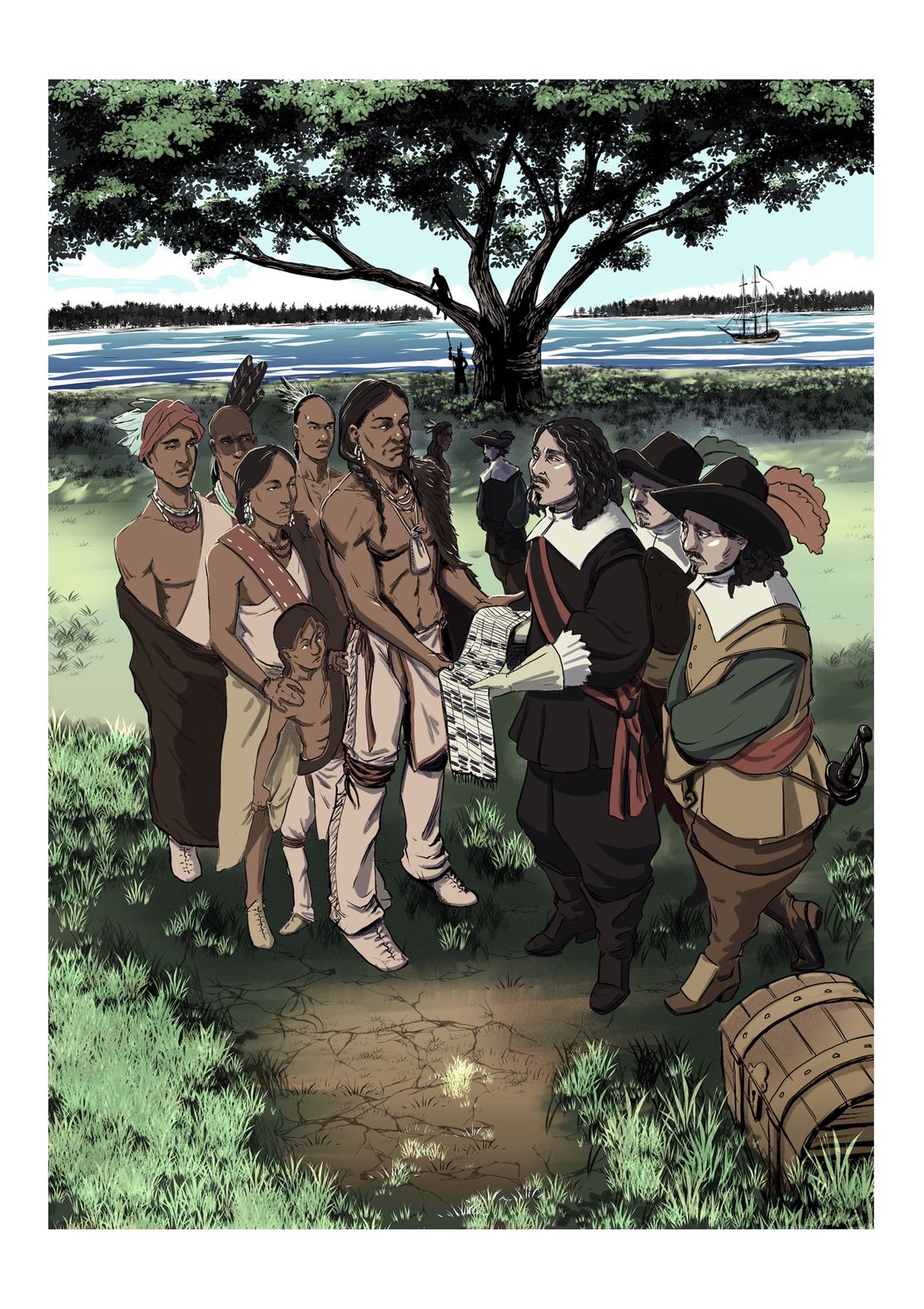
Reciprocal Liberty, Peacemaking, and Lenape Diplomacy

Reciprocal Liberty, Peacemaking, and Lenape Diplomacy

Narrative 1600 - 1860
MALLKUANKA – Vuelo Surnorte de Colores/The South-North Flight of Colors

MALLKUANKA – Vuelo Surnorte de Colores/The South-North Flight of Colors

Narrative 2023
Mapping Lenapehoking

Mapping Lenapehoking

Video 1682 - 2024
Mapping Lenapehoking: A mythology with Sharp Edges and a History with Blurred Lines

Mapping Lenapehoking: A mythology with Sharp Edges and a History with Blurred Lines

Graphic Novel 1600 - 1799
The Third Malón of Peace

The Third Malón of Peace

Video 2023
Nuestro Mundo

Nuestro Mundo

Video 2021 - 2023

Dispossessions in the Americas

A project by

University of Pennsylvania

Copyright 2024

With support from

Mellon Foundation

Site design & development

Element 84

Art Credits

Roberto Mamani Mamani in front of his mural MALLKUANKA – Vuelo Surnorte de Colores/The South-North Flight of Colors, located at 2100 Washington Avenue, Philadelphia, PA on the east side of the Philadelphia Animal Specialty and Emergency (PASE) building. Photo credit: Bryan Karl Lathrop.

Site Pages

  • Home
  • Explore
  • About
  • Authors
  • Art
  • Bodies
  • Curricula
  • Cultural Heritage
  • Maps
  • Territories