Dispossesions in the Americas

Dispossesions in the Americas

  • Home
  • Explore
  • About
  • Authors
  • Art
  • Bodies
  • Curricula
  • Cultural Heritage
  • Maps
  • Territories
Back to Explore
Map Commentary 1573

LIMIT DEMARCATION OF THE PUEBLO REAL DE INDIOS (REDUCTION) OF TALINA (1573)

  • Medeiros, Carmen

  • Grisi, Celina

  • Sánchez Patzy, Radek

Published: 2024

  • Download Image
Palomeque, Silvia. "Los chichas y las visitas toledanas. Las tierras de los chichas de Talina (1573-1595)". Surandino Monográfico, segunda sección del Prohal Monográfico 1 (2): pp, 1-76.

Palomeque, Silvia. “Los chichas y las visitas toledanas. Las tierras de los chichas de Talina (1573-1595)”. Surandino Monográfico, segunda sección del Prohal Monográfico 1 (2): pp, 1-76.

Abstract

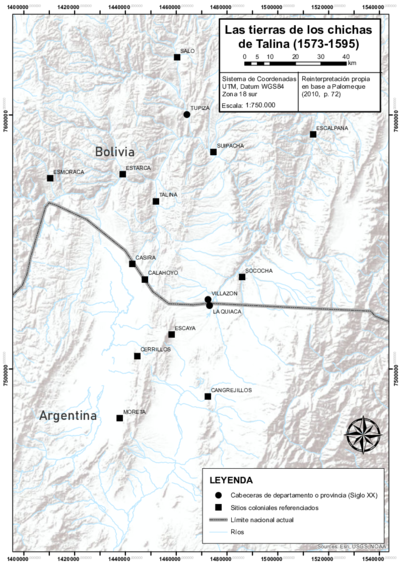
Set against the background of a satellite photograph, this map shows the boundary markers or permanent signs that defined the limits of the Pueblo Real de Indios or Reducción of Talina, with the concentration of a large segment of the Aymara political system of the Chichas starting in 1573.1 This action was part of the reforms implemented by the colonial state in the 1570s that imposed the relocation of dispersed or scattered settlements, in clustered towns. In the case of the Aymara lordship AYMARA POLITIES of THE QULLASUYU in the 16th CENTURY of the Chichas, the dispossession was manifested in the complete rearrangement and restructuring of its territorial organization, and a disarticulation of the original large political entity into a variety of fragmented communities in Reductions, as occurred with Talina THE LANDS OF THE AYMARA LORDSHIP OF THE CHICHAS DE TALINA UNDER COLONIAL RULE IN THE LATE 16TH CENTURY .

The finding of a colonial document has made it possible to identify the approximate location of the boundary markers of the Talina Reduction. The data derived from it was contrasted and cross-checked with the in situ validation of these markers, giving way to the creation of this map, a key piece in the knowledge-acquisition process of this Reduction.2

The document describes that the designated colonial authority (Visitor), starting his rounds from the Indian village of San Juan de la Frontera in the Talina valley, and after visiting the nine villages of the Hatun Chichas area —that is, those in the highland section of the territory—, resolved for those settlements to come together and be concentrated in the Talina valley. There, he distributed land for farming and animal husbandry. The Visitor then proceeded to demarcate the land for each set of family groupings called ayllus*—*which constituted the organizational cell of pre-Hispanic Andean societies—, through precise markings along the territory following the rivers watercourses.

The delimited territory stands along a kind of continuous valley, showing a small elevation forming a circle in its southwestern part, with markings displayed from left to right. Through consultation with different references, in addition to the core document, Palomeque was able to find in a quite truthful way the milestones that indicated the place where the jurisdiction of each of the nine ayllus that made up the Reduction ended.

The map documents some of the names of the ayllus that were concentrated in Talina, as well as the lands and farming plots destined for the elderly, widows, and the poor, as well as those that were common to all. Finally, it shows the importance of the rivers in the delimitation of each space, also referencing the republican towns of Villazón and La Quiaca, in the current demarcation between Argentina and Bolivia.

REFERENCES:

Palomeque, Silvia. “Los Chichas y las visitas Toledanas: las tierras de los Chichas de
Talina (1573-1595).” Surandino Monográfico 1, no. 2 (March 2010): 1-76.


  1. Silvia Palomeque, “Los Chichas y las Visitas Toledanas: las Tierras de los Chichas de Talina (1573-1595)”. Surandino Monográfico 1, no.2 (2010). ↩︎

  2. Palomeque, “Los Chichas y las Visitas Toledanas”. ↩︎

Citation

Medeiros, Carmen, Celina Grisi, and Radek Sánchez Patzy. 2024. 'LIMIT DEMARCATION OF THE PUEBLO REAL DE INDIOS (REDUCTION) OF TALINA (1573)'. Dispossessions in the Americas. https://dia.upenn.edu/en/content/BOL0019Y/
  • Download Image

Reading in Spanish

Map Commentary 1573

DEMARCACIÓN DE LÍMITES DEL PUEBLO REAL DE INDIOS (REDUCCIÓN) DE TALINA (1573)

  • Medeiros, Carmen

  • Grisi, Celina

  • Sánchez Patzy, Radek

Published: 2024

  • Download Image
Palomeque, Silvia. "Los chichas y las visitas toledanas. Las tierras de los chichas de Talina (1573-1595)". Surandino Monográfico, segunda sección del Prohal Monográfico 1 (2): pp, 1-76.

Palomeque, Silvia. “Los chichas y las visitas toledanas. Las tierras de los chichas de Talina (1573-1595)”. Surandino Monográfico, segunda sección del Prohal Monográfico 1 (2): pp, 1-76.

  • Download Image

Reading in Portuguese

Map Commentary 1573

DEMARCAÇÃO DE LIMITES DO “PUEBLO REAL DE ÍNDIOS” (REDUÇÃO) DE TALINA (1573)

  • Medeiros, Carmen

  • Grisi, Celina

  • Sánchez Patzy, Radek

Published: 2024

  • Download Image
Palomeque, Silvia. "Los chichas y las visitas toledanas. Las tierras de los chichas de Talina (1573-1595)". Surandino Monográfico, segunda sección del Prohal Monográfico 1 (2): pp, 1-76.

Palomeque, Silvia. “Los chichas y las visitas toledanas. Las tierras de los chichas de Talina (1573-1595)”. Surandino Monográfico, segunda sección del Prohal Monográfico 1 (2): pp, 1-76.

Resumo

Sobre o fundo de uma fotografia satelital, este mapa mostra os marcos ou sinais permanentes que definiram os limites do Pueblo Real de Índios ou Redução de Talina onde se concentrou grande parte do sistema político aimará dos Chichas a partir de 1573. 1 Esta ação fez parte das reformas implementadas pelo estado colonial na década de 1570 que impuseram a realocação de assentamentos dispersos em povoados concentrados.

A desapropriação, no caso do senhorio aimará AS POLÍTICAS AIMARÁS DO QULLASUYU NO SÉCULO XVI dos Chichas se expressou na reconfiguração completa de sua organização territorial e na desarticulação da grande entidade política original em uma variedade de comunidades fragmentadas em Reduções, como aconteceu com Talina AS TERRAS DO SENHORIO AIMARÁ DOS CHICHAS DE TALINA SOB DOMÍNIO COLONIAL NO FIM DO SÉCULO XVI .

O achado de um documento colonial permitiu identificar a localização aproximada dos marcos de delimitação da Redução de Talina que, ao ser contrastado com a verificação in situ desses marcos, permitiu a realização deste mapa; uma peça fundamental para a o conhecimento desta Redução.2

O documento encontrado descreve que, a partir do “povoado de índios” de San Juan de la Frontera, no Vale de Talina, a autoridade colonial responsável (Visitador), depois de visitar os nove povoados da “parcialidade” Hatun Chichas, que se localizavam no altiplano, concentrou-os no Vale de Talina. Nesse local, ele distribuiu terras para cultivo e criação de animais. O Visitador demarcou, então, as parcelas para cada conjunto de agrupações de famílias denominadas ayllus— que constituíam a célula organizacional das sociedades andinas pré-hispânicas, por meio de sinais precisos ao longo do território que seguia o curso dos rios.

O território delimitado está localizado em uma espécie de vale contínuo que na parte sudoeste apresenta uma pequena elevação circular, onde a sinalização vai da esquerda para a direita. Por meio de diferentes referências, além do documento central, Palomeque conseguiu encontrar de forma muito aproximada os marcos que indicam o local onde acabava a jurisdição de cada um dos nove ayllus ayllus* que faziam parte da Redução.

O mapa registra alguns dos nomes dos ayllus localizados em Talina, além das terras e parcelas de cultivo destinadas a anciãos, viúvas e pobres, bem como aquelas terras que eram comuns a todos. Por último, mostra a importância dos rios na delimitação de cada espaço, referenciando também as localidades republicanas de Villazón e La Quiaca, na demarcação atual entre Argentina e Bolívia.

REFERÊNCIAS:

Palomeque, Silvia. “Los Chichas y las visitas Toledanas: las tierras de los Chichas de
Talina (1573-1595).” Surandino Monográfico 1, no. 2 (março 2010): 1-76.


  1. Silvia Palomeque, “Los Chichas y las Visitas Toledanas: las Tierras de los Chichas de Talina (1573-1595)”. Surandino Monográfico 1, no.2 (2010). ↩︎

  2. Palomeque, “Los Chichas y las Visitas Toledanas”. ↩︎

Citation

Medeiros, Carmen, Celina Grisi, and Radek Sánchez Patzy. 2024. 'DEMARCAÇÃO DE LIMITES DO “PUEBLO REAL DE ÍNDIOS” (REDUÇÃO) DE TALINA (1573)'. Dispossessions in the Americas. https://dia.upenn.edu/pt/content/BOL0019Y/

  • Download Image

Related Content

THE LANDS OF THE AYMARA LORDSHIP OF THE CHICHAS DE TALINA UNDER COLONIAL RULE IN THE LATE 16TH CENTURY

THE LANDS OF THE AYMARA LORDSHIP OF THE CHICHAS DE TALINA UNDER COLONIAL RULE IN THE LATE 16TH CENTURY

Map Commentary 1573 - 1595
AYMARA POLITIES of THE QULLASUYU in the 16th CENTURY

AYMARA POLITIES of THE QULLASUYU in the 16th CENTURY

Map Commentary 1530 - 1539
QULLASUYU PROVINCES UNDER INCA RULE EARLY 16TH CENTURY

QULLASUYU PROVINCES UNDER INCA RULE EARLY 16TH CENTURY

Map Commentary 1500 - 1599
COLONIAL LEGISLATIONS AS FRAMEWORK FOR DISPOSSESSIONS IN THE CENTRAL ANDES: THE “REDUCCIONES” OR “PUEBLOS REALES DE INDIOS”

COLONIAL LEGISLATIONS AS FRAMEWORK FOR DISPOSSESSIONS IN THE CENTRAL ANDES: THE “REDUCCIONES” OR “PUEBLOS REALES DE INDIOS”

Timeline 1570 - 1749

Dispossessions in the Americas

A project by

University of Pennsylvania

Copyright 2024

With support from

Mellon Foundation

Site design & development

Element 84

Art Credits

Palomeque, Silvia. “Los chichas y las visitas toledanas. Las tierras de los chichas de Talina (1573-1595)”. Surandino Monográfico, segunda sección del Prohal Monográfico 1 (2): pp, 1-76.

Site Pages

  • Home
  • Explore
  • About
  • Authors
  • Art
  • Bodies
  • Curricula
  • Cultural Heritage
  • Maps
  • Territories