Abstract
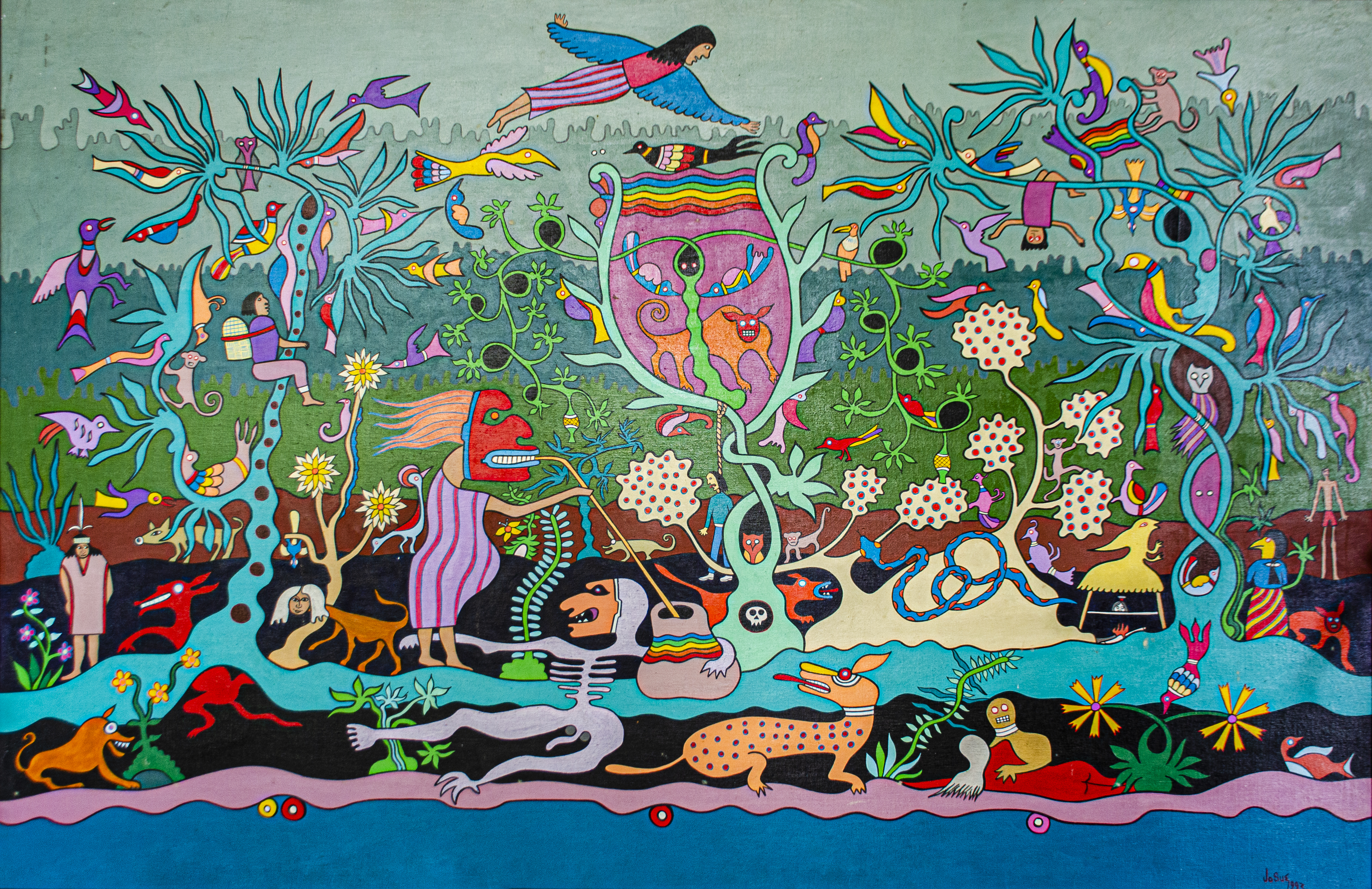
This work relates to the territory and cultural heritage because it visualizes the Amazon as a living, spiritual space rooted in Indigenous cosmology. Through vibrant colors and symbolic figures, the painting reflects ancestral knowledge, rituals, and the deep connection between humans, nature, and spirits. It reclaims the Amazon not as a resource, but as a sacred territory full of meaning, memory, and cultural identity. At the center, a shaman figure exhales visions into the landscape, suggesting a ritualistic or ayahuasca-induced trance that reveals the deeper, unseen layers of the forest. Plants appear animated, animals morph into spirits, and vibrant colors pulse through the scene, evoking the sensory intensity of the jungle. This visual language honors ancestral knowledge systems and reflects a worldview in which nature is not inert, but alive and communicative. The painting becomes an act of cultural preservation, reinforcing Indigenous perspectives on interconnectedness, healing, and respect for the land. By foregrounding these visions, the artist not only pays tribute to the Amazon as a sacred territory but also challenges extractivist views that reduce it to mere resources. This work invites viewers to reconsider their relationship with nature and to recognize the Amazon as a space of cultural richness, memory, and profound spiritual significance.
Various symbolic representations of nature and Andean spirituality can be observed in this painting. Bird-human emerges from the composition, merging the human form with the avian in unique symbolism. Flowers and tree branches transform into hummingbirds, creating a psychedelic nature that profoundly connects with the Andean worldview. The artwork invites the viewer to enter a world of symbolism, where the boundary between the human and the natural blurs and where spirituality and nature intertwine magically.
Citation
Sánchez, Josué. 1993. 'Chamán asháninka [Ashánika Shaman]'. Dispossessions in the Americas. https://dia.upenn.edu/en/art/APER051/